
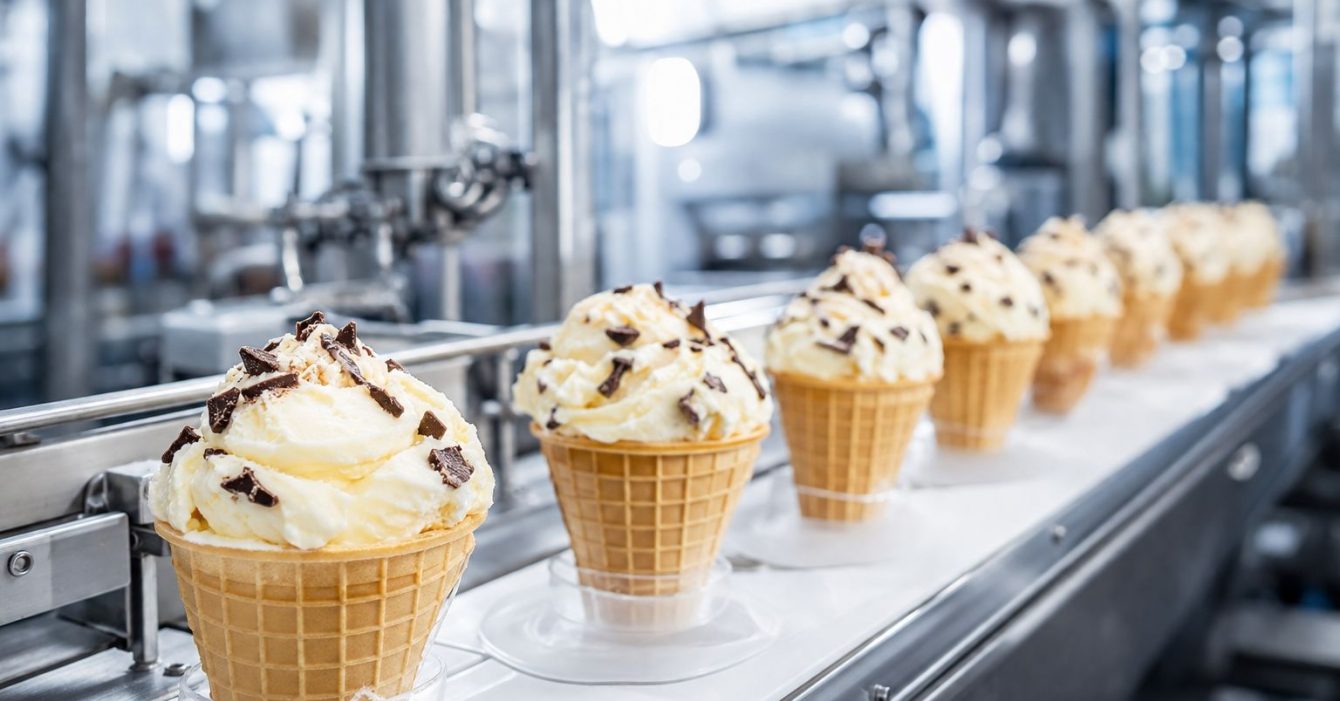
While the peak of the season is still under way, the most far-sighted producers are already designing the next one. In this overview Steiner has gathered the Ukrainian ice cream market of 2025–2026, examined the record export of Ukrainian ice cream, the key trends in flavours and textures on real producer cases — and shown which technologies stand behind each of them.
Ice cream has long ceased to be a simple seasonal dessert. It is a high-tech category at the intersection of dairy processing, confectionery and freezing, where competition is about texture, clean label and the ability to launch novelties quickly. In 2026 the global market is estimated at approximately 126 billion dollars, and it is growing steadily despite inflation, changing eating habits and pressure on production costs.
For the Ukrainian manufacturer this is a rare combination of tailwinds. Exports to the EU have grown almost 100-fold over nine years and in 2025 set a new all-time record. Domestic consumption per capita is still several times lower than the European level, which means the room for growth is objectively large. And the category is so attractive that in 2025 even Roshen entered it. The only question is who will be able to implement global trends in their own range quickly and to a high standard. Below is the information worth relying on when planning the next season.
The global ice cream market in 2026: how much it is worth and where it is growing
In 2026 the global ice cream market is estimated in the range of 126–127 billion dollars (Grand View Research — 125.8 billion, Fact.MR — 127.0 billion, Towards FNB — 126.9 billion). In physical terms this is approximately 24–25 million tonnes of product per year. Analysts agree on an average annual growth rate (CAGR) of about 4.3% — and forecast the market at the level of ~169 billion dollars by 2033.

Fig. 1. Dynamics and forecast of the global ice cream market in value terms
The largest market share in 2025 was formed by the Asia-Pacific region — which is also the fastest growing. The main drivers highlighted by analysts are: plant-based desserts, reduced-sugar recipes, online delivery of frozen products, sustainable packaging and premiumisation. The last factor is key: the value of the market is growing faster than volumes in tonnes, meaning the consumer is paying more for quality and an unusual experience, and not simply for something “cold and sweet”.
How much ice cream is eaten around the world
Consumption per capita is the best illustration of the potential of individual countries. The USA leads (more than 20 kg per year). In Europe the picture is mixed: from 16 kg in Ireland to less than 5 kg in a number of countries. Ukraine, with an indicator of 2–2.5 kg per person, is so far at the end of this list — and this is not a verdict, but unmet demand that someone will inevitably meet.

Fig. 2. Ice cream consumption per capita per year, kg (USA, EU countries, Ukraine)
Europe: a mature market that holds on quality
According to Eurostat data (the latest full annual data), the EU countries produced 3.3 billion litres of ice cream over the year — 2% more than a year earlier. This is a mature market: it grows slowly, so competition is not about volume, but about margin, brand and the technological level of the product. Germany remains the main producer in the EU, followed by France and Italy. Poland is a telling example: +29% over the year — an illustration of how investment in capacity quickly changes the balance of power.

Fig. 3. Top 5 ice cream producers in the EU, million litres (Eurostat)
The EU’s external contour is also important for us. The Union is a net exporter of ice cream, but at the same time imports from outside the EU are growing by 24% per year — and it is exactly this flow that Ukrainian products are entering ever more confidently. For Ukrainian companies Europe is at once both a quality benchmark and an open sales market.
The ice cream market in Ukraine: resilience plus an export breakthrough
The Ukrainian ice cream market is one of the most dynamic segments of the food industry. According to a study by the analytical system YouControl, the manufacturers that published their financial reporting received in the last full year a combined revenue of UAH 13.3 billion — 21% more year on year and 44% more than two years ago. In physical terms Ukraine produces more than 150 thousand tonnes of ice cream per year, while consumption remains at the level of 2–2.5 kg (about 2.4–2.8 l) per person.

Fig. 4. Revenue of Ukrainian ice cream producers, UAH billion (YouControl)
The market is highly concentrated in the upper segment. The leader is “Rud” (revenue of UAH 3.38 billion, about 26% of the combined revenue of the top producers and the widest range — 118 items). It is followed by “Lasunka”, “Khladoprom”, “Try Vedmedi” and “Laska”. The best indicator of the attractiveness of the category is new players: in 2025 Roshen entered ice cream production, launching two brands at once (Lacmi and Milky Splash), and completely new companies are also appearing among the producers.

Fig. 5. The largest ice cream producers of Ukraine by revenue (YouControl)
The geography of production is uneven: more than half of the volume is provided by the Zhytomyr region — the home region of the largest player, followed at a noticeable distance by the Kharkiv and Dnipropetrovsk regions.

Fig. 6. Structure of Ukrainian ice cream production by region, % (YouControl)
The export breakthrough: how Ukrainian ice cream is conquering the EU
The most important story of the industry in recent years is the export one, and it deserves separate consideration. The dynamics of Ukrainian ice cream deliveries to the EU is a classic “hockey stick”: a slow start, and then a sharp take-off.
In 2025 the EU countries purchased a record 9.9 thousand tonnes of Ukrainian ice cream worth 33.9 million euros — the highest figure for the entire period of the Free Trade Area. Compared with the previous year the volume grew by 32%, and the value — by 41.8%. Over nine years, since 2016, physical volumes have increased almost 100-fold: from a symbolic 0.1 thousand tonnes to almost 10 thousand.

Fig. 7. Export of ice cream from Ukraine to the EU, 2016–2025 (Eurostat, “Slovo i Dilo”)
One detail makes this story particularly convincing: the growth is measured in euros, and not in hryvnias. The value increase of 41.8% is real growth in demand and prices on the foreign market, and not the effect of devaluation. In other words, Ukrainian ice cream sells at a higher price precisely because its quality is recognised.
And this is the main signal for the industry. The EU is a market with the strictest requirements for safety, traceability and consistency of quality. If a product consistently makes it onto the European shelf, this is confirmation of the technological maturity of the manufacturer. But that same market punishes most severely for unstable texture, deviations in portion weight or a failure in the cold chain — there is no room here for “almost good enough”.
| Year | Volume, thousand t | Value, € million |
| 2016 | 0,1 | 0,1 |
| 2020 | 2,0 | 4,4 |
| 2022 | 3,0 | 8,5 |
| 2023 | 5,5 | 17,7 |
| 2024 | 7,5 | ≈24,0 |
| 2025 | 9,9 | 33,9 |
Table 1. Export of Ukrainian ice cream to the EU by year (selected years)
Opportunities for manufacturers: where the potential is hidden
If the data is brought together, at least four directions of growth open up for the Ukrainian manufacturer — and all of them come down to the readiness to meet demand technologically.
- Exports to the EU and beyond. The trend has been steady for nine years already and has survived even the start of the full-scale war. There is still plenty of room: the share of Ukrainian ice cream in the EU’s total imports is still small, while logistics via container shipping also opens up the markets of the Middle East and North Africa.
- Unmet domestic demand. Consumption of 2–2.5 kg per person against 5–16 kg in the EU is a structural reserve. Every half kilogram per person means tens of thousands of tonnes of additional market inside the country.
- Premiumisation and niche products. The global market is growing faster in value than in tonnes. Craft, signature and functional ice cream delivers a higher margin — but requires flexible equipment, rather than a mass line of “one format”.
- Private labels (private label). EU retail chains are actively looking for manufacturers for their own brands. These are stable volumes for those who can guarantee quality and documentary traceability of batches.
Top ice cream production trends of 2026 — based on real cases
Trends are not fashion for the sake of fashion, but what recipes and lines are already being reconfigured for. Below are the directions that will have the strongest influence on the product range, and living examples of how Ukrainian and global manufacturers are implementing them.
1. Texture as the main arena of competition
Flavour attracts, but it is texture that brings the buyer back. Demand for crunchy elements is growing on average by 13.5% per year. The trend is broader than “add a biscuit”: the consumer wants a multi-layered experience — cream, crunch and chewiness in a single bite. Technologically, behind this lies control of the size of the ice crystals and precise dosing of inclusions.
| Case • Ukraine “Try Vedmedi” Crunch A separate range with the emphasis precisely on crunchy texture — an example of how a Ukrainian manufacturer puts texture into the product name and builds its positioning around it, rather than hiding it in the ingredients description. |
2. Flavours: viral hits and controlled exotica
In desserts milk chocolate leads (about 38% of new products), followed by vanilla, caramel and white chocolate. But the real sales are made by seasonal hits born on social media and by bold gourmet profiles.
| Case • World “Dubai chocolate” as a viral format The pistachio flavour with crunchy kataifi that went viral in 2025 instantly moved into ice cream: from limited-edition Baskin Robbins bars to adaptations by chains of the Aldi level. The lesson for the manufacturer: the ability to quickly put a limited series onto the line to catch a seasonal hype is already a competitive advantage, and not a marketing whim. |
| Case • Ukraine “Try Vedmedi”: exotica in a mini format A series of 55 g ice creams with the flavours of watermelon, lemon, popcorn and pitaya. The pitaya version comes with a bright purple milk-chocolate-based coating, a fruit filling and chia seeds. Here there are three trends at once in a single SKU: an unusual flavour, a mini format and textural inclusions. |
| Case • World Salt & Straw: controlled boldness The American craft brand releases experimental flavours every month — from olive oil to bone marrow with cherry. This is not about mass appeal, but about a news hook and a premium margin. |
3. Healthier ice cream: protein, less sugar, clean label
The «better-for-you» category is one of the fastest-growing drivers. Consumers are looking for products without artificial colourings, with a clean label, higher protein and reduced sugar. Technologically this is more complex than ordinary ice cream: protein fortifiers and sugar substitutes change the freezing point and the behaviour of the mix, so they require precise control at pasteurisation, homogenisation and freezing.
| Case • World Protein ice cream is becoming a shelf of its own Brands such as Protein Pints are building a «protein first» product and in 2025 are expanding their ranges with new flavours; even mass-market classics are entering the category. Ice cream is turning into a snack for those who count macronutrients. |
4. Plant-based ice cream goes mainstream
The plant-based segment is growing faster than the market as a whole — according to forecasts, from approximately 2.9 billion dollars in 2026 to 7.3 billion by 2036. Bases made from oats, coconut, almonds and pea protein require separate work on creaminess — and often separate or thoroughly cleaned lines in order to avoid cross-contact traces of allergens.
5. Formats and shapes: from mochi to mini portions
The format market is fragmenting. Mochi ice cream, craft gelato, bars and mini portions are growing on the back of demand for calorie control and for «trying several flavours». The Tri Vedmedi 55 g series mentioned above is a local example of the same global movement towards small portions. The variety of formats is a direct challenge for filling equipment: a single line increasingly has to be able to produce several form factors.
6. Packaging: sustainability and «smart» contact
About two thirds of manufacturers already use, or plan to switch to, more environmentally friendly packaging. The second layer of the trend is digital: QR codes on the packaging and even on the sticks turn the wrapper into a channel for traceability, promotion and communication. For the manufacturer this means new requirements for packaging materials and for marking systems on the line.
| The 2026 trends in brief • Texture and multi-layering are the main differentiator on the shelf (Tri Vedmedi Crunch). • Viral flavours (Dubai chocolate) call for fast limited editions. • Health (protein, less sugar) and plant-based bases are growing fastest. • Formats are fragmenting — from mochi to 55 g mini portions. • Packaging is becoming sustainable and «smart» (QR codes, traceability). |
The technologies behind the trends
Every consumer trend rests on specific equipment and process parameters. This is where the marketing promise turns into an engineering task — and where Ukrainian producers either win on quality or lose margin.
Freezing: the heart of the process
It is freezing that determines whether the texture will be creamy or «sandy». The aim of modern continuous freezers is to form fine, uniform ice crystals: the smaller they are, the creamier the product. The leading global solutions (Tetra Pak, WCB/SPX FLOW, Gram Equipment) are built around hygienic design, stable overrun (whipping with air) and energy efficiency. For «healthy» and plant-based recipes with a non-standard freezing point, the precision of the freezer becomes even more critical.
Mix preparation: pasteurisation, homogenisation, ageing
Before the freezer the mix passes through pasteurisation, homogenisation and ageing. This is where the stability of the emulsion is decided, and therefore how even the texture will be from batch to batch — critical for export contracts. Heat exchangers, mixing systems and pumping equipment matched to the specific viscosity and fat content of the mix are the basis of predictable quality.
Liquid nitrogen: texture and new formats
Liquid nitrogen dosing works directly for the trend towards textures and fast formats: the ultra-low temperature produces extremely fine crystals and opens up new moulding possibilities. This is a technologically demanding area, where the precision and safety of dosing determine both quality and cost price.
Filling, forming and inspection
The fragmentation of formats shifts the complexity to the end of the line. Flexible filling and forming solutions make it possible to produce several form factors (from a bar to a mini portion), while inspection and control systems monitor portion weight, foreign inclusions and packaging integrity. It is at this stage that export contracts most often «fall apart» — and it is precisely here that automated control pays for itself fastest.
Below is how the trends map onto process areas and the corresponding equipment categories.
| Trend | Technological task | Equipment category |
| Texture, multi-layering | Fine ice crystals, precise dosing of inclusions | Continuous freezers, liquid nitrogen dosers |
| Viral flavours, limited editions | Fast recipe change and changeover | Flexible mixing and filling lines |
| Healthier ice cream | Freezing point control, stable emulsion | Pasteurisation, homogenisation, heat exchangers |
| Plant-based bases | Creaminess without milk fat, protection against allergens | Mixing systems, CIP cleaning, separate circuits |
| Quality and export | Control of weight, inclusions, integrity | Inspection and control systems |
| Stable cost price | Energy efficiency, uninterrupted refrigeration | Pumping equipment, refrigeration, automation |
Table 2. From the consumer trend to the specific process area
What this means for the Ukrainian producer
The ice cream season is short, while decisions about equipment and recipes take a long time. That is why the best time to prepare for next summer is the height of the current one, when real sales, line bottlenecks and retail chain requests are all visible. Companies that start planning modernisation in the autumn rather than in March enter the season with an advantage of several months — and it is they who manage to surprise customers with new products first.
The practical conclusion is simple. The market is growing both inside the country and for export; consumption per capita still has room to grow; competition is shifting towards texture, healthy recipes, plant-based bases and flexible formats. The winner will be the one who is able to implement these trends technologically — consistently, with a predictable cost price and quality at the level of export markets.
| Steiner — an engineering partner, not just a supplier Steiner has been working on the Ukrainian market since 2006, selecting, supplying and servicing equipment for the food and beverage industry. For ice cream this is the complete technological chain: mix preparation and blending, heat exchangers, pumping equipment, liquid nitrogen dosers, filling lines, inspection and control systems. We follow market trends and select solutions for a specific recipe, format and sales plan — so that the new line works for your product range and not the other way round. |
Planning to upgrade or expand your ice cream production in time for the next season? Tell us about your product and your objectives — and we will help you select an equipment configuration to match your trends, volumes and export plans.
Data current as of July 2026. Estimates of market value differ between research companies because of differences in methodology; the text gives ranges and indicates the source of each figure. Data on producers’ domestic revenue is given for the last full year confirmed by financial statements; export data is based on the results of 2025.


