
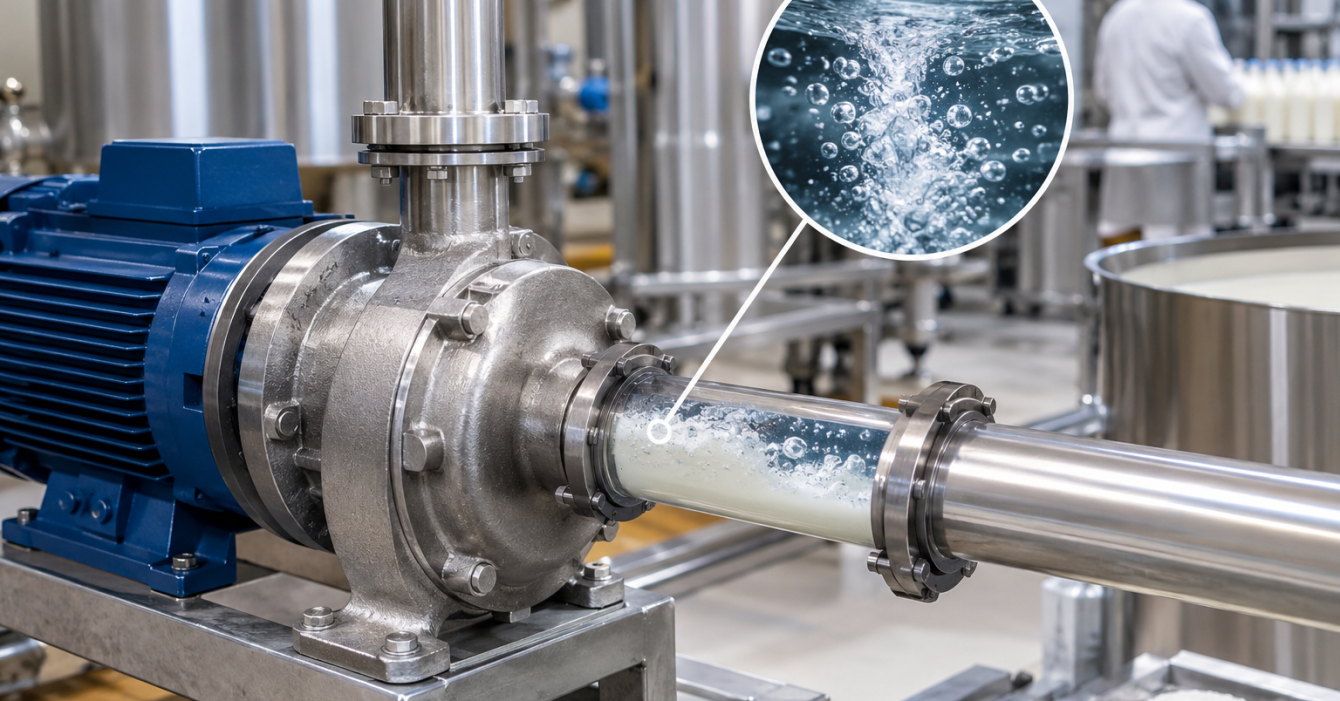
A pump that “sounds like it’s pumping gravel” is often dismissed by maintenance technicians as simply noisy. In reality, it is one of the most expensive sounds in a manufacturing facility. This is what cavitation sounds like: a process that can eat away at a stainless-steel impeller within a few months, damage a mechanical seal, and bring a production line to a halt at the worst possible moment.
In food, dairy, and pharmaceutical plants, cavitation occurs more frequently than one might think. Hot CIP cleaning solutions, viscous products, long suction pipelines, and clogged filters are all typical conditions that can trigger it. Below, we examine the problem from a service engineer’s perspective: from the symptoms to the underlying causes and, ultimately, the solutions.
What Is Cavitation in Simple Terms?
When liquid enters a pump, the pressure at the impeller inlet drops. If it falls below the liquid’s vapor pressure at the current temperature, the liquid begins to boil locally, even without additional heating. Vapor bubbles form.
The flow then carries these bubbles into a higher-pressure zone, where they collapse almost instantaneously. Each collapse produces a microscopic impact against the metal surface. Thousands of these impacts per second gradually dislodge metal particles from the impeller blades. This creates the characteristic “spongy” erosion pattern visible on a removed impeller.
The key concept here is NPSH (Net Positive Suction Head), or the available suction head above the liquid’s vapor pressure. The pump manufacturer specifies NPSHr: the minimum suction head required by the pump. The piping system provides NPSHa: the actual available suction head at the pump inlet. A pump operates without cavitation when NPSHa remains consistently higher than NPSHr. In practice, engineers allow an additional margin of at least 0.5–1 m or 10–30% above NPSHr, with a greater margin for hot and volatile liquids.
Symptoms: How to Tell If a Pump Is Cavitating
Cavitation is rarely visible immediately. However, it is easy to hear, and it leaves clear signs in operating parameters.
- Noise. A characteristic crackling or rumbling sound, as if sand or gravel were passing through the pump. It often becomes louder as the flow rate increases.
- Vibration. The pump and pipeline vibrate noticeably, mounting bolts may loosen, and bearing noise may develop.
- Reduced head and flow rate. The pump fails to deliver its rated performance even though the motor is running at its nominal speed.
- A fluctuating pressure gauge. The discharge pressure gauge needle moves erratically, even when the operating conditions of the production line remain unchanged.
- Mechanical seal leakage. Vibration and brief periods of dry friction cause the seal faces to deteriorate well before their expected service life ends.
- Изменения в продукте. Foaming, aeration, and unstable dosing in subsequent stages of the line.
- Erosion of components. During disassembly, pitting and a “spongy” surface can be seen on the impeller blade leading edges and on the casing near the inlet.
If two or three of these symptoms occur together, it is time to investigate the cause rather than wait for an emergency shutdown.
Causes: What Triggers Cavitation in Industrial Facilities?
All causes come down to one fundamental issue: the pressure at the pump inlet is lower than required. However, there are several ways this can happen.
- High liquid temperature. The hotter the liquid, the higher its vapor pressure and the more readily it “boils” at the pump inlet. For water at 20°C, the vapor pressure is approximately 2.3 kPa. At 80°C, it rises to around 47 kPa, and at 95°C, it approaches atmospheric pressure. As a result, a pump that has handled cold water reliably for years may begin to cavitate when pumping hot alkaline solution during a CIP cycle.
- Excessive suction-side losses. A long suction line, undersized pipe diameter, and numerous bends, tees, and fittings all contribute to pressure losses. Every component reduces the pressure available before the liquid reaches the pump. The recommended flow velocity in a suction pipeline generally does not exceed 1–1.5 m/s, whereas higher velocities may be acceptable on the discharge side.
- Partially closed valves or a clogged inlet filter. This is one of the most common causes encountered during service work. A mesh filter becomes clogged with product residue, a valve fails to open fully after maintenance, or a gate valve is partially closed to “reduce the flow.” Flow must never be regulated using a valve on the suction side.
- Low tank level or excessive suction lift. The pump is installed above the liquid level, or the liquid level in the tank drops toward the end of emptying. The lower the liquid level, the lower the available NPSHa.
- Viscous products. Syrups, condensed milk, sauces, and creams create significantly greater hydraulic losses at the pump inlet. A centrifugal pump selected based on water-handling performance is highly likely to cavitate when handling such products.
- Operation outside the pump’s intended operating range. An excessively high flow rate means the pump is demanding more liquid than the suction system can supply. Conversely, prolonged operation at a very low flow rate can cause recirculation cavitation in the impeller inlet region.
- Air ingress. Leaking suction-side connections or a vortex forming in the tank above the inlet nozzle can allow air to enter the system. Technically, this is not cavitation but aeration. However, the symptoms are similar, and the two problems are often confused.
Diagnostics: How to Confirm Cavitation and Identify the Cause
Diagnostics should be performed systematically, progressing from simple checks to more advanced investigations.
- Measure the inlet pressure. Install a compound pressure-vacuum gauge at the suction nozzle. A reading below the calculated value or fluctuations in inlet pressure are direct indications of a problem.
- Compare the operating temperature with the design specifications. Check the temperature for which the pump was originally selected and compare it with the current operating temperature, particularly during cleaning cycles.
- Inspect the suction line. Check the condition of filters, the position of valves and gate valves, the presence of air pockets in horizontal sections, and the correct installation and orientation of pipe reducers.
- Perform a discharge-side throttling test. Carefully reduce the flow rate using a valve on the discharge side. If the noise and vibration decrease noticeably, the most likely cause is insufficient NPSHa at the higher flow rate.
- Calculate NPSHa. The calculation accounts for the pressure in the tank, elevation difference, suction-line losses, and the liquid’s vapor pressure at the operating temperature. Compare the result with the pump’s specified NPSHr at the actual flow rate.
- Inspect the components. During scheduled maintenance, assess the condition of the impeller, casing, and mechanical seal. Characteristic erosion along the impeller blade leading edges supports the diagnosis.
- Perform vibration diagnostics. On critical production lines, vibration monitoring can help detect cavitation at an early stage, before noticeable noise develops.
How Cavitation Damages Equipment
The consequences accumulate gradually, which is why they are often underestimated.
- Impeller. Erosion of the blade leading edges reduces efficiency and pump head and can disrupt impeller balance. A severely damaged impeller must be replaced.
- Mechanical seal. Vibration and vapor formation in the sealing interface can cause overheating, chipping, and leakage. In food-processing applications, this also creates a risk of product contamination.
- Bearings and shaft. Dynamic loads shorten bearing service life and can cause fatigue cracks.
- Pipelines and valves. Vibration is transmitted through the system, loosening supports and potentially damaging sensors.
- Product and process. Unstable flow, foaming, and dosing inconsistencies result in product defects and production downtime.
Ultimately, the manufacturer pays for spare parts, unplanned repairs, production-line downtime, and increased energy consumption as the pump operates at reduced efficiency.
Solutions: How to Eliminate Cavitation
The appropriate solution depends on the identified cause. In most cases, a combination of measures is required.
Increase the available suction head (NPSHa):
- Raise the liquid level in the tank or lower the pump installation.
- Shorten the suction line and increase its diameter.
- Remove unnecessary bends and fittings from the suction line and use long-radius bends.
- Install an eccentric reducer at the inlet with its flat side facing upward to prevent air pockets from forming.
- Clean suction filters regularly and monitor the pressure drop across them.
- If necessary, pressurize the tank or install a booster pump.
Reduce the pump’s NPSH requirement (NPSHr):
- Reduce the pump speed using a variable frequency drive (VFD), provided the process allows it.
- Bring the pump back to an operating point closer to its best efficiency point (BEP).
- Select a pump with a lower NPSHr, such as a model with a larger suction nozzle, a low rotational speed, or an inducer.
Account for the liquid’s properties:
- For hot CIP cleaning solutions, perform a separate NPSH calculation at the actual cleaning temperature.
- For viscous products, consider low-speed positive displacement pumps, such as rotary lobe or twin-screw pumps, instead of centrifugal pumps.
Eliminate air ingress:
- Check the tightness of all suction-side connections and seals.
- Ensure that the inlet nozzle is sufficiently submerged and install anti-vortex devices in the tank.
Prevention: How to Avoid Cavitation
The most cost-effective solution starts at the production-line design stage. A pump must be selected for the actual operating conditions, including temperature, viscosity, flow-rate range, and the specific suction piping arrangement—not simply on the basis of water-handling performance and nominal capacity.
During operation, a straightforward maintenance routine can help prevent cavitation:
- Monitor inlet pressure and product temperature.
- Establish a schedule for cleaning suction filters.
- Inspect the impeller and mechanical seal during planned maintenance.
- Keep original spare parts in stock for critical pumps to prevent component replacement from turning into a week-long production shutdown.
Frequently Asked Questions
For a short period, yes. However, erosion and seal wear accumulate with every hour of operation. Delaying repairs almost always increases the final cost.
Yes. For rotary lobe, screw, and gear pumps, NPIPR is a corresponding parameter used to assess inlet pressure requirements. If the inlet pressure is insufficient, these pumps can also lose flow capacity and suffer accelerated wear.
Only temporarily. If the underlying cause is not eliminated, the replacement impeller will suffer the same type of erosion.
Cavitation is not a pump defect in itself; it is a mismatch between the pump and the system in which it operates. Noise, vibration, reduced head, and seal leakage are warning signs that the available suction pressure margin has been exhausted. Measuring suction pressure early, checking the operating temperature, and inspecting the suction line can help identify the cause before it develops into an expensive repair.
Steiner specialists help select pumps for actual product and process conditions, evaluate suction piping arrangements, and provide original spare parts and servicing for pumping equipment. If your pump “sounds like it’s pumping gravel,” contact us while your production line is still running.


