
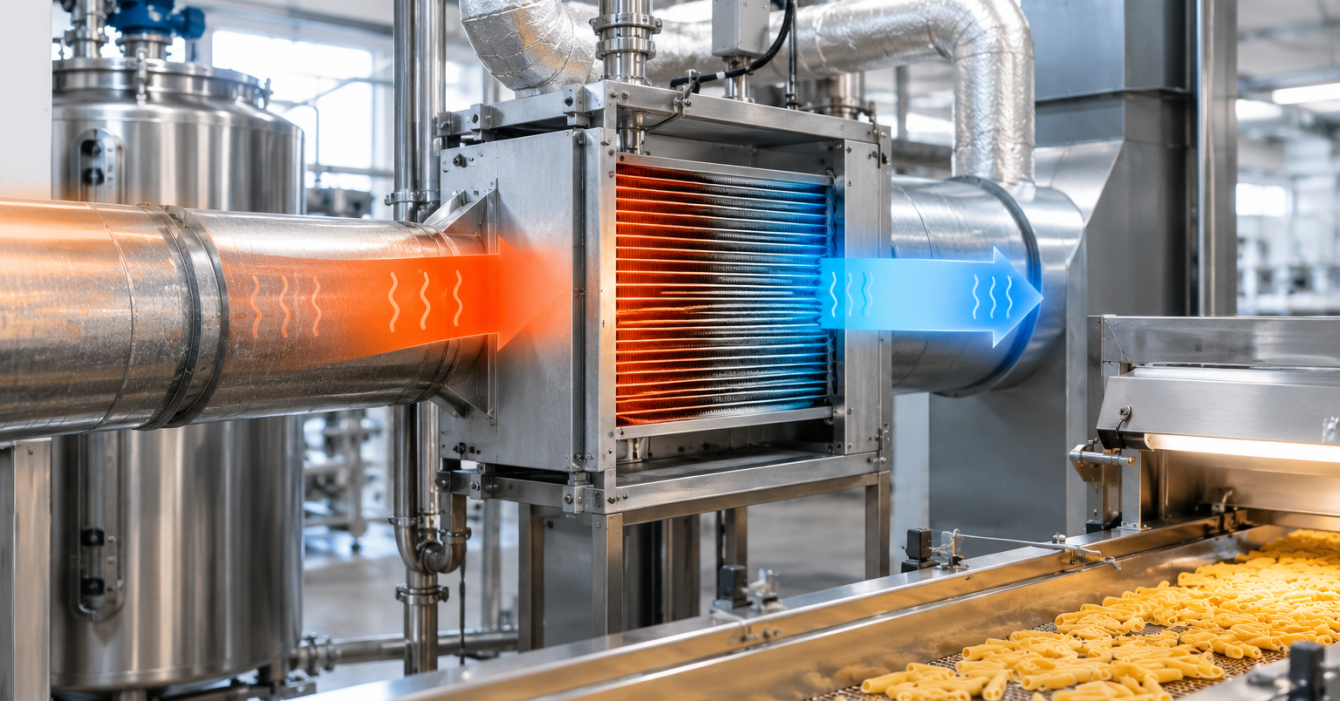
At most food processing plants, a significant share of the energy purchased in the form of gas and electricity escapes as waste heat: into the wastewater system with hot water, into the air through the condensers of refrigeration units and compressors, and up the boiler stack with flue gases. Heat recovery captures part of this energy and returns it to the process.
The exact savings depend on the facility, but the principle is straightforward: the more hours per year the equipment operates and the greater the temperature difference, the faster the heat recovery system pays for itself. The shortest payback periods are usually found where a heat source already exists and a heat consumer is nearby: regeneration in a pasteurizer, recovery of heat from air compressors, or preheating water for cleaning.
Where Does the Heat Actually Go? Mapping Energy Losses
Before purchasing equipment, it is worth identifying exactly where the facility is losing energy. A typical food processing plant’s “energy loss map” looks like this:
- Process lines: The product is first heated for pasteurization or sterilization and then cooled. If no heat exchange takes place between these stages, the facility pays twice: once for heating and again for cooling.
- CIP cleaning: Hot cleaning solutions and rinse water at 60–85°C are discharged into the drain after use.
- Refrigeration units: All the heat removed from the product and storage rooms, together with the heat generated by the compressors, is rejected into the atmosphere through the condensers.
- Air compressors: Almost all the electricity they consume is converted into heat, which is usually simply blown out of the compressor room.
- Boiler house: Flue gases at 150–250°C carry away part of the fuel’s energy.
- Autoclaves and sterilizers: Hot water and condensate remain after the cooling stage of the cycle.
Once this map is available, the key opportunity becomes clear: a plant has both sources of excess heat and consumers that purchase heat from the boiler house. Heat recovery simply connects the two.
5 Heat Sources Worth Checking First
- Heat regeneration in pasteurizers and sterilizers. After the holding stage, the hot product transfers its heat to the incoming cold product. Modern plate pasteurization systems have a regeneration section that can recover up to 90–95% of the heat. In practice, however, efficiency is often lower because of fouled plates, hardened or compressed gaskets, or outdated equipment design. Upgrading the regeneration section is one of the projects with the shortest payback periods.
- Heat from air compressors. Most of the electricity consumed by a screw compressor is converted into heat in the oil and compressed air. Using an integrated or external heat exchanger, this energy can be recovered to heat water to 60–70°C for cleaning, domestic hot water, or boiler feedwater preheating.
- Heat from refrigeration units. A desuperheater installed downstream of the compressor can produce water at 50–60°C by recovering part of the heat released during refrigerant condensation. For larger quantities of low-temperature heat, heat pumps can raise the temperature to the required level.
- Wastewater and CIP solutions. Heat Exchanger A wastewater-to-fresh-water heat exchanger uses heat from discharged water to preheat incoming cold water. An important consideration: wastewater containing product particles requires tubular or wide-channel heat exchangers rather than standard plate heat exchangers.
- Boiler houses and cogeneration. An economizer installed in the boiler flue-gas line preheats feedwater and can increase boiler efficiency by several percentage points. Facilities that have installed their own gas engine generators for backup power have another significant heat recovery opportunity: recovering heat from the engine coolant and exhaust gases. The available thermal energy can be approximately equal to the electrical output.
A Calculation Example: What Do the Numbers Look Like?
The thermal power that can be recovered is calculated using the basic formula:
Where: Q is the thermal power, kW; ṁ is the mass flow rate of the liquid, kg/s; cp is the specific heat capacity, kJ/(kg·K); ΔT is the temperature difference, K. Annual energy savings are calculated by multiplying the recovered thermal power by the number of operating hours per year.
Example 1. Milk pasteurizer. The processing capacity is 10,000 L/h (approximately 10,300 kg/h, or 2.86 kg/s). The milk is heated from 4°C to 74°C, with a specific heat capacity of approximately 3.9 kJ/(kg·K).
The total heating requirement without regeneration is: 2.86 × 3.9 × 70 ≈ 780 kW. The same amount of heat must be removed when the milk is cooled back to 4°C.
- With 80% heat regeneration, approximately 156 kW of additional heating capacity is required.
- With 90% heat regeneration, approximately 78 kW is required.
The difference between the old and upgraded regeneration sections is 78 kW of thermal power. At 4,800 operating hours per year (16 hours × 300 days), this represents approximately 375,000 kWh of heat annually. Converted into natural gas consumption, assuming approximately 9.3 kWh per cubic meter of gas and a boiler efficiency of 90%, this is equivalent to roughly 45,000 m³ of natural gas per year. In addition, the refrigeration unit’s cooling load is reduced by the same 78 kW, which also lowers electricity consumption.
Example 2. Screw compressor. A 75 kW compressor operates for 6,000 hours per year. If 70% of its power is recovered as hot water, the result is approximately 52 kW of thermal power, or 315,000 kWh of heat annually. This is equivalent to roughly 37,000 m³ of natural gas.
To convert these figures into monetary savings, multiply the energy saved in kWh or cubic meters by your facility’s current energy tariff.
Payback Period: How to Calculate It for Your Plant
The simple payback period can be calculated as follows:
Where: CAPEX is the cost of equipment and installation; E(year) is the amount of energy saved annually; P is the price per unit of energy; OPEX is the additional operating and maintenance cost of the heat recovery system.
Three factors have the greatest impact on the payback period:
- Operating hours. A production line running two or three shifts will typically pay back its heat recovery system much faster than a seasonal line.
- Synchronization between the heat source and consumer. If compressor heat is available during the day but hot water is needed at night, a buffer tank may be required, increasing project costs.
- Distance. The closer the heat source is to the consumer, the less piping, insulation, and heat loss are involved.
What Can Go Wrong? Limitations of Heat Recovery
Heat recovery in food processing has specific technological and sanitary limitations that must be considered at the project design stage.
- Hygiene and product safety. If the product flows on one side of a heat exchanger and utility water or wastewater flows on the other, the pressure on the product side should be higher. This helps prevent contamination if a small leak develops. Double-wall heat exchangers are used in critical applications.
- Surface fouling. Protein, fat, and scale deposits reduce heat transfer efficiency. The heat exchanger must be accessible for CIP cleaning and inspection.
- Temperature level. Heat available at 30–40°C is difficult to use directly for higher-temperature processes. It can be used for preheating or upgraded with a heat pump.
- Impact on the process. Changes to the temperature profile must not compromise pasteurization conditions, holding time, or HACCP requirements.
Checklist: Where to Start
- Collect data on gas, electricity, and hot water consumption for the past 12 months, broken down by production area wherever possible.
- List all heat sources: pasteurizers, sterilizers, CIP systems, compressors, refrigeration units, boiler houses, and generators. Record the temperature, flow rate, and operating hours for each.
- List all heat consumers: water preparation for cleaning, product heating, space heating, and domestic hot water.
- Match heat sources with consumers that have compatible temperature requirements and operating schedules.
- Estimate the heat recovery potential for each pairing using the formula Q = ṁ × cp × ΔT, then calculate the annual savings.
- Inspect existing regeneration sections by checking temperature and pressure differentials, plate condition, and gasket condition.
- Rank projects by payback period and start with those offering the fastest return.
Heat recovery does not require a complete transformation of the plant. In most cases, it starts with upgrading an existing pasteurizer, installing a heat exchanger for cleaning wastewater, or recovering heat from compressors. Each of these projects can be evaluated in advance using actual facility data: temperatures, flow rates, and operating hours.
Steiner engineers help select plate, tubular, and scraped-surface heat exchangers for specific products, assess the condition of regeneration sections, and upgrade process lines while taking sanitary requirements into account.


