
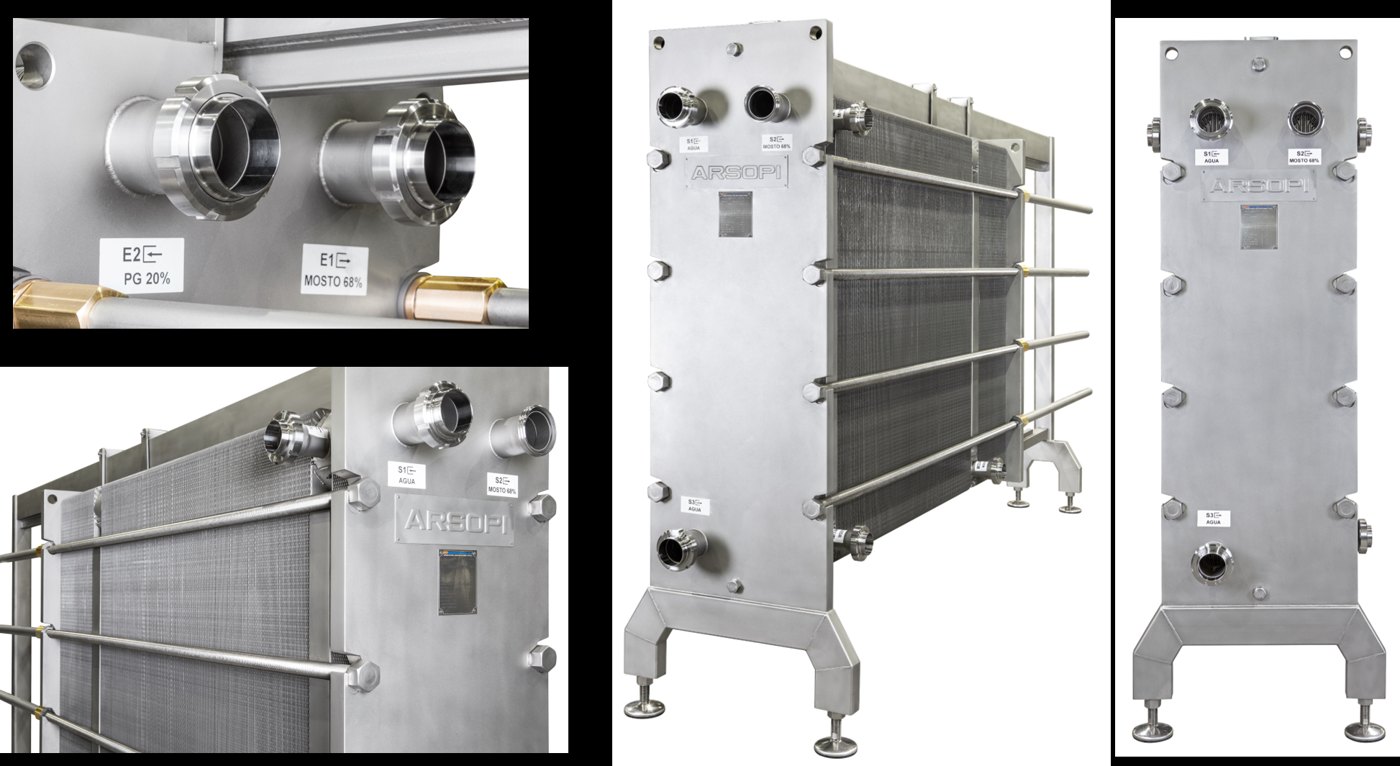
Arsopi Thermal – Gasketed Plate Heat Exchanger
The Arsopi Thermal gasketed heat exchanger is a plate unit with gaskets that can be opened for inspection, cleaning and changing the number of plates. It transfers heat between two media that flow in separate channels and do not mix.
Steiner Ukraine is the official representative of Arsopi Thermal in Ukraine. The general working principle, corrugation types and the full gasket table are on the page Arsopi Thermal.
How is the Arsopi Thermal gasketed heat exchanger designed?
The plate pack hangs on a guide bar and is clamped with bolts between the fixed and movable frame plates. Plates are made of stainless steel or titanium.
Each plate has a gasket in a groove around its perimeter. Alternating A and B plates sets the flow pattern: the hot and cold media pass through alternate channels in counterflow.
The double-barrier gasket with a drain prevents the media from mixing. If one gasket is damaged, the liquid escapes outside through the drain rather than into the adjacent channel.
Arsopi Thermal gasketed heat exchanger: technical specifications
| Parameter | Value |
|---|---|
| Plate material | stainless steel, titanium |
| Corrugation | wave (washboard), herringbone |
| Special plates | CH-FX / CH-FA, FH-GX, FH-CW, FH-YX, HESTIA NX-50 |
| Gaskets | NBR, EPDM, EPDM-HT, N-EPDM, FKM, PTFE-encapsulated NBR/EPDM |
| Max. temperature | up to 180 °C, depending on the gasket |
| Gasket fixing | glued or glue-free Slit-In |
| Connections | threaded, studded, flanged; special connections on request |
| Options | condensate tray, protective cover, insulation, inlet filters, thermometers and pressure gauges, RAL painting |
Which plates suit dairy products and beverages?
CH-FX and CH-FA plates are designed for food products and beverages. The pattern and pressing depth provide gentle, uniform heating of sensitive products.
- no flow stagnation zones;
- channels drain and vent completely;
- effective CIP cleaning with lower detergent consumption;
- compatible with PTFE (TCG) gaskets;
- two patterns: wave (washboard) and herringbone.
For products with fibres and sediment there are FH-GX plates with a channel up to 20 mm. Where mixing of media is not permitted, FH-CW double-wall plates are used. How to organise cleaning without stopping the line is described in the article on CIP cleaning of equipment.
What makes it convenient to operate?
- Small internal volume — the unit reaches operating mode quickly and responds precisely to changing conditions.
- For inspection and cleaning it is enough to loosen the tie bolts.
- Capacity is changed by adding or removing plates.
- Glue-free Slit-In gaskets shorten replacement time.
How to choose gaskets?
The gasket material determines the permissible temperature and resistance to the product and cleaning solutions. For food products NBR, EPDM or FKM are usually used; for chemically aggressive media — PTFE-encapsulated gaskets.
How gaskets and parts affect the unit’s energy consumption is described in the article on heat exchanger energy efficiency. On gaskets for heat exchangers — see the article on the Steiner and Orobica partnership.
How to select an Arsopi Thermal gasketed heat exchanger?
Selection requires:
- product and heating/cooling medium;
- flow rates on both sides;
- inlet and outlet temperatures;
- allowable pressure drop and operating pressure;
- CIP cleaning regime and chemistry.
Steiner Ukraine supplies plates and gaskets and performs regeneration on site and at the service centre. Prices are quoted on request.
FAQ
Is the Arsopi Thermal gasketed heat exchanger suitable for milk pasteurisation?
Yes. For dairy products and beverages there are CH-FX and CH-FA plates, which provide gentle, uniform heating and complete channel drainage.
What happens if a gasket is damaged?
The double-barrier gasket has a drain: the liquid escapes outside, not into the channel of the other medium.
Can the capacity be increased?
Yes, by adding plates to the pack within the frame length.
What is the maximum temperature?
Up to 180 °C with EPDM-HT or N-EPDM gaskets. NBR — up to 130 °C, EPDM — up to 150 °C, FKM — up to 175 °C.
Who provides service in Ukraine?
Steiner Ukraine: diagnostics, regeneration, replacement of plates and gaskets, on site and at the service centre.
Manufacturer: Arsopi Thermal, Portugal
Category: Heat exchangers
Industries: Dairy and food industry, Beverages, Chemicals, Pharmaceuticals, HVAC
Type: gasketed plate

