
Arsopi Thermal – Plate Heat Exchangers
Country: Portugal
Year of foundation: 1989
Type of equipment: Heat exchangers
Industries: Food industry, Beverages, Chemicals, Pharmaceuticals, HVAC
Arsopi Thermal heat exchangers are plate units from a Portuguese manufacturer in three types: gasketed, semi-welded and brazed. Steiner Ukraine is the official representative of Arsopi Thermal in Ukraine.
We select heat exchangers for the thermal load and product, supply equipment and spare parts, and provide service. On the start of the partnership — see the Steiner Ukraine news.
What does Arsopi Thermal manufacture?
Arsopi Thermal was founded in 1989 within Arsopi Group, a Portuguese group from Vale de Cambra that has been building equipment for the dairy, chemical and petrochemical industries since 1942.
The company obtained plate heat exchanger technology under licence from the Japanese company Hisaka Works. Hisaka Works later became a co-owner of Arsopi Thermal.
Plate design and testing, production and quality control are carried out at the company’s own plant in Portugal.
Which Arsopi Thermal heat exchangers does Steiner Ukraine supply?
| Type | Design | Operating limits | Typical tasks |
|---|---|---|---|
| Gasketed | gasketed plate pack clamped with bolts between two frame plates | up to 180 °C, depending on the gaskets | heating, cooling and pasteurisation of products, heat recovery |
| Semi-welded | cassettes of two laser-welded plates, gaskets on the side of the second medium | up to 4.0 MPa and 180 °C | aggressive and hazardous media, refrigerants |
| Brazed | non-dismountable plate pack joined by brazing | from vacuum to 4.5 MPa, from −100 to +200 °C | refrigeration cycles, heat pumps, oil cooling |
How does a plate heat exchanger work?
The core of the unit is a pack of thin corrugated plates made of stainless steel or titanium. Channels form between the plates. The hot and cold media pass through them alternately, in counterflow, and do not mix.
Corrugation increases the heat transfer area and creates turbulent flow. This gives a high heat transfer coefficient.
As a result, a plate heat exchanger is more compact and lighter than a shell-and-tube unit of the same duty. It has a small internal volume and reaches operating mode faster.
Which plates does Arsopi Thermal offer?
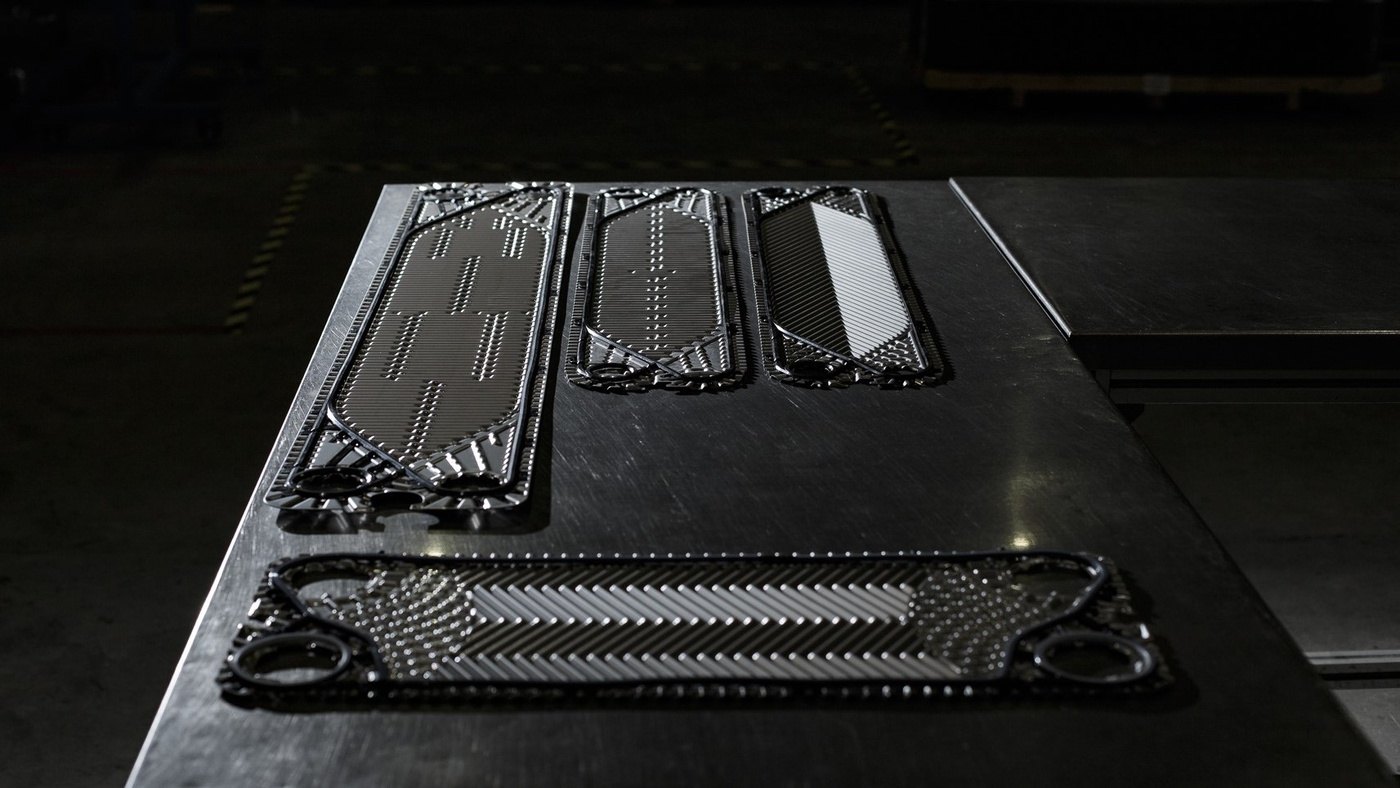
There are two basic corrugation patterns:
- Wave (washboard). There are few contact points between plates, so liquids with fibres and sediment pass through the channels without clogging.
- Herringbone. V-shaped grooves give many contact points. The pack withstands higher pressure, and the complex channel increases heat transfer. The manufacturer rates it 3–5 times higher than in a shell-and-tube unit.
Special plates are available for specific tasks:
- CH-FX / CH-FA — for dairy products, food products and beverages;
- FH-GX Multi Gap — channel up to 20 mm wide for viscous liquids with fibres and solids;
- FH-CW Dual Wall — double wall: if a plate is damaged, the leak is visible from outside and the media do not mix;
- FH-YX — for condensers and gas coolers handling large gas volumes under vacuum or low pressure;
- HESTIA NX-50 — plate with a double gasket line for high pressure and temperature, sizes DN 150 and DN 200.
Which gaskets are used?
| Material | Media | Max. temperature |
|---|---|---|
| NBR | water, brines, oils, food products and beverages | 130 °C |
| EPDM | steam, hot water, caustic, alcohol, ammonia, weak acids and alkalis, food products | 150 °C |
| EPDM-HT | steam, hot water, caustic, alcohol, ammonia | 180 °C |
| N-EPDM | high temperature, aggressive media | 180 °C |
| FKM (Viton) | concentrated acids, oils, lubricants, fuels, food products | 175 °C |
| PTFE-encapsulated NBR/EPDM (TCG) | organic chemicals, solvents, ultra-pure water | 150 °C |
Slit-In gaskets snap into the groove without glue. They are convenient where gaskets are replaced often, and in the food industry where glue odour is undesirable.
Where are Arsopi Thermal heat exchangers used?
- food and beverage industry — pasteurisation, heating and cooling of product;
- chemical and pharmaceutical industries;
- heating, ventilation and air conditioning (HVAC);
- marine systems;
- heat recovery — for details see the article on heat recovery in food production.
What are the benefits of working with the official representative?
- Heat exchanger selection by thermal calculation for the product and operating mode. The approach to selection is described in the article «How to choose the optimal heat exchanger».
- Supply of heat exchangers, plates and gaskets — see heat exchanger parts.
- Service on site and at the service centre: diagnostics, regeneration with plate inspection for capillary cracks and gasket replacement, reassembly with pack clamping control. The list of services is in the section «Services».
- When plates and gaskets need replacing is explained in the article on signs of heat exchanger wear. Why original parts matter for them — see the article on original heat exchanger spare parts.
FAQ about Arsopi Thermal heat exchangers
Who is the official representative of Arsopi Thermal in Ukraine?
Steiner Ukraine. The company selects and supplies Arsopi Thermal heat exchangers, their plates and gaskets, and provides service.
Where are Arsopi Thermal heat exchangers made?
In Portugal, at the company’s own plant in Vale de Cambra. The co-owners are Arsopi Group and the Japanese company Hisaka Works.
How does a gasketed heat exchanger differ from a brazed one?
A gasketed unit can be opened, cleaned mechanically and its number of plates changed. A brazed unit cannot be opened, but it is more compact and withstands pressure up to 4.5 MPa.
What seals are available?
NBR, EPDM, EPDM-HT, N-EPDM, FKM (Viton) and PTFE-encapsulated NBR/EPDM. Maximum temperature is 130 to 180 °C depending on the material.
Do you supply spare parts for Arsopi Thermal heat exchangers?
Yes. We supply plates and gaskets and regenerate heat exchangers.
How to get a price?
The price depends on the thermal calculation, materials and scope of supply. Send a request with the process parameters, and we will prepare a quotation.


