Masdaf - Circulation pumps (ModulA Red)
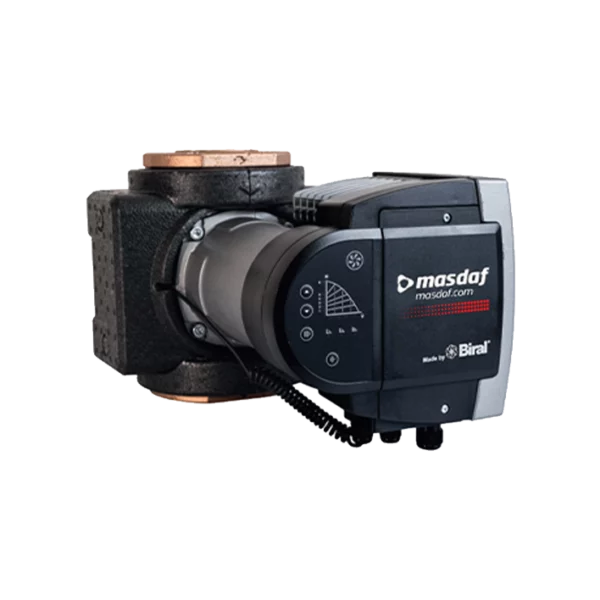
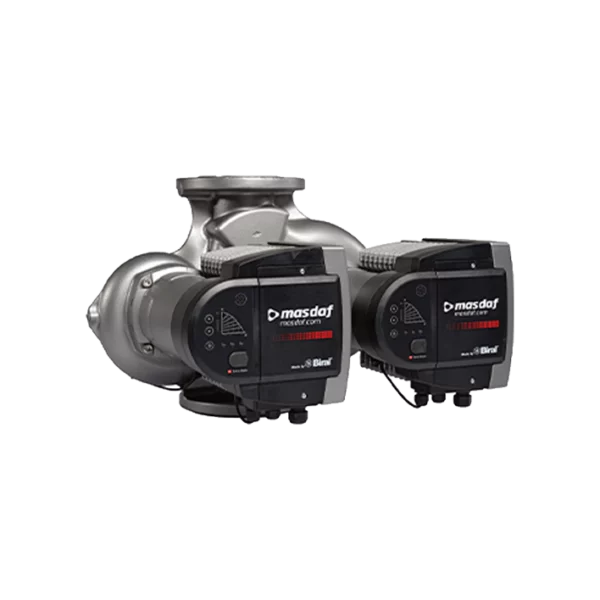
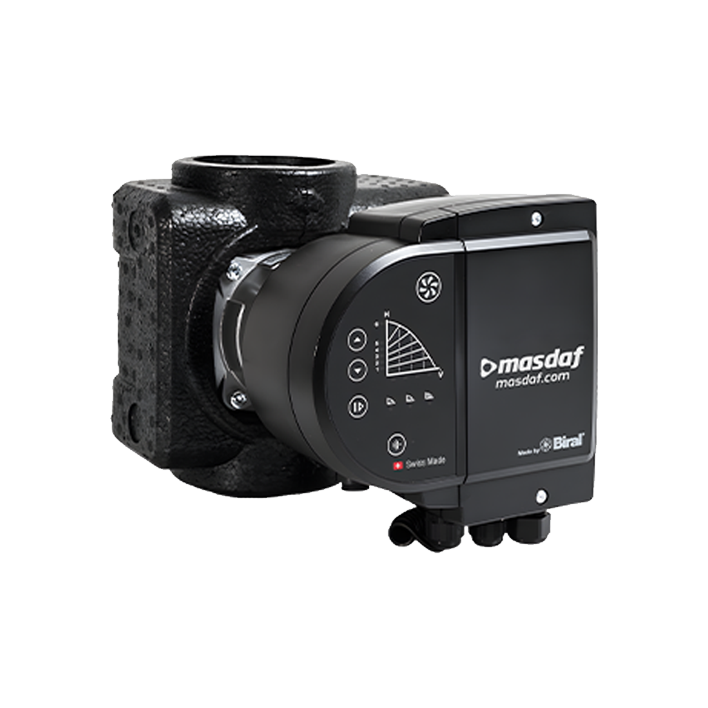
The ModulA RED circulation pump is a wet-rotor pump with a built-in frequency converter for heating and cooling systems. Fluid temperature range: +15 to +110 °C; energy efficiency index (EEI) ≤ 0.17; power supply: 1~230 V; noise level: 39–55 dB(A). The series comprises threaded models in sizes DN 25–32 and flanged models in sizes DN 32–100, with a maximum head of 4 to 18 m.
How to read the ModulA RED markings
The symbol consists of seven elements and is read from left to right: ModulA (-D) 32 (F) -6 220 RED.
ModulA — series. -D — twin pump (without this code, the pump is a single pump). 32 — nominal diameter DN in millimetres. F — flanged connection to the pipework (if no index is given, the connection is threaded). -6 — maximum head in metres. 220 — installation length in millimetres. RED — area of application: heating and cooling.
In other words, the ModulA 65F-12 340 RED is a single DN 65 flanged pump with a maximum head of 12 m and an installation length of 340 mm.
Technical specifications of the ModulA RED
| Parameter | Value |
|---|---|
| Type | circulating, with a wet rotor |
| Regulation | built-in frequency converter |
| Fluid temperature | +15…+110 °C |
| Ambient temperature | 0…+40 °C |
| Relative humidity | max. 95 per cent |
| Supply voltage | 1–230 V |
| Frequency | 50/60 Hz |
| Protection class | IPX4D |
| Noise level | 39–55 dB(A) |
| Energy Efficiency Index | EEI ≤ 0.17 |
| Engine protection | built-in; no external unit required |
| Installation | indoor areas only |
What does EEI ≤ 0.17 mean?
EEI — the energy efficiency index, which replaced the previous A to G labelling system on 1 January 2013. The lower the value, the less electricity the pump consumes to perform the same hydraulic work.
The reference value for the most efficient circulation pumps in the ErP Directive is EEI ≤ 0.20. The ModulA RED has an EEI of ≤ 0.17, meaning it comfortably meets this threshold. The series complies with the requirements of the Ecodesign Directive (EU Regulation No 641/2009) and exceeds the stricter EEI values that have been in force since August 2015.
Construction materials
| Node | Material |
|---|---|
| Pump casing | cast iron |
| Impeller | PES |
| Stator housing | aluminum |
| Gasket | EPDM |
| Plain bearing | aluminium oxide |
| Axial bearing | aluminium oxide, synthetic carbon |
| Body | PPS |
| Wear ring | stainless steel |
| Bearing cover | stainless steel |
| Shaft | stainless steel (ModulA M/L), ceramics (ModulA S) |
| Frequency converter housing | PC-ABS (UL94 V-0) |
| Thermal insulation casing | EPP, fire resistance class B2 according to DIN 4102 |
What control modes does the ModulA RED have, and when should you choose which one?
The pump has three modes, each of which corresponds to a different type of system.
Proportional pressure — for two-pipe radiator heating systems: the head decreases in line with the flow rate, as the system resistance drops when the thermostatic valves are closed. Constant pressure — for underfloor heating, where a stable pressure drop is required regardless of flow rate. Constant speed — for circuits supplying hot water boilers, where the pump operates at a single operating point.
Configuration and diagnostics are available via the built-in Bluetooth interface and the mobile app. A separate interface module is provided for connection to building automation systems.
ModulA RED standard sizes
Threaded versions: 25-4, 25-6, 25-8, 25-10, 25-12, 32-6, 32-8, 32-10, 32-12.
Flanged versions: 32F-6, 32F-12, 40-4, 40-6, 40-8, 40-10, 40-12, 40-18, 50-6, 50-8, 50-11, 50-12, 50-18, 65-6, 65-8, 65-12, 65-15, 80-8, 80-12, 100-8, 100-12.
The flow axis on the summary chart for flanged versions ends at 20 l/s, which corresponds to approximately 72 m³/h. The exact flow rate at the operating point should be taken from the data sheet for the specific model, rather than from the summary chart.
What are the requirements for the fluid being pumped?
The pump is designed for clean, low-viscosity liquids free from solid and long-fibre inclusions, which do not affect the pump mechanically or chemically, and which are neither corrosive nor explosive. Coolants free from mineral oils and softened water are also suitable.
The water in heating systems must comply with current quality standards — the catalogue cites VDI 2035 and SWKI BT102-01 as examples.
Water-glycol mixtures are permitted. The maximum viscosity is 50 mm²/s, which corresponds approximately to 50 per cent ethylene glycol at −10 °C. When operating with a glycol mixture, the pump automatically limits its power output via an overload protection function; consequently, the maximum performance is reduced.
Selection and service from Steiner Ukraine
An EEI value of ≤ 0.17 is only achieved when the pump size and control mode correspond to the actual system. A pump selected with a head margin operates outside its highest efficiency range, and the savings inherent in its design are not realised.
We determine the design flow rate and pressure drop of the circuit, the type of system — radiator, underfloor or boiler-fed — the temperature regime, the presence of a glycol mixture and the site’s altitude above sea level, and based on this, we determine the model, configuration and control mode. Next come supply, service and spare parts. Steiner Ukraine has been operating in the industrial equipment market since 2006.
The following helps to identify exactly where energy is being lost in the existing system: Energy audit of pumping stations. Other items — in the section Masdaf pumps and in the general catalogue industrial pumps and hydraulic systems.