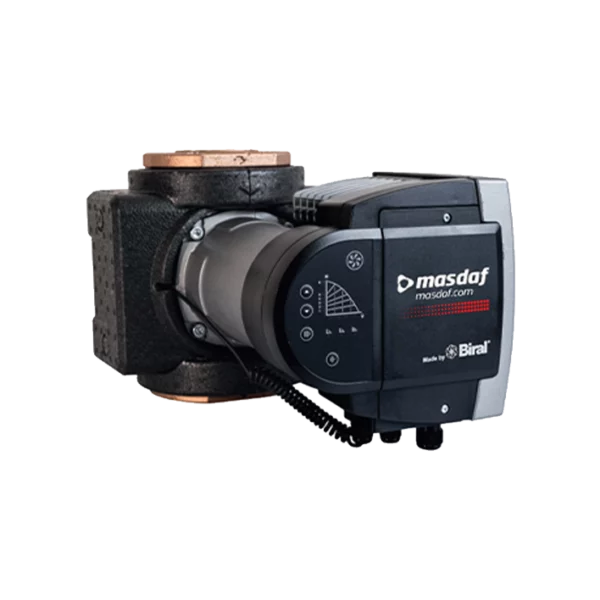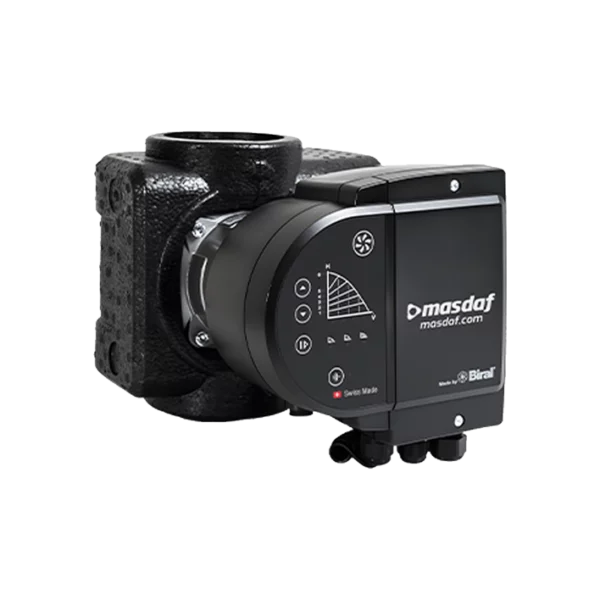
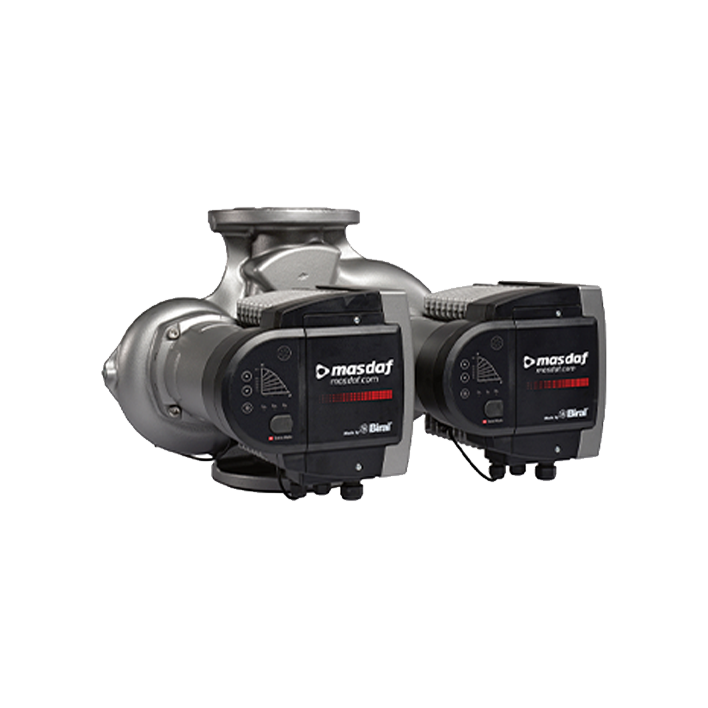
Masdaf ModulA-D — a twin-rotor circulation pump
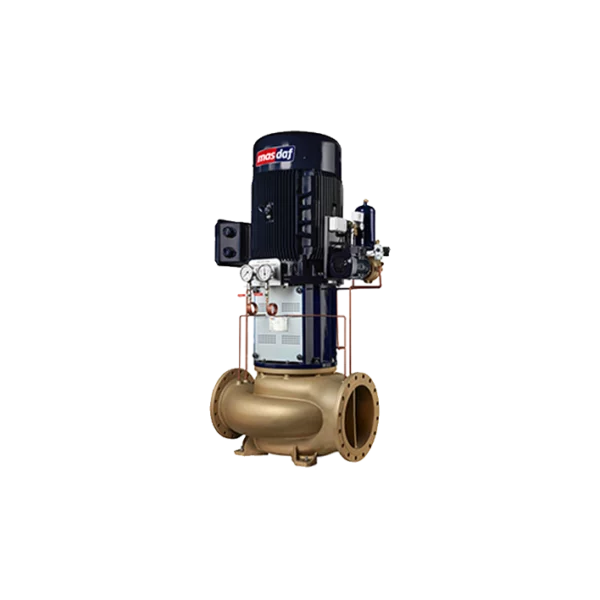
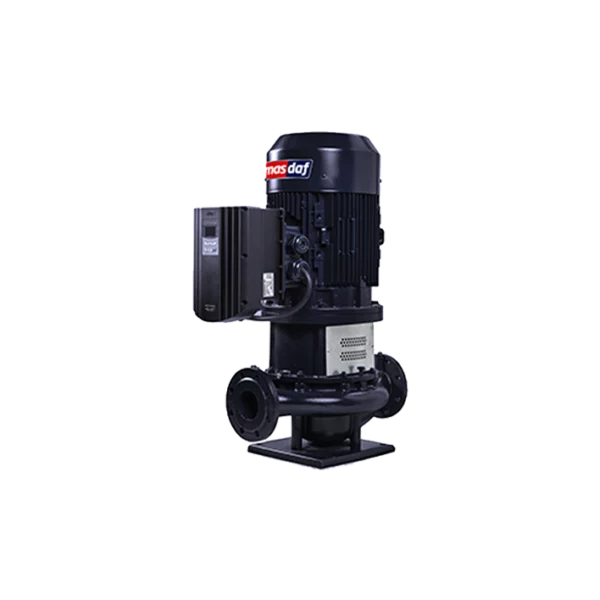
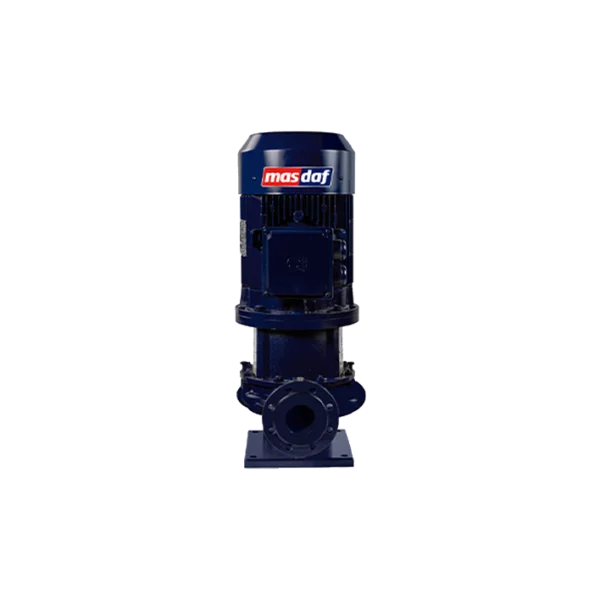
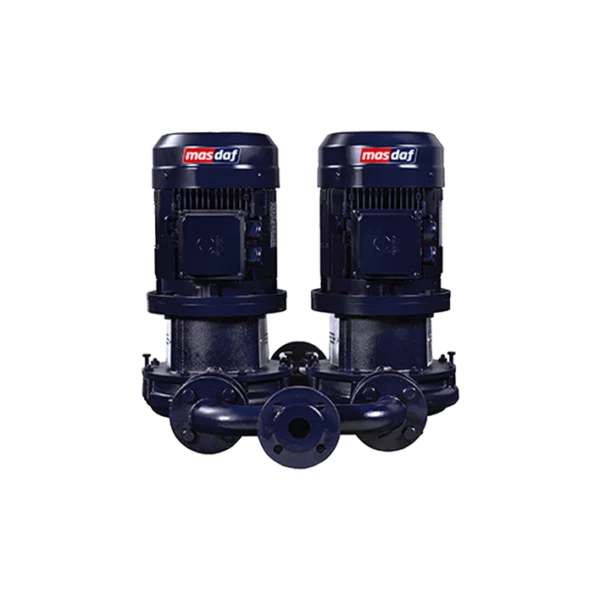
ModulA-D — a twin-head version of the ModulA series: two wet-rotor pump heads on a shared casing with one inlet and one outlet flange. The pump is designed for a flow rate of 0–75 m³/h and a head of 6–18 m, operates with fluids at temperatures ranging from +15 to +110 °C, and is available in sizes from DN 32 to DN 100. The pump is manufactured by Biral AG in Münsingen (Switzerland), whilst Masdaf supplies it under its own brand – this is confirmed in the TSE certificate, where Masdaf is listed as the licence holder and Biral AG as the place of manufacture. The single-stage versions of the same platform are listed in separate data sheets: ModulA Red for heating and ModulA Blue for hot water supply.
What are the benefits of a twin-pump design compared to two separate pumps?
In the twin-body design, both heads are connected to a single pair of flanges, therefore the pipeline requires neither a double connection nor external changeover valves — the centre-to-centre installation length ranges from 220 mm for DN 32 to 450 mm for DN 100. The design is intended for operation with one active head and a second as a spare, therefore maintenance can be carried out without shutting down the circuit: when one pump head is removed for repair, the opening is sealed with a blind flange (Biral part number 2205210150), and the pump continues to operate using the second pump head. The manufacturer specifies that the minimum inlet head when operating the twin pump must be increased by 0.1 bar compared to the nominal values for the single-head version.
What are the technical specifications of the Masdaf ModulA-D?
| Parameter | Value |
|---|---|
| Type | Twin wet-rotor circulation pump |
| Capacity | 0–75 m³/h |
| Pressure | 6–18 m |
| Suction flange | 1½” — DN 100 |
| Discharge flange | 1½” — DN 100 |
| Standard sizes | DN 32, 40, 50, 65, 80, 100 |
| Installation length L1 | 220–450 mm |
| Mass | 31–68 kg, depending on the size |
| Medium temperature | +15…+110 °C |
| Ambient temperature | 0…+40 °C; transport −40…+70 °C |
| Maximum operating pressure | as stated on the nameplate: PN 6 — 6 bar, PN 10 — 10 bar, PN 16 — 16 bar |
| Power supply | 1×230 V ±10 per cent, 50/60 Hz, PE |
| Engine protection | No external one is required |
| Degree of protection | IPX4D (EN 60529) |
| Winding insulation class | F |
| Temperature class | TF110 (EN 60335-2-51) |
| Noise level | 45–55 dB(A), depending on the size |
| Leakage current | < 3.5 mA |
| Power consumption when switched off | < 3 W |
| Power factor | 0.98–0.99 (built-in PFC filter) |
| EEI | 0.17…0.20 |
| EMC | EN 55014-1, EN 55014-2, EN 61000-3-3, EN 61000-3-2 |
What sizes are included in the ModulA-D range?
The series comprises 20 configurations with flanged bores in PN 6–16 or PN 10–16.
| DN | Standard sizes | Installation length L1, mm | Mass, kg |
|---|---|---|---|
| 32 | 32F-12 220 | 220 | 31 |
| 40 | 40-8 220, 40-10 220, 40-12 250, 40-18 250 | 220–250 | 31–32 |
| 50 | 50-6 240, 50-8 240, 50-12 270, 50-18 270 | 240–270 | 35–36 |
| 65 | 65-8 340, 65-12 340, 65-15 340 | 340 | 42–48 |
| 80 | 80-8 360, 80-12 360 | 360 | 58 |
| 100 | 100-8 450, 100-12 450 | 450 | 68 |
What control functions does ModulA-D have?
According to the manufacturer, the series features a built-in energy-saving function via a power-limiting feature that can be switched on and off, an external ON/OFF switch, customisable fault and operational notifications, as well as a Wi-Fi function via a remote adapter, which enables communication between the pumps and a smartphone. The electric motor has built-in protection — no external thermal protection in the cabinet is required. The LED display on the panel indicates the pump’s status via colour and indicator movement: a flashing green light indicates operation, a steady green light indicates STOP mode, red indicates a warning, and a steady red light with the SSM relay active indicates a fault. Factory settings on delivery: proportional pressure, third characteristic curve, all three DIP switches in the OFF position.
How does ModulA-D differ from the single-unit ModulA Red and ModulA Blue?
The hydraulics and electronics are common to all three versions — Biral describes all three versions in a single manual, and their factory settings are identical. The differences relate to their intended use and operating range. The ModulA-D is rated for +15 to +110 °C and is used in heating and cooling circuits, just like the single ModulA Red; the ModulA Blue is limited to +85 °C and is designed for hot drinking water. In terms of flow rate, the dual version covers 0–75 m³/h compared to 0–11.5 m³/h for the ModulA Blue, whilst in terms of diameters, it ranges from DN 32 to DN 100 compared to DN 40 for the Blue. The manufacturer specifies the EEI index for the twin version as ranging from 0.17 to 0.20, whilst for the single-unit A and ModulA series, the TSE certificate records a value of 0.17.
Where is ModulA-D used?
The manufacturer identifies three areas of application: central heating networks in residential and commercial buildings, water circulation in air-conditioning and cooling systems, and underfloor heating systems. The dual-circuit version is chosen where a circuit shutdown is unacceptable or where the two heads need to operate in turn — this is typical for boiler rooms in blocks of flats, shopping and office centres, hotels and industrial buildings operating year-round. A comprehensive list of applications is provided in the section in-line circulation pumps, whilst equipment for the pressurised supply and transport of liquids can be found in the section industrial pumps.
What does an EEI of 0.17–0.20 mean?
EEI — the energy efficiency index for circulation pumps, calculated based on a typical annual load profile: the lower the value, the less power the pump consumes in actual operation, rather than at its rated point. For the A and ModulA series, TSE certificate No. 020888-TSE-01/06 specifies an EEI of 0.17 and temperature classes TF 60 / TF 95 / TF 110. For the twin-head version, the Masdaf series data sheet specifies a range of 0.17–0.20 — the exact value depends on the size and is indicated on the pump’s nameplate. The certificate published by Masdaf is valid until 25 March 2026; therefore, the latest version from the manufacturer is required for tender documentation.
What to bear in mind during installation
The arrow on the casing indicates the direction of flow. The frequency converter and control panel must never be covered with insulation, and the drain hole near the motor must be kept clear. When installing a non-return valve, the pump must be adjusted so that the discharge pressure constantly exceeds the valve’s closing pressure — this is critical for proportional pressure operation, where the head decreases as the flow rate decreases. The minimum inlet head is determined by the medium temperature and the height of the installation: the table values are given for 500 m above sea level, with a correction of ±0.01 bar for every ±100 m, and for dual mode, 0.1 bar is added to these values.
Selection and service from Steiner Ukraine
We select the size based on the actual flow rate and head of the circuit, check the required head, taking into account the temperature and height of the site, agree on the wiring diagram for the relay outputs, and choose between a twin-pump configuration and two single pumps with changeover valves. Installation supervision, commissioning, control mode configuration and ongoing maintenance are included in service sector. The rest of the Masdaf circulation series — ModulA Red, ModulA Blue, INM, GenIO INM, CSV.