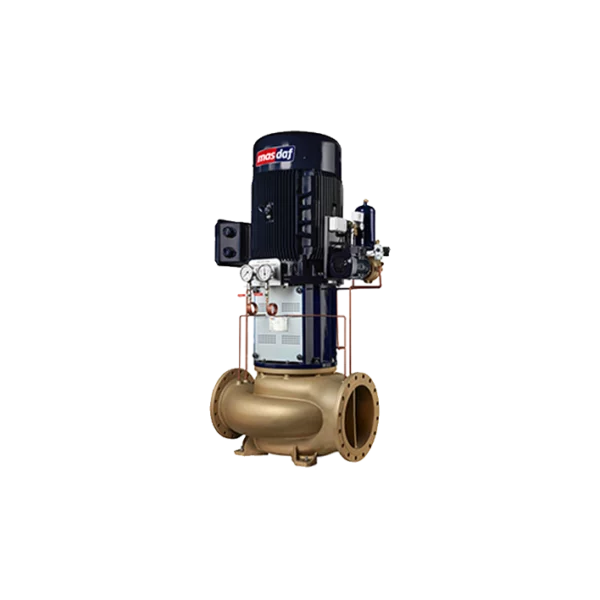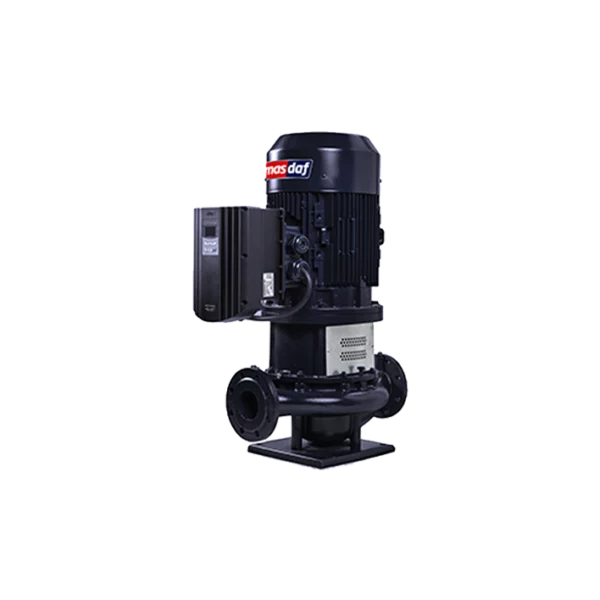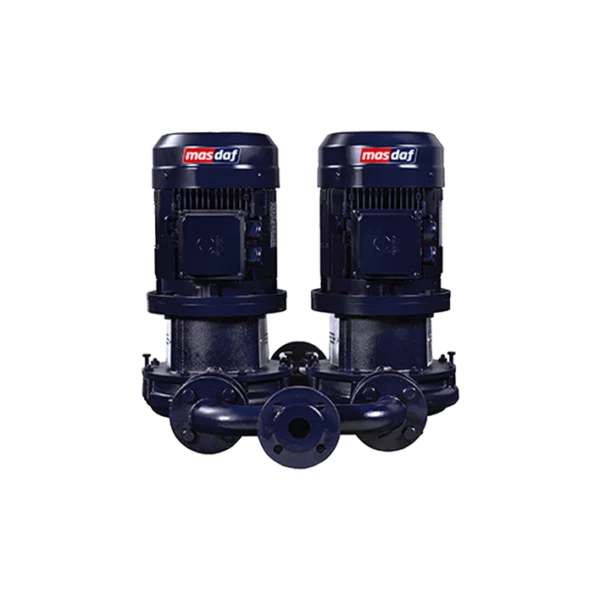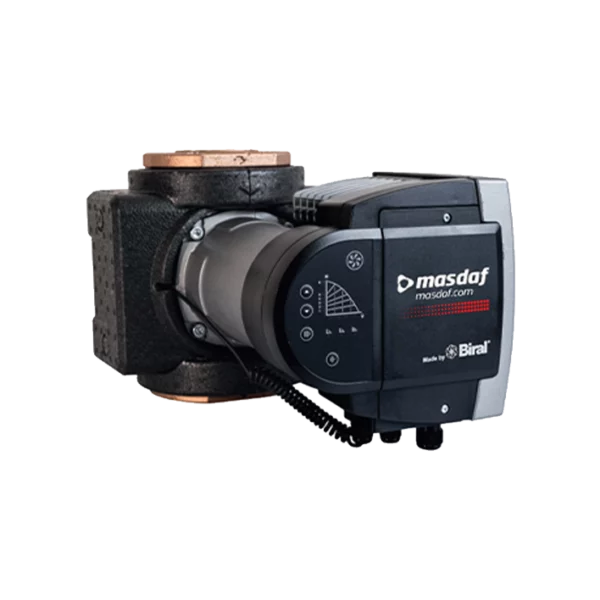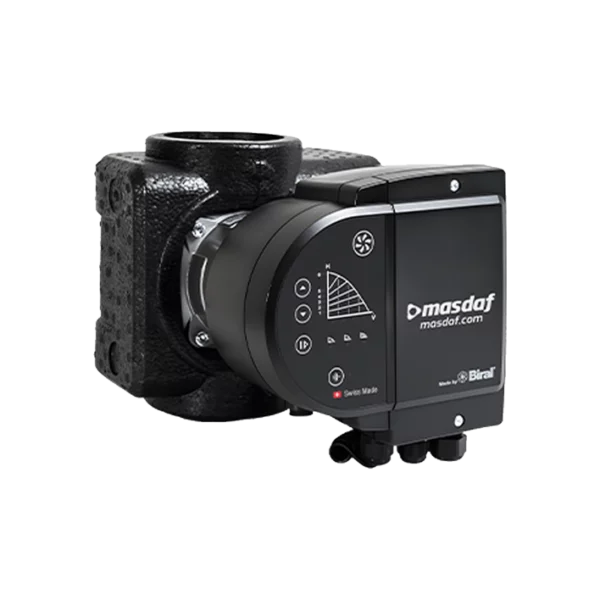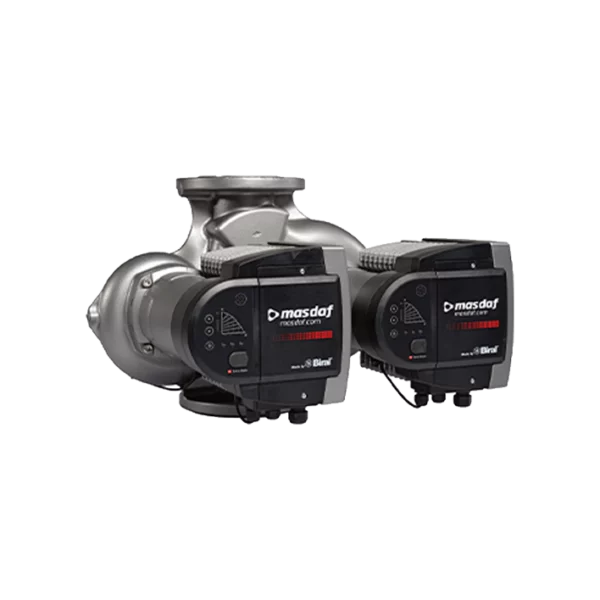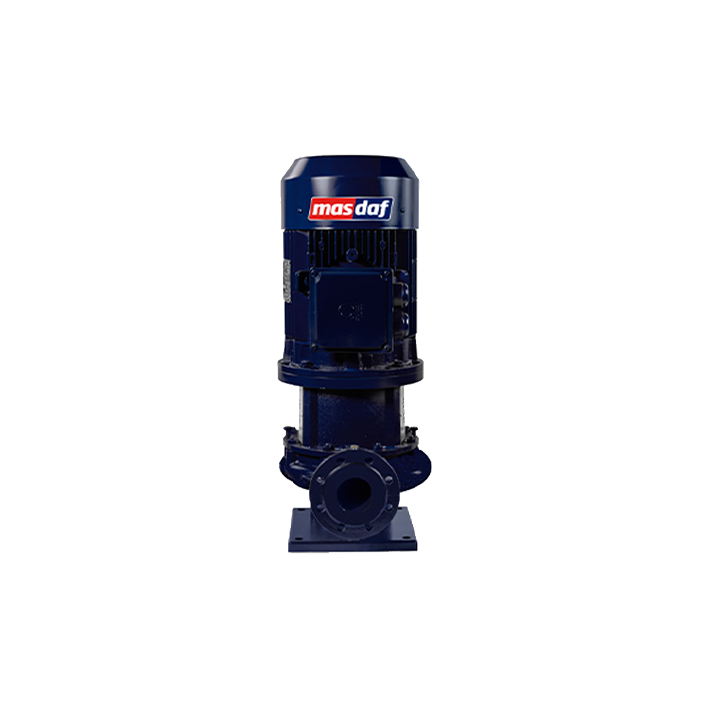
Masdaf - Circulation pumps (INM)
The INM pump is a single-stage, in-line centrifugal pump with a dry rotor. Flow rate from 2 to 520 m³/h, head from 2 to 105 m, suction and discharge flanges DN 40–DN 200, located on the same axis and of the same diameter, speed range 1,000–3,600 rpm, medium temperature from −25 to +120 °C. The flanges and impeller are manufactured in accordance with ISO and EN standards; the series complies with DIN 24255 within the nominal flow rate range.
INM pump: what does ‘dry rotor’ mean?
The INM pump has a dry rotor: the motor rotor is separated from the pumped liquid by a mechanical face seal and does not come into contact with it. In wet-rotor pumps, the fluid passes through the rotor clearance, thereby lubricating the bearings and cooling the motor.
There are three practical differences. The first is the range: a dry rotor allows the motor to be set to any required power output, so the series can reach a head of 105 m, whilst a wet rotor is limited to approximately 18 m. Secondly, the operating environment: the fluid does not pass through the motor’s windings or bearings, so the purity requirements are lower. Thirdly — maintenance: the seal is a wear-and-tear component that needs replacing, whilst the motor is accessible separately from the hydraulic section.
The motor shaft is fitted via an adapter and a flange, so the motor can be removed without dismantling the hydraulic system.
How does the INM pump differ from the GenIO INM?
The hydraulic specifications are identical in both series. Flow rate 2–520 m³/h, head 2–105 m, speed 1,000–3,600 rpm, flanges DN 40–DN 200 and temperature range −25…+120 °C are identical across the board.
The only difference is in the drive. The INM pump is powered by a standard motor, whilst the variable-frequency drive, if required, is installed separately in the control cabinet. In the series GenIO INM The converter is mounted directly on the motor and comes with functions for controlling two pumps from a single drive, connecting sensors and providing protection against dry running.
Selection rule. If the pump operates at a single operating point with a constant flow rate, the INM is sufficient. If the flow rate in the system varies and the pump needs to compensate for this variation via speed rather than a valve, a GenIO INM or an INM supplied with a separate drive is required. If a control cabinet is already in place and has space for the drive, an INM with a separate drive unit achieves the same result.
INM pump: technical specifications
| Parameter | Value |
|---|---|
| Type | linear centrifugal, single-stage, dry rotor |
| Capacity | 2–520 m³/h |
| Pressure | 2–105 m |
| Revolutions | 1,000–3,600 rpm |
| Suction flange | DN 40–DN 200 |
| Discharge flange | DN 40–DN 200 |
| Flange positioning | on the same axis, of the same diameter |
| Medium temperature | −25…+120 °C |
| Pressure at the discharge flange | not exceeding 16 bar |
| Flanges and impeller | in accordance with ISO and EN standards |
| Compliance | DIN 24255 |
| Minimum Efficiency Index | MVE ≥ 0.4 |
For applications with pressures exceeding 16 bar, a special version is required for the discharge flange.
What does MVE ≥ 0.4 mean?
MVE, or MEI — the minimum efficiency index under the Ecodesign Directive 2009/125/EC, introduced by Regulation 547/2012. It applies to pumps with a maximum shaft power of 150 kW or less at the largest impeller diameter.
For this series, the index is at least 0.4. The specific value for each pump is indicated on the manufacturer’s nameplate and shown on the performance curves; it can therefore be checked directly on the equipment, rather than solely in the documentation.
It is also worth noting that when operated at variable speeds, the pump delivers higher efficiency than when running at a constant speed. This applies to all models in the series — whether fitted with a separate inverter or a GenIO drive.
Where is the INM pump used?
The range is used in two sectors: building services and shipbuilding.
The INM pump is used in heating and cooling circuits to circulate hot or cold water, in condensate lines and as part of industrial installations, in irrigation and sprinkler systems, as well as for pumping fresh and seawater on ships.
A broader range of applications includes water supply networks and pressure boosting, filling and emptying reservoirs and tanks, water circulation in swimming pools, sanitary and hygiene facilities, and industrial and social facilities.
The alignment of the flanges on a single axis simplifies installation: the pump is fitted into the existing pipework without the need for adaptors or changes to the pipework layout, whilst the identical suction and discharge diameters eliminate the need for adaptors.
What are the requirements for the fluid being pumped?
The INM pump is designed for clean or slightly contaminated water — liquid, non-abrasive, free from large solid particles and fibrous inclusions.
The performance curves are plotted for water with a density of 1 kg/dm³ and a kinematic viscosity of 1 sSt. For fluids with different densities or viscosities, the performance characteristics will differ, and the selection must be agreed separately. For seawater and media with different chemical properties, the design is tailored to the specific application.
Selection and service from Steiner Ukraine
The efficiency index is only achieved when the pump is selected to match the actual characteristics of the system. A pump selected with a head margin operates to the left of the point of maximum efficiency, consumes more energy and places an increased load on the bearings and seals.
We determine the design flow rate and head at the operating point, the system resistance characteristics, the temperature and composition of the medium, the available inlet head, the discharge pressure, the pipework layout and the requirement for variable-speed control. Based on this, we determine the model size, flange diameter, seal type and drive configuration. Next come supply, service and spare parts. Steiner Ukraine has been operating in the industrial equipment market since 2006.
The following helps to identify where energy is being lost in the existing system Energy audit of pumping stations. The series is designed for flow rates in excess of 520 m³/h CSV. Other items — in the section Masdaf pumps and in the catalogue industrial pumps and hydraulic systems.