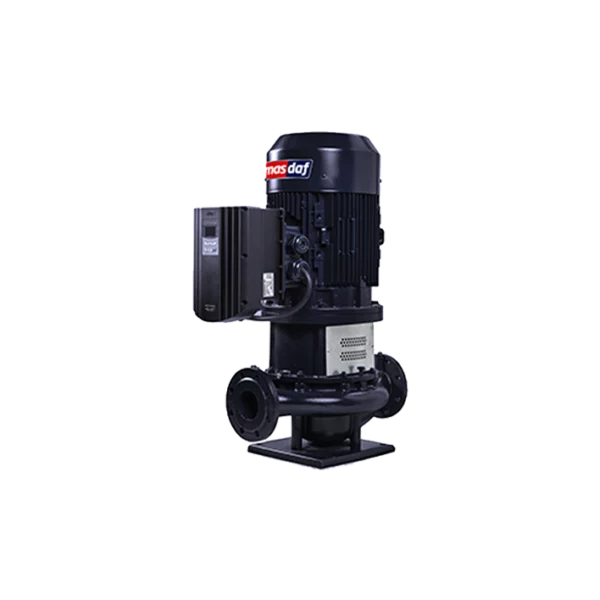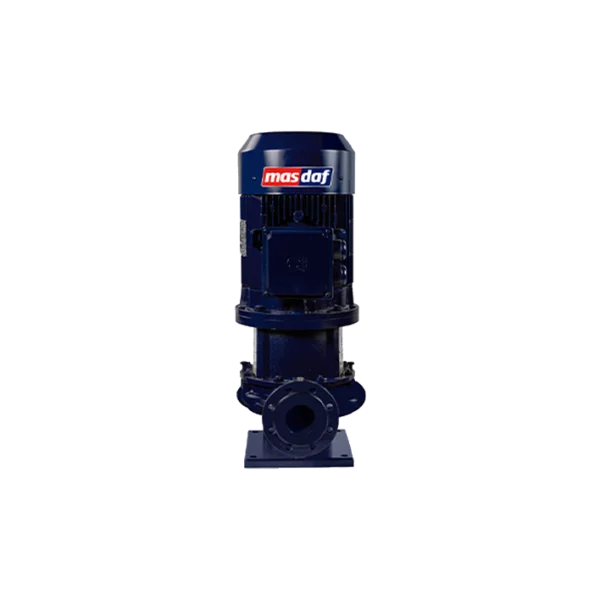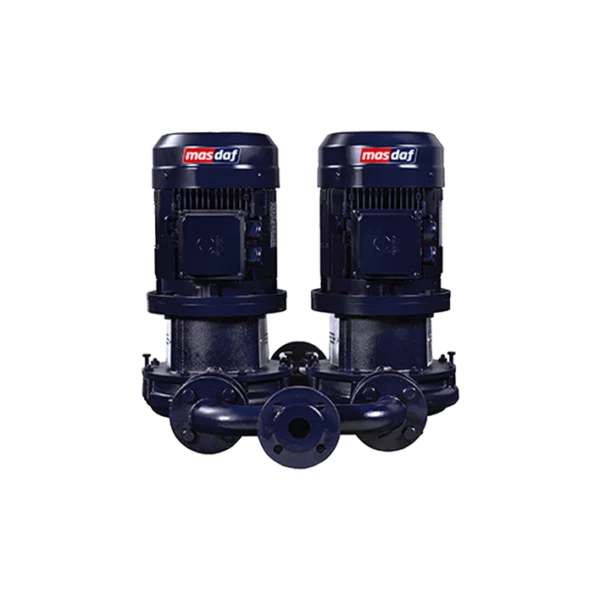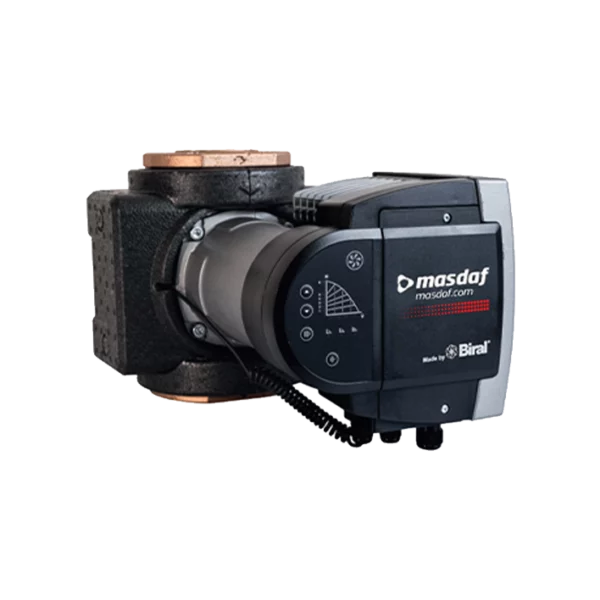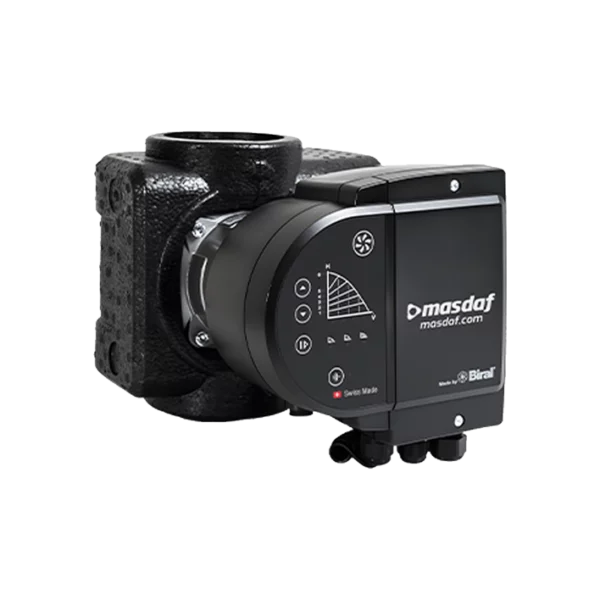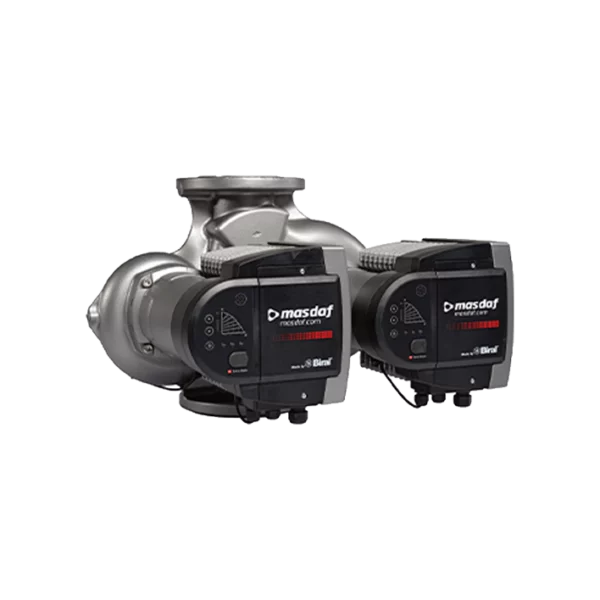
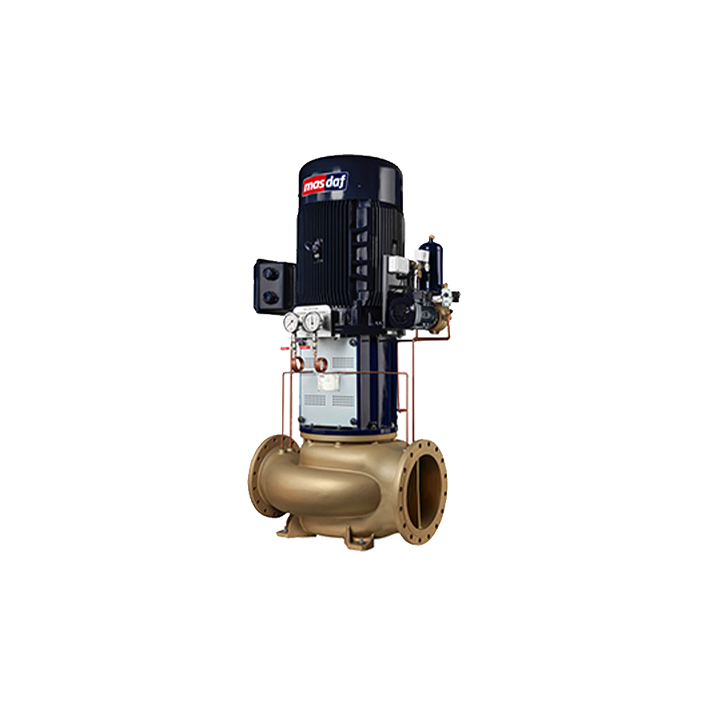
Masdaf - Circulation pumps (CSV)
The CSV pump is a double-suction in-line centrifugal pump with a mechanical face seal. Flow rate from 400 to 2,200 m³/h, head from 10 to 60 m, suction flange DN 400, discharge flange DN 350, speed range 750–1,800 rpm, fluid temperature from −15 to +90 °C. The series complies with DIN 24255 within the nominal flow range.
CSV pump: the benefits of double-suction
The fluid enters the impeller symmetrically from both sides, rather than from one side, as in a cantilever pump. The pressure on both sides of the impeller is balanced, and the axial hydraulic load on the shaft is reduced.
The practical implication concerns bearing life. In a single-suction pump, the axial force is absorbed by the bearing assembly, and this load increases proportionally as the flow rate rises. In a CSV pump, this force is largely compensated for by the impeller geometry itself; consequently, the series operates at flow rates of up to 2,200 m³/h with two ball bearings lubricated with grease, without a separate thrust bearing assembly.
The second advantage of this design is that the symmetrical inlet provides a more uniform flow in front of the impeller, which reduces vibration at high flow rates.
How does the CSV pump differ from the GenIO INM?
Both series are in-line and are fitted directly into the pipework, but cover opposite ends of the range.
GenIO INM — a single-suction pump with a flow rate of up to 520 m³/h and a head of up to 105 m, fitted with a frequency converter on the motor. This model is designed for high head at moderate flow rates.
The CSV pump is the opposite case: a flow rate of up to 2,200 m³/h at a head of up to 60 m. High flow rate, limited head.
The selection rule is simple. If a head of more than 60 m is required, the GenIO INM range is suitable. If the flow rate exceeds 520 m³/h, the CSV range is suitable. In the overlap zone, approximately 400–520 m³/h at a head of up to 60 m, both series are suitable, and the choice is determined by the available inlet head and control requirements.
Technical specifications of the CSV pump
| Parameter | Value |
|---|---|
| Type | linear centrifugal, double-suction |
| Capacity | 400–2,200 m³/h |
| Pressure | 10–60 m |
| Revolutions | 750–1,800 rpm |
| Suction flange | DN 400 |
| Discharge flange | DN 350 |
| Medium temperature | −15…+90 °C |
| Bearings | two ball bearings, grease |
| Shaft seal | mechanical face |
| Motor | in accordance with IEC, DIN, VDE and TSE standards |
| Compliance | DIN 24255 |
The CSV pump can be operated with variable-frequency control — a drive with a frequency converter is available as an option. The current models in the series are listed below on the manufacturer’s website.
CSV pump and low NPSH
NPSH — the net positive suction head required by the pump to prevent the fluid from boiling before it enters the impeller. If the actual inlet head is less than required, cavitation begins: vapour bubbles form and collapse within the impeller, damaging its surface and reducing the flow rate.
The CSV pump is designed for a low NPSH value. This broadens the range of installation conditions: it allows for a lower inlet head, a higher fluid temperature, or the pump to be positioned higher than the water level in the tank.
In high-flow applications, this parameter is often the deciding factor. The higher the flow rate, the greater the fluid velocity at the inlet and the greater the head required by the pump; therefore, it is in this range that NPSH, rather than head, limits the choice of equipment.
Where is the CSV pump used?
The series is used in two sectors: industry and shipbuilding.
Typical applications include ballast pumps on ships, the supply of cooling water, general-purpose pumps in process systems, and the transfer of water between tanks or sections of a network.
The ballast application also dictates the design: large volumes of water at low head, limited installation space and the need to compensate for axial forces during prolonged continuous operation. The same characteristics are required in cooling circuits, where the CSV pump operates in steady-state mode at a constant flow rate.
What are the requirements for the fluid being pumped?
The pump is designed for clean or slightly contaminated water — liquid, non-abrasive, free from large solid particles and fibrous inclusions.
The performance curves are plotted for water with a density of 1 kg/dm³ and a kinematic viscosity of 1 sSt. For fluids with different densities or viscosities, the performance characteristics will differ, and the selection must be agreed separately. For seawater and media with different chemical properties, the design is tailored to the specific application.
Selection and service from Steiner Ukraine
With flow rates of several hundred or thousands of cubic metres per hour, an error in selection proves costly: a pump selected with too much head margin operates to the left of its peak efficiency point, consumes more energy and places increased stress on the bearings and seals.
We determine the design flow rate and head at the operating point, the system resistance characteristics, the available inlet head and the required NPSH, the temperature and composition of the fluid, the pipework layout and whether frequency control is required. Based on this, we determine the size, seal type and drive configuration. Next come supply, service and spare parts. Steiner Ukraine has been operating in the industrial equipment market since 2006.
The following helps to identify where energy is being lost in the existing system Energy audit of pumping stations. Other items — in the section Masdaf pumps and in the catalogue industrial pumps and hydraulic systems.