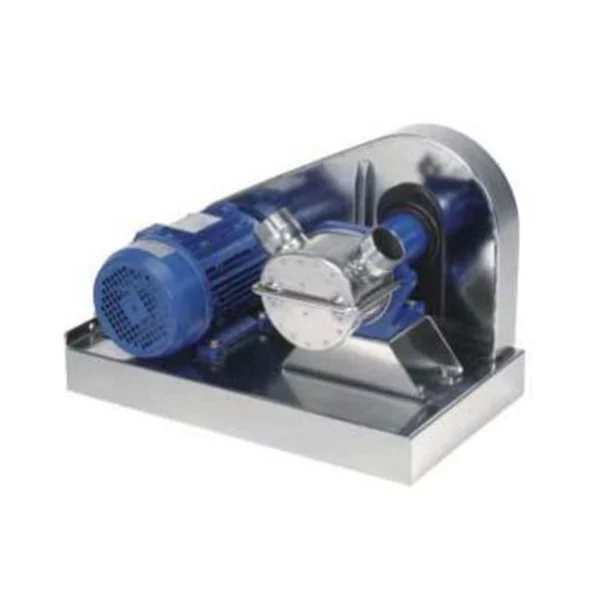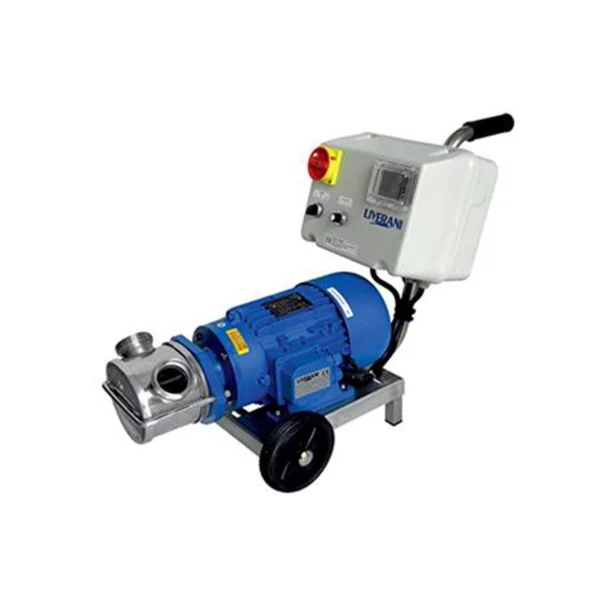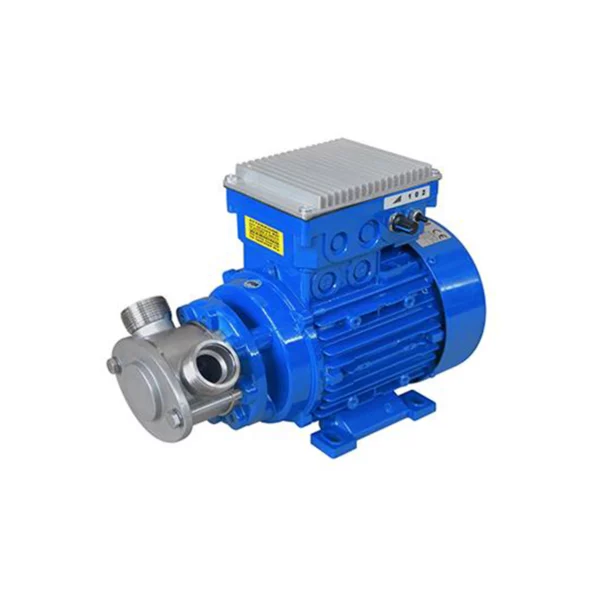

LIVERANI - Impeller pump (VA / INV)
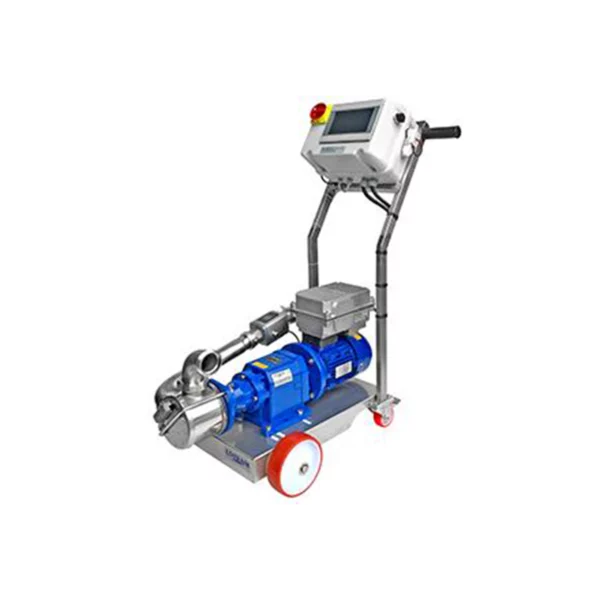
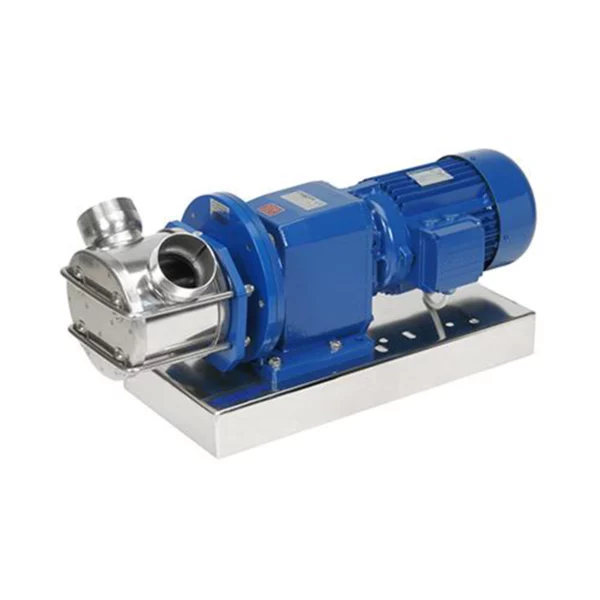
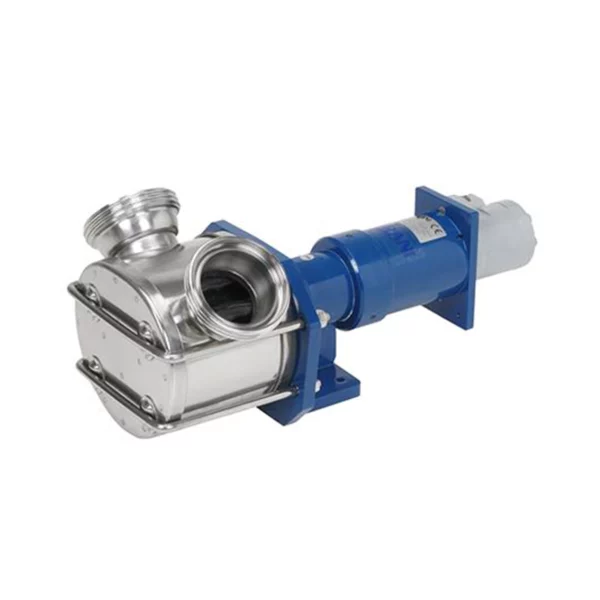
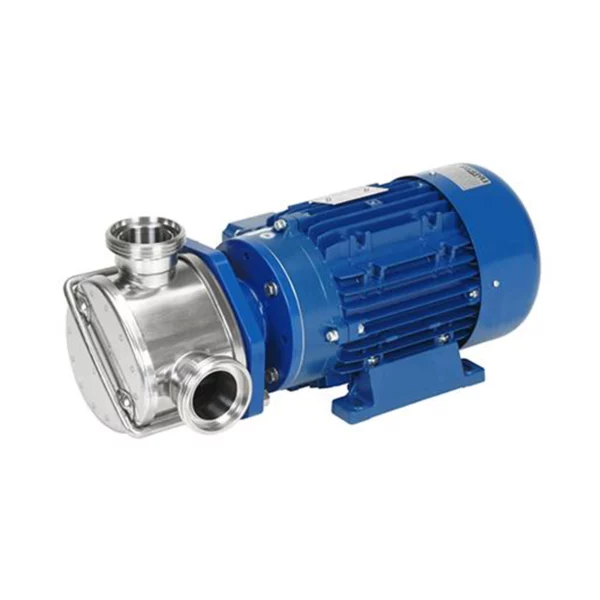
The LIVERANI VA / INV pump is a self-priming impeller pump with variable speed. Manufacturer: LIVERANI s.r.l. (Via De’ Brozzi 94, 48022 Lugo, Province of Ravenna, Italy). The company was founded in the 1950s. The equipment is manufactured in accordance with CE standards.
The designation covers two different versions. VA — a pump with a mechanical variable-speed drive. INV — a pump with a frequency converter. The hydraulic components are identical in both: a flexible elastomer impeller and a casing made of AISI 304 or AISI 316 stainless steel. However, the model ranges differ.
LIVERANI VA / INV Pump: Technical Specifications
| Parameter | Value |
|---|---|
| Type | impeller-type self-priming, flexible impeller |
| Speed control | mechanical variator (VA) or frequency converter (INV) |
| Flow rate, max. | up to 72,000 litres per hour in the MAXI 80 version |
| Maximum pressure drop | 4 bar |
| Medium temperature | up to +100 °C |
| Viscosity of the medium | up to 50,000 cP |
| Housing material | AISI 304 or AISI 316 stainless steel |
| Impeller material | NR, CR, NBR, EPDM or VMQ |
| Shaft seal | face-type mechanical |
| Self-priming | up to 6 m |
| Reverse side | Yes, it works in both directions of rotation |
| Installation instructions | any |
| Accession | DIN 11851, Garolla, BSP, Macon, Triclover, SMS, BSM/RJT |
The manufacturer provides specifications for pressure head, temperature, viscosity, self-priming and reverse flow for the entire range of LIVERANI impeller pumps.
VA or INV: what’s the difference?
VA — mechanical continuously variable transmission. The speed is varied by means of a transmission ratio that is adjusted manually. The motor operates at a constant frequency. The drive contains no power electronics.
INV — frequency converter. The speed varies in line with the motor’s supply frequency. The control is electronic, with precise setting of the value.
There are two practical differences. The first is the speed range. In the VA version, the catalogue specifies speeds ranging from 150 to 700 rpm. In the INV version, the lower limit drops to 50 rpm for the MINOR 40 and MAJOR 60 sizes. This is a range four times wider at the lower end.
The second is the control method. The mechanical variator is adjusted manually on site. A frequency converter allows you to set the value precisely and, if necessary, transfer control to an automation system.
VA valves are used where regulation is required infrequently and there is no desire to incorporate electronics into the actuator. INV valves are used where the flow rate needs to be adjusted frequently, precisely or over a wide range.
Standard sizes in the VA version
| Size | Revolutions |
|---|---|
| VA MINOR 40 | 150–700 rpm |
| VA MAJOR 60 | 150–700 rpm |
| VA MAXI 80 | 150–600 rpm |
The VA version is based on a belt-driven mechanism. The power supply is three-phase, 230 or 400 V, 50 Hz. The catalogue does not list the small MICRO, MINI and MIDEX sizes in the VA version: the mechanical variator is fitted from the MINOR 40 size upwards.
Standard sizes in the INV range
| Size | Power | Power supply | Revolutions | Mass |
|---|---|---|---|---|
| INV MINI 3/4″ | 0.56 kW | 230 V or 400 V, 50 Hz | 150–900 rpm | 9–10 kg |
| INV MIDEX 1″1/4 | 0.75 kW | 230 V or 400 V, 50 Hz | 180–1,400 rpm | 15 kg |
| INV MINOR 40 | 1.87 kW | 230 V or 400 V, 50 Hz | 50–900 rpm | 20 kg |
| INV MAJOR 60 | 2.2 kW | 230 V or 400 V, 50 Hz | 50–900 rpm | 27 kg |
| INV MAXI 80 | 4 or 7.5 kW | 400 V, 50 Hz | 50–600 rpm | 95 kg |
The catalogue also features the INV MAXI Double 2Q-2H model, weighing 109 kg. The configuration of this variant is agreed upon at the time of ordering.
The INV series is two sizes wider than the VA series — MINI and MIDEX. Together with a lower limit of 50 rpm, this makes the INV suitable for small and precise feeds that are beyond the capabilities of a mechanical variator.
How a flexible impeller works
The impeller is made of elastomer and has flexible blades. As the impeller rotates, the blades deform against the casing wall. Enclosed volumes are formed between them, which draw in the fluid at the inlet and carry it to the outlet.
This gives rise to four characteristics. The first is self-priming up to 6 metres without flooding. The second is volumetric flow: the flow rate is proportional to the speed, so adjusting the speed directly determines the flow rate. The third is gentle pumping: the product does not pass through a high-shear zone, its structure remains intact and it is not aerated. The fourth is that the pump allows solid particles to pass through in a suspended state without grinding them up.
It is precisely the volumetric nature of the flow that makes speed control the correct method of regulating flow rate. Throttling at the discharge end is not suitable for this type of pump: it does not regulate the flow rate correctly and places a strain on the seals.
The pump is reversible and operates in both directions of rotation. It can be installed in any position. Prolonged operation without liquid in the casing is not permitted: the impeller blades come into contact with the casing wall and are damaged by dry friction.
Impeller material: NR, CR, NBR, EPDM or VMQ
| Material | Designation | Typical application |
|---|---|---|
| Natural rubber | NR | water, wine, general food liquids |
| Neoprene | CR | oils, moderately corrosive media |
| Nitrile | NBR | fats, mineral oils, petroleum products |
| EPDM | EPDM | hot water, cleaning solutions, alkalis |
| Silicone | VMQ | food and pharmaceutical products |
The casing is made from AISI 304 or AISI 316 stainless steel. The shaft seal is a mechanical face seal. The impeller is supplied as a separate spare part.
The LIVERANI VA / INV pump, amongst other series in the range
The range comprises nine models with the same hydraulic system. Four of these offer adjustable flow rates, and they differ in terms of their control method and level of specification.
| The series | Method of regulation | A distinctive feature |
|---|---|---|
| VA | mechanical continuously variable transmission | without power electronics, from MINOR 40 |
| INV | frequency converter | from 50 to 1,400 rpm, range from MINI to MAXI 80 |
| INV BS | frequency converter | control panel on the housing, two sizes |
| MINIVERTER | frequency converter | converter in a terminal box, compact dimensions |
| ALL IN ONE | frequency converter | plus a magnetic flow meter and a touchscreen panel |
Fixed-speed series: SP — a shaft without a drive, EP — coaxial drive, GR — belt drive, RID — gear motor, MID — a hydraulic motor.
How to choose a LIVERANI VA / INV pump at Steiner Ukraine
Seven pieces of information are required for selection: the required flow rate in litres per hour and its range; the head or pipeline resistance in metres; the name of the product, its viscosity and temperature; the presence and size of any solid particles; the type and size of the connection; and the steel grade of the casing.
The key question for this series is how often and how precisely the power supply needs to be adjusted. If adjustments are infrequent and approximate, a VA is sufficient. If adjustments are frequent, precise or cover a wide range, an INV is required. The available power supply is specified separately: 230 V single-phase or 400 V three-phase.
Steiner Ukraine supplies LIVERANI equipment together with design calculations, complete sets and spare parts, including impellers made from various elastomers. The scope is described in the section services. Industrial pumps — in the section industrial pumps, equipment for food production — in in a separate section. Sector-specific recruitment — in sector-specific solutions. The technical specifications of the original source are published at the LIVERANI website.
Frequently Asked Questions
How does VA differ from INV?
VA — mechanical variator; the speed is adjusted manually via the gear ratio. INV — frequency converter; the speed is adjusted electronically.
What is the rev range for each version?
In the VA catalogue, the speed is listed as between 150 and 700 rpm. In the INV catalogue, it ranges from 50 to 1,400 rpm, depending on the model.
What sizes are available in the VA version?
Three: MINOR 40, MAJOR 60 and MAXI 80. The catalogue does not list the small sizes in the VA version.
What sizes are available in the INV version?
Five: MINI 3/4″, MIDEX 1″1/4, MINOR 40, MAJOR 60 and MAXI 80. There is also a separate version, the INV MAXI Double 2Q-2H.
What is the maximum flow rate?
Up to 72,000 litres per hour in the MAXI 80 size. This is the upper limit of the LIVERANI impeller pump range.
What power supply is required?
Single-phase 230 V or three-phase 400 V are available for most sizes. For the MAXI 80, three-phase 400 V is available.
Can the flow rate be adjusted whilst the machine is running?
Yes, both versions are designed for this purpose. INV allows you to do this more accurately and over a wider range.
Is the pump self-priming?
Yes, up to 6 m. The pump primes the suction line automatically, without the need for manual priming.
Is it safe to run the pump dry?
Prolonged operation without fluid in the housing is not permitted. The flexible blades come into contact with the housing wall and are damaged by dry friction.
How much does a LIVERANI VA/INV pump cost?
The price depends on whether the model is VA or INV, the size, the drive power, the steel grade of the casing, the impeller material and the connection type. Please send us the flow rate, the required control range, the product and the connection type – and we will prepare a quotation.
Manufacturer: LIVERANI
Category: Impeller pumps
Industries: Food, Beverages, Pharmaceutical, Other
Model range: 10 positions