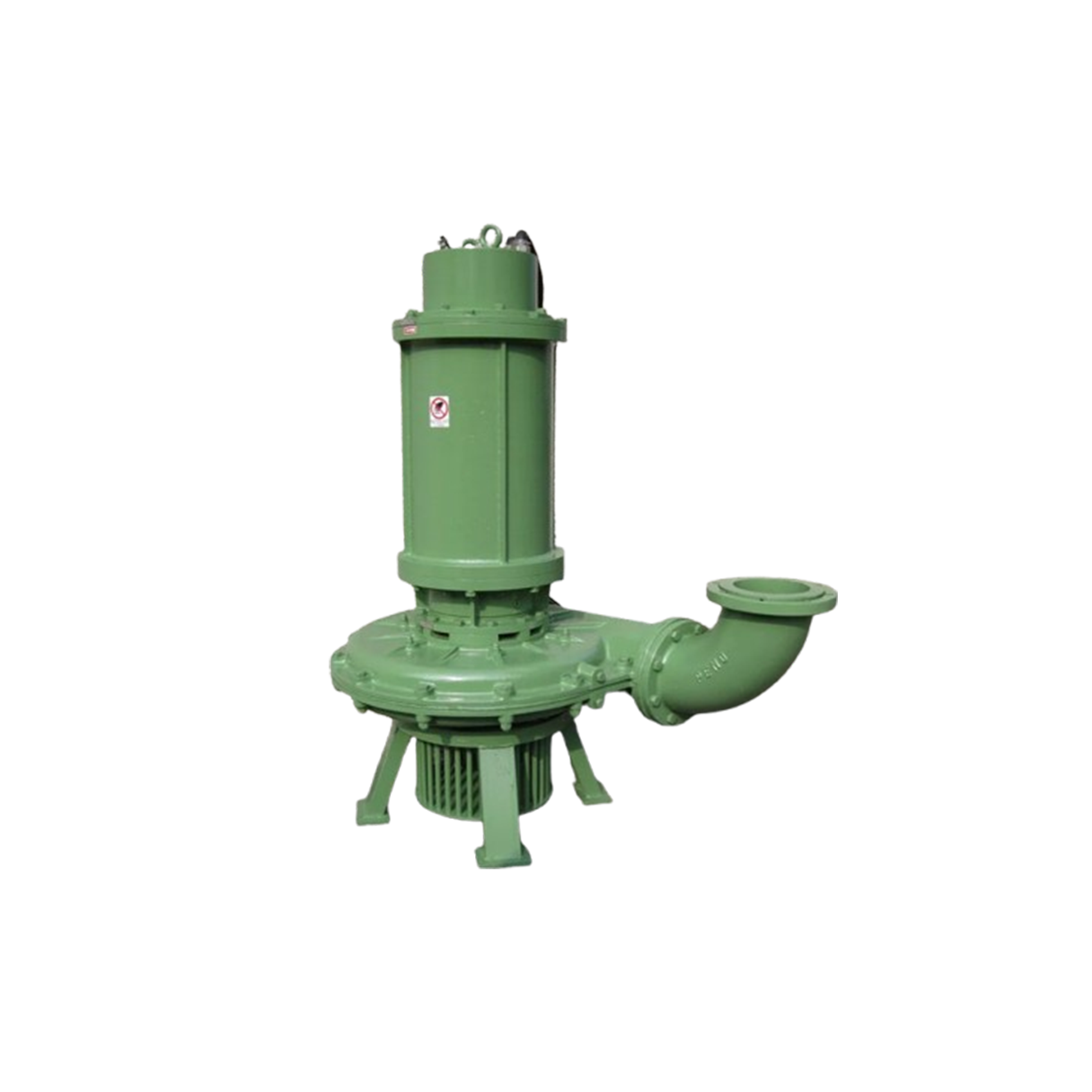
Pemo Pumps – submersible pump for abrasive and corrosive slurries (SUBMERSIBLE)
Submersible pump Pemo operates fully submerged in slurry. Flow rate up to 700 m³/h, pressure up to 7 bar, IE3 class motor with a power of 1.1 to 90 kW.
The pump is equipped with a double mechanical seal, a sensor system that detects sludge leakage into the motor, and an agitator to keep the solid phase in suspension.
Steiner Ukraine supplies Pemo Pumps equipment to Ukraine: media sizing, material selection, supply, service, spare parts.
What is a Pemo submersible pump?
This is a pump in which both the hydraulics and the motor are submerged in the liquid it is pumping. The motor is cooled by the slurry itself.
This principle provides three things that surface pumps do not have. First, the pump does not require space above the sump. Second, noise and vibration remain below the liquid level. Third, there is no suction line, and therefore no issue with inlet head.
The manufacturer designs these pumps for heavily abrasive and corrosive environments. The materials and construction are tailored precisely to this.
Other equipment from this manufacturer can be found on the page Pemo Pumps.
What are the technical parameters of the Pemo submersible pump?
| Parameter | Value |
|---|---|
| Maximum flow rate | 700 m³/h |
| Maximum pressure | 7 bar |
| Motor | three-phase asynchronous, efficiency class IE3 |
| Power | 1.1–90 kW |
| Revolutions | 735–3,500 rpm (50 and 60 Hz) |
| Working with a frequency converter | provided |
| Impeller | only half-open |
| Shaft | AISI 431 stainless steel |
| Gaskets | dual mechanical face, back-to-back, oil lubricated |
| Friction rings | silicon carbide or tungsten carbide |
| Bearings | radial-thrust, lubricated for the entire service life, maintenance-free |
| Body | Hardalloy or rubber lining |
| Engine cooling | pumped liquid |
| Engine protection | thermal |
Power ratings ranging from 1.1 to 90 kW mean that a single product line covers both small drainage sumps and process areas.
Working with a frequency converter makes it possible to bring the pump to its operating point without replacing the impeller.
How is the Pemo submersible pump protected against slurry leaking into the motor?
This is the main failure of a submersible pump: the seal leaks, slurry reaches the winding, and the motor burns out. The manufacturer builds a three-layer protection system.
| Protective layer | What does |
|---|---|
| Double mechanical seal counter-scheme | two friction pairs instead of one, with an oil chamber between them |
| Silicon carbide or tungsten rings | abrasion- and corrosion-resistant hard friction pairs |
| Two engine oil level sensors | they are recording the appearance of sludge in the oil chamber |
The logic is as follows. If the outer friction pair starts to leak, the sludge goes not into the engine, but into the oil chamber between the seals. The sensors detect this and trigger a signal.
So you will learn about seal wear before the engine fails, and you manage to plan the stop.
A standalone engine thermal sensor — a bimetallic switch, on request a PTC. It monitors the winding temperature.
Device for analysing signals from the thermal sensor and oil sensors be included in the pump supplyThat is, the monitoring system is not an optional extra that you have to buy.
Angular contact bearings, lubricated for life. There are no periodic lubrication points in the submerged section.
What is the purpose of an agitator on a submersible pump?
A typical sump problem: the solid phase settles to the bottom, and the pump pumps the clarified liquid while a layer of sediment grows beneath it. After a certain time, the sump has to be cleaned manually.
The agitator at the inlet eliminates this. The manufacturer offers two types.
| Type of agitator | Location | How it works |
|---|---|---|
| Mechanical | on the pump shaft, at the inlet | rotates with the wheel, stirs up settled sediment into suspension and cleans the suction filter |
| Hydraulic | at the pump outlet | bleeds off part of the discharge flow and directs it to the bottom, fluidising the sediment and cleaning the filter |
The mechanical agitator does not require piping, but works only directly beneath the pump. The hydraulic one requires a branch from the discharge, but provides a controlled jet and does not add load to the shaft.
Both also perform a second function — they prevent the suction filter from becoming clogged.
What does the flow path consist of?
| Node | Execution and purpose |
|---|---|
| Impeller | only semi-open — it allows larger solid inclusions to pass through and clogs less than a closed one |
| Body | Hardalloy or rubber lining; directs the flow from the impeller to the discharge |
| Intake filter | traps large particles and debris, protects the wheel |
| Shaft | AISI 431 is a martensitic stainless steel that combines corrosion resistance with high strength |
The choice between Hardalloy and rubber lining is determined not by the industry, but by the shape and hardness of the particles in your slurry. Read more about this on the page Pemo Pumps.
When is a submersible pump better than a vertical pump?
Both types are installed in the pit. The difference is where the motor is located.
| Criterion | Submersible | Vertical |
|---|---|---|
| Motor | liquid-immersed, liquid-cooled | above the base plate, in the dry zone |
| Pit depth | virtually not limited by the shaft length | up to 4–5 m beneath the slab |
| Space above the pit | not required | needed for the engine and frame |
| Noise and vibration | below the liquid level | at site level |
| Operation during level drop | unacceptable – engine is losing cooling | AUS series operates dry |
| Engine access | the pump needs to be raised | without lifting |
| Maximum flow rate | 700 m³/h | larger |
| Maximum pressure | 7 bar | 6–7 bar |
Selection rule. A deep pit, tight overhead, significant noise—this is a submersible. The level may drop, regular access to the drive is required, or the flow rate exceeds 700 m³/h—this is a vertical one.
What are the typical problems that arise during operation?
The manufacturer lists eight critical points. This is useful to know before ordering, as some of them are resolved at the selection stage.
| Issue | The cause and what makes it less likely |
|---|---|
| Cavitation | drop in pressure below the vapour pressure; resolved by the correct selection of the operating point |
| Abrasive wear | constant movement of solid particles; Hardalloy and rubber lining plus scheduled maintenance |
| Corrosion | chemical composition of the medium; material selection for a specific sludge |
| Clogging | particulate matter; suction filter and agitator |
| Overheating | insufficient lubrication; in submersible pumps, the immersion itself provides cooling |
| Mechanical seal failure | wear of the friction pair; double seal and oil sensors give a warning |
| Electrical faults | ingress of moisture, installation errors, voltage surges |
| Sediment accumulation in deep sumps | solved by a mixer and scheduled monitoring |
What industries is the Pemo submersible pump designed for?
| Industry | Task according to the manufacturer's description |
|---|---|
| Mining | mine dewatering, tailings pumping, mineral slurries, maintenance of water levels in mines |
| Dredging | sediment transport |
| Construction | site dewatering, bentonite slurries in tunnelling, waste management, concrete pumping |
| Sewage treatment | wastewater recirculation, sludge transfer, filter press feed |
| Energy sector | ash and slag slurries and other abrasive media |
| Chemical | corrosive and abrasive chemical slurries |
| Ceramic | slip pumping |
| Pulp and paper | cellulose pulp and fibrous suspensions |
What needs to be specified in a matching request
The manufacturer provides its own list of parameters used for selection.
| Data | What does it affect |
|---|---|
| Particle size and distribution | impeller type, filter |
| Slurry density | power rating and size |
| Viscosity | power and flow rate |
| Abrasiveness and corrosiveness | tangible performance |
| Flow rate, m³/h | standard size |
| Total dynamic pressure | taking into account the geometric head and losses |
| Immersion depth | pressure and cooling |
| Dimensions of the pit or sump | layout and configuration |
| I need the cable length | package contents |
These data determine six decisions: wheel type, materials, sealing system, presence and type of agitator, suction strainer, motor power.
Frequently asked questions about the Pemo submersible pump
What is the maximum flow rate?
700 m³/h
What is the maximum pressure?
7 bar.
What is the engine power?
From 1.1 to 90 kW, IE3 efficiency class, speed from 735 to 3500 rpm at 50 or 60 Hz.
Can a pump be controlled by a frequency inverter?
Yes, the manufacturer indicates that the motors are suitable for inverter operation.
How do you know when a seal has started leaking?
The pump has two oil level sensors that detect the ingress of sludge into the oil chamber between the seals. The signal evaluation unit is included in the supply.
Do bearings need to be lubricated periodically?
No. The angular contact ball bearings are sealed for life and maintenance-free.
What is the mixer for?
To prevent the solid phase from settling at the bottom of the sump and clogging the suction filter. A mechanical agitator on a shaft and a hydraulic one at the pump discharge are available.
Which impeller is used?
Only semi-open. It allows larger solid inclusions to pass through and is less prone to clogging than a closed one.
What steel is the shaft made of?
AISI 431 — martensitic stainless steel.
Can the pump be left without liquid?
No. The motor is cooled by the pumped medium. The vertical AUS series is designed for operation in the event of a possible drop in level.
What is included in the delivery set?
Besides the pump, there is a motor thermal sensor, two oil level sensors and a device for analysing their signals. The agitator is ordered separately.
Enquiry for selection and price via ContactsOther equipment from the manufacturer — Pemo PumpsConcurrent execution: horizontal, verticals, multi-stage. Sections: Industrial pumps, Pumps and systems, Spare parts.