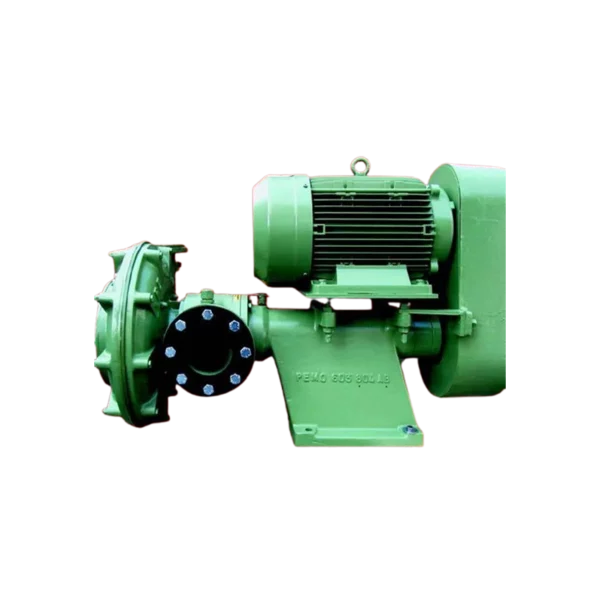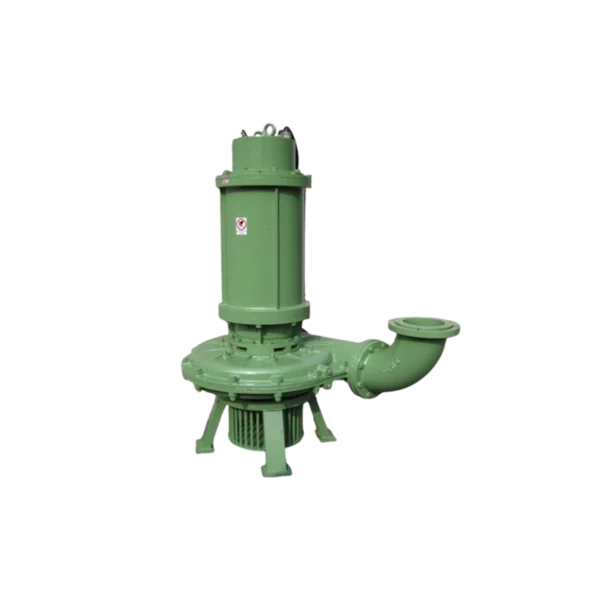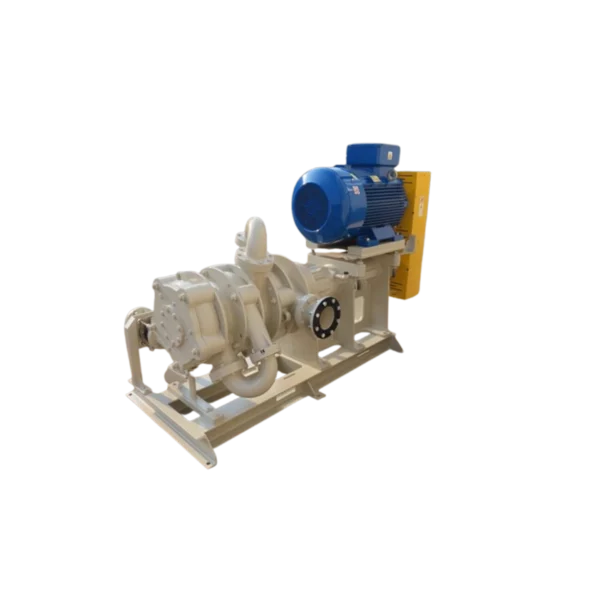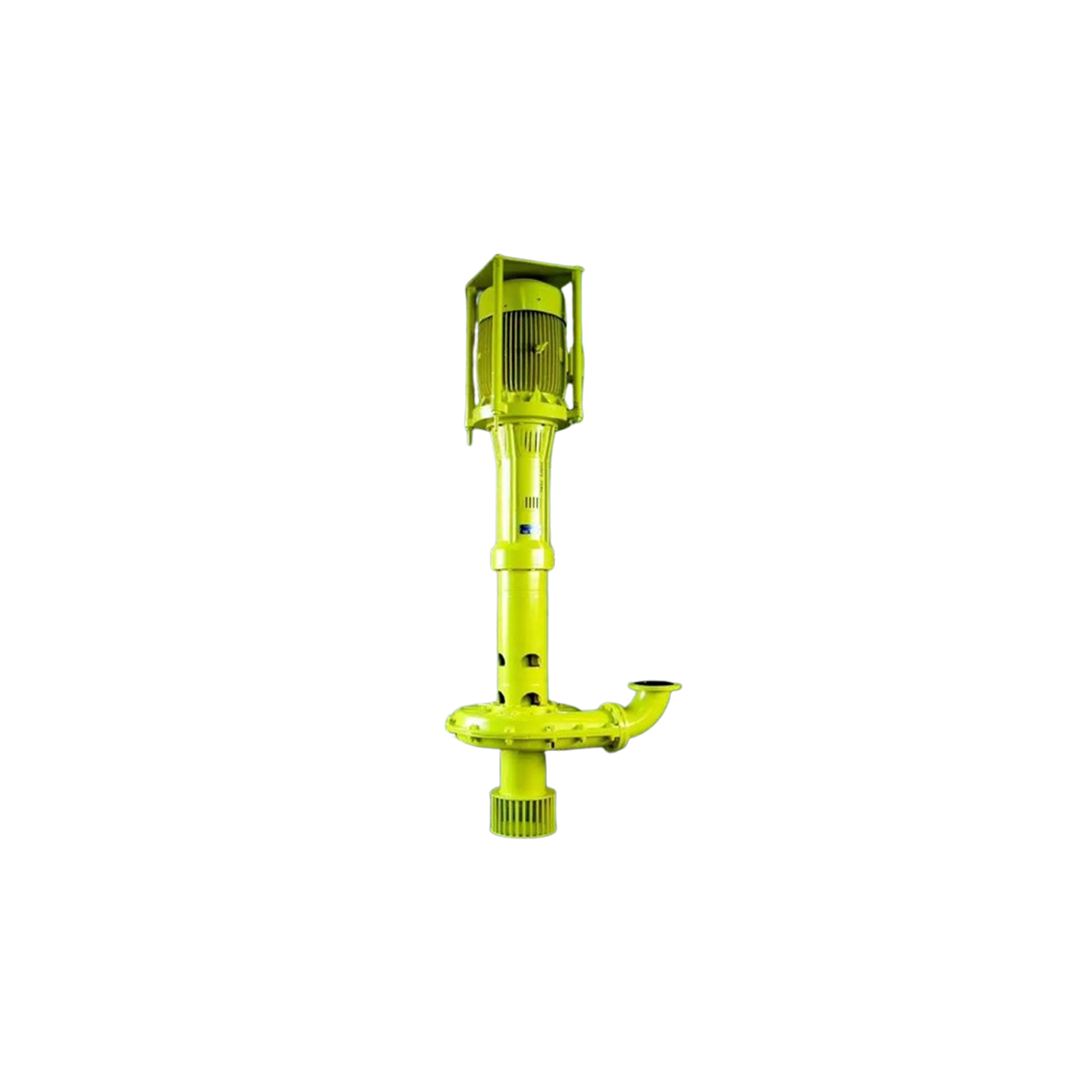
Pemo Pumps – vertical pump (VERTICAL)
Vertical Pemo pump designed for pumping abrasive, corrosive and thick slurries from sumps, pits and tanks. Only the casing and impeller are submerged. The bearings and motor remain above the liquid level.
The manufacturer has three vertical series: JOLLY, MEC and AUS. The flow rate starts from 5 m³/h, the maximum pressure is 6–7 bar, and the immersion depth below the baseplate is up to 4–5 metres.
Steiner Ukraine supplies Pemo Pumps equipment to Ukraine: media sizing, material selection, supply, service, spare parts.
What is a Pemo vertical pump?
This is a sump pump. It is lowered into the pit from above, through the baseplate, and pumps out what has settled at the bottom.
The constructive logic is simple: only what has to be there is immersed in the product. The impeller and casing are in the slurry. The bearings, seals and motor are above the plate, in the dry zone.
This gives two things. First, the bearings do not operate in abrasive material. Second, access to the service units does not require emptying the sump.
The manufacturer targets the series at heavy-duty applications: highly abrasive and acidic slurries.
Other equipment from this manufacturer can be found on the page Pemo Pumps.
Which three series of vertical pumps does the manufacturer have?
| The series | Drive | Length under the hob | Dry cleaning | Capacity | Pressure |
|---|---|---|---|---|---|
| JOLLY | flexible coupling or V-belt drive | up to 4–5 m | no | from 5 m³/h | 6–7 bar |
| MEC | always direct, via a flexible coupling | standard, no more than 2 m | no | from 5 m³/h | 6–7 bar |
| Australia | just like at JOLLY | usually no more than 2 m | yes | from 5 m³/h | 6–7 bar |
The difference between JOLLY and MEC lies in the drive and depth. JOLLY units are built to order, with lengths under the plate of up to 4–5 metres and a choice of drive. MEC has standard lengths of up to 2 metres, always features a direct drive via an elastic coupling, and includes a metal frame around the motor with an eyebolt for lifting.
Rim-ring is a component that matters in operation: the pump is lifted from the sump by a crane using the standard lifting point rather than the motor.
Which series can operate dry?
Only AustraliaThe reason is structural: it does not have a mechanical seal system.
In the JOLLY and MEC series, the seal consists of a sleeve and a bushing. This assembly is lubricated by the fluid being pumped. When the fluid level falls below a certain mark, the lubrication is lost and the assembly fails.
| The series | Gaskets | Consequence |
|---|---|---|
| JOLLY, MEC | bush and bush | you cannot work below a certain level |
| Australia | missing | you can work dry |
Rule of thumb: if the level in the sump is not monitored or the pump could run dry, it is an AUS. If a depth of more than 2 metres below the slab is required, it is a JOLLY, and level control is then needed.
AUS has two further differences. The fluid inlet is usually above the casings, but in certain designs it can be near the bottom — in which case a double-suction impeller is fitted. And AUS can be mounted both inside and outside the tank.
What are the components of a Pemo vertical pump?
| Node | Function |
|---|---|
| Motor | located above the base plate; connected by a flexible coupling or V-belts |
| Tubing string | holds the shaft in place and transmits rotation from the motor to the impeller |
| Impeller | semi-open; passes larger solid inclusions and clogs less than a closed one |
| Body | directs flow from the impeller to the discharge; Hardalloy or rubber lining |
| Intake filter | traps large particles and debris at the inlet, protecting the wheel from damage |
In the JOLLY series, the shaft is supported by two bearings located in the base above the base plate. In other words, there are no supports at all within the product area.
Semi-open impeller: the anti-clogging choice. The closed impeller gives higher efficiency, but a narrower passage. In sump slurry, the priority is different.
What are the technical specifications of the Pemo vertical pump?
| Parameter | Value |
|---|---|
| Minimum order | 5 m³/h |
| Maximum flow rate | 1500 or 2000 m³/h depending on the source (see note) |
| Maximum pressure | 6–7 bar |
| Maximum depth under the slab | 4–5 m (JOLLY); up to 2 m (MEC, AUS) |
| Impeller type | semi-open |
| Body material | Hardalloy or rubber lining |
| Drive | flexible coupling or V-belt drive |
| Dry cleaning | AUS series only |
What materials protect the pump from abrasives?
For vertical pumps, the manufacturer specifies two casing design options.
| Implementation | Where is it used |
|---|---|
| Hardalloy PEMO | strong abrasive, hard sharp particles |
| Rubber lining | abrasive without sharp edges, moderate temperatures |
Hardalloy PEMO — the manufacturer's proprietary wear-resistant alloy with a hardness of 750–800 Brinell. Standard grey cast iron has about 200 HB. The difference in hardness directly determines how many hours the wheel will operate in slurry.
Rubber lining works on a different principle: the resilient surface absorbs the impact of a particle instead of resisting it with hardness. For rounded particles, rubber lasts longer than metal, while for sharp ones, the opposite is true.
The choice between them is determined not by the industry, but by the shape and hardness of the particles in your slurry. This is the main thing that needs to be ascertained before selection.
For which industries is the Pemo vertical pump designed?
| Industry | Task according to the manufacturer's description |
|---|---|
| Mining | dewatering, tailings pumping, by-product management |
| Quarries and non-metallic materials | dewatering, slurry transport, tailings management, hydrocyclone feed, sump pumping, material washing |
| Construction | jet grouting, dewatering, waste management, concrete pumping |
| Sewage treatment | effluent recirculation, sludge pumping |
| Energy sector | ash and slag slurries and other abrasive media |
| Chemical | corrosive and abrasive slurries |
| Ceramic | slip pumping |
| Pulp and paper | cellulose pulp and fibrous suspensions |
A common feature is that the pump is positioned above a sump or reservoir into which the medium containing the solid phase flows by gravity.
Frequently asked questions about the Pemo vertical pump
How many vertical ranges does the manufacturer have?
Three: JOLLY, MEC and AUS. On the English-language version of the manufacturer's website, only two are described – JOLLY and AUS; the MEC series is described on the Italian-language version.
What is the minimum order?
5 m³/h
What is the maximum pressure?
6–7 bar across all three series.
How deep can the pump be lowered?
In the JOLLY series, the length under the base plate reaches 4–5 metres. In the MEC and AUS series, it generally does not exceed 2 metres.
Which pump can withstand dry running?
Only the AUS — it does not have a mechanical seal system. JOLLY and MEC use a sleeve and gland, which are lubricated by the liquid, so they cannot operate below a certain level.
Does the motor submerge in the liquid?
No. The motor and bearings are located above the baseplate. Only the casing and impeller are submerged. For a fully submerged version, there is submersible pumps.
Which impeller is used?
Semi-open. It passes larger solid inclusions and is less prone to clogging than a closed one.
What is Hardalloy?
Manufacturer's proprietary wear-resistant alloy with a hardness of 750–800 HB. An alternative is rubber casing lining.
Can the pump be installed outside the tank?
The manufacturer permits the installation of the AUS series both inside and outside the tank.
Why is a vertical pump better than a submersible pump in a sump?
The motor does not come into contact with the medium and is independent of the cooling liquid level. Servicing the drive does not require lifting the pump from the sump.
Enquiry for selection and price via ContactsOther equipment from the manufacturer — Pemo PumpsConcurrent execution: horizontal, submersible, multi-stage. Sections: Industrial pumps, Pumps and systems, Spare parts.