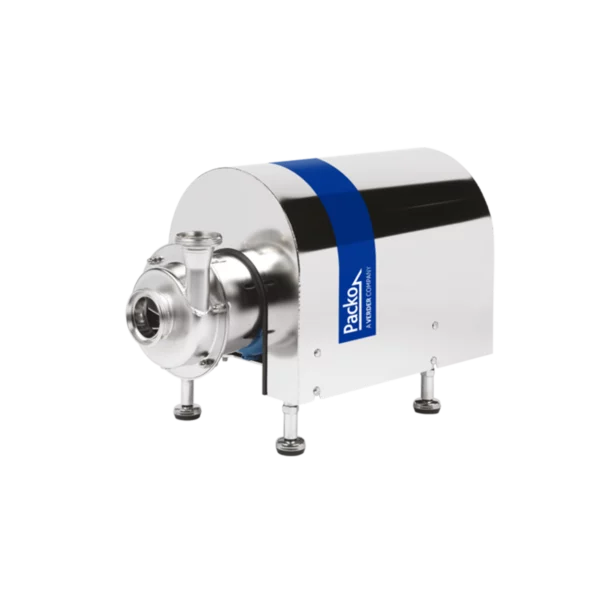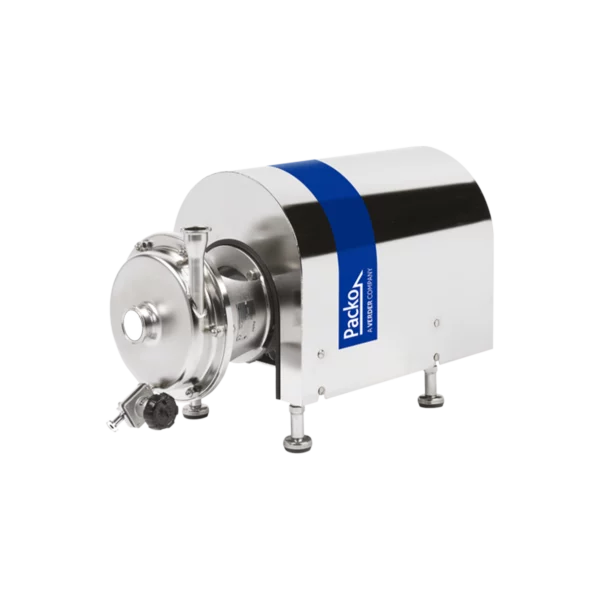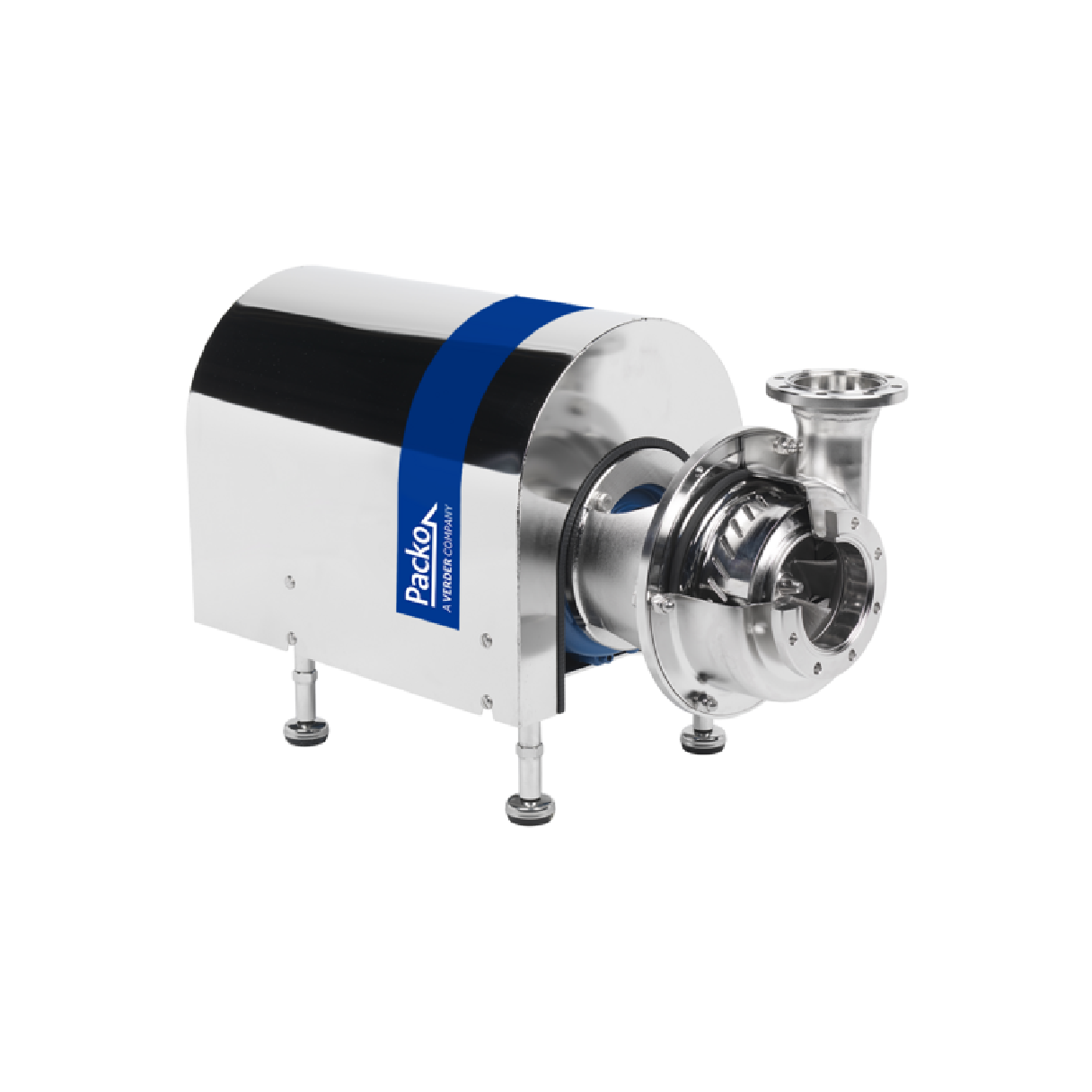
Packo Mixing Technologies — high-shear mixers, colloidal mill and powder mixer
Packo Mixing Technologies — a range of controlled-shear mixing equipment. It comprises four machines: the SFP2 and SFP3 high-shear in-line mixers, the CM colloid mill and the PM powder mixer.
All four pump and process liquid simultaneously. The purpose of the line is to dissolve the powder, break down microparticles, and obtain a stable emulsion or suspension.
Steiner Ukraine supplies Packo equipment in Ukraine: process-specific selection, delivery, service, and spare parts.
What is Packo Mixing Technologies?
The manufacturer describes the line as a mixing technology that applies controlled shear forces. The three stated results are efficient liquid mixing, enhanced powder dissolution, and microparticle disruption.
A key feature is self-priming. The machine does not require a separate supply pump because it creates the flow itself. This removes one unit from the line along with its power consumption and maintenance.
Industries by manufacturer description: food, pharmaceutical, cosmetic, dairy, beverage production, personal care products.
Other equipment from this manufacturer can be found on the page Verder – Packo.
Which four cars are in the range?
| Car | Purpose | Max delivery | Pressure | Max offset | Viscosity | Temperature |
|---|---|---|---|---|---|---|
| SFP2 | high-shear in-line mixer, open impeller | 80 m³/h | 45 m WG | 100,000 s⁻¹ | 1000 cP | 140 °C |
| SFP3 | high-shear in-line mixer, closed impeller | 200 m³/h | 55 mWG | 60,000 s⁻¹ | 1000 cP | 140 °C |
| CM | colloid mill | 15 m³/h | 35 m wg | won't publish | 100,000 cP with a feed pump | 140 °C |
| PM | powder mixer | 50 m³/h | 45 m WG | 100,000 s⁻¹ | 1000 cP | 140 °C |
The maximum pressure in all four is 10 bar. In SFP2, CM and PM this is the inlet pressure, and in SFP3 it is the discharge pressure.
Drive power: SFP2 — 22 kW at 3600 rpm, CM — up to 45 kW. For SFP3 and PM the manufacturer does not publish the power.
What is shear rate and why is it measured in s⁻¹?
Shear is the difference in velocity between adjacent layers of fluid. Shear rate shows how sharply this difference increases per unit of distance. The unit s⁻¹ is reciprocal seconds because it is a velocity gradient: metres per second per metre.
In the SFP2, a shear effect is generated between the rotor and the perforated stator according to the manufacturer's patent. A droplet or agglomerate, passing through the stator holes, enters a zone of abrupt velocity gradient and is broken up.
The practical significance of the number is this. 100,000 s⁻¹ breaks down the fat phase in the emulsion to a state where it does not separate during storage. 60,000 s⁻¹ is sufficient for dissolution and homogenisation, but provides a lower fineness of dispersion.
So a higher offset is not "better overall", but a finer dispersion for the same pass.
How does SFP2 differ from SFP3?
The difference in the impeller type, and everything else follows from that.
| Parameter | SFP2 | SFP3 |
|---|---|---|
| Impeller | open | closed |
| Maximum flow rate | 80 m³/h | 200 m³/h |
| Pressure | 45 m WG | 55 mWG |
| Maximum displacement | 100,000 s⁻¹ | 60,000 s⁻¹ |
| Pressure 10 bar | at the input | on the delivery side |
| Drive power | 22 kW at 3600 rpm | won't publish |
The pattern is simple: SFP3 provides a 2.5 times higher feed rate, but a 40 % lower shear rate. SFP2 offers finer processing for a smaller flow, while SFP3 delivers a larger flow with more moderate processing.
Both are in-line machines. They are integrated into the pipeline rather than installed above a vessel.
What does the PM powder mixer do?
The PM is designed for dissolving and blending powders: thickeners, emulsifiers, and stabilisers.
At the heart of the machine is the SFP2 high-shear pump. It is precisely its self-priming capability that eliminates the need for a separate feed pump in the unit.
| Parameter | Value |
|---|---|
| Maximum flow rate | 50 m³/h |
| Pressure | 45 m WG |
| Maximum displacement | 100,000 s⁻¹ |
| Powder output | up to 3.5 t/h |
| Maximum temperature | 140 °C |
| Implementation | modular design, three versions |
Hygienic frame design: minimum horizontal surfaces and complete drainage. This means that no puddles or spilled powder remain on the frame after washing.
Industries according to the manufacturer's description: dairy, beverages, food, personal care products.
What is the CM colloid mill used for?
CM is the only machine in the range designed for truly viscous products: up to 100,000 cP with a feed pump. The other three are limited to 1,000 cP, which is a hundred times lower.
| Parameter | Value |
|---|---|
| Maximum flow rate | 15 m³/h |
| Pressure | 35 m wg |
| Maximum viscosity | 100,000 cP with a feed pump |
| Maximum drive power | 45 kW |
| Maximum temperature | 140 °C |
The ratio of 45 kW to 15 m³/h indicates the purpose of the machine. This is not pumping equipment: almost all the power goes into grinding, not moving.
A colloid mill is used where fine dispersion is required in a viscous medium – pastes, creams, thick emulsions.
What are the materials and hygienic design?
The data are provided by the manufacturer for SFP2.
| Position | Value |
|---|---|
| Details regarding the product | 316L stainless steel or equivalent |
| Mechanical seal | single, quenched, double |
| Sealing rings | EPDM, FKM, FEP-FKM, FFKM or equivalent |
| Accession | hygienic fittings |
| Surface treatment | hand-polished and electropolished internal welds |
| Roughness of wetted surfaces | 0.8 µm |
| Impeller roughness | 3.2 µm |
| Compliance documents | EC 1935/2004, FDA, USP, ATEX |
FEP-FKM — is a fluororubber ring encased in an FEP sheath. The sheath contacts the product and provides chemical resistance close to PTFE, while the core retains its elasticity.
The quench seal supplies liquid from the atmospheric side. It is not a dual seal: it washes crystals away from the friction faces, but does not isolate the product.
For what tasks are Packo Mixing Technologies chosen?
| Task | Car |
|---|---|
| Dissolve the powder, thickener or stabiliser | PM |
| In-line flow homogenisation up to 80 m³/h | SFP2 |
| The same for a flow rate of up to 200 m³/h | SFP3 |
| Disperse a solid in a liquid | SFP2 or SFP3 |
| Disperse a gas in a liquid | SFP2 or SFP3 |
| Mix liquids of varying viscosity and density | SFP2 or SFP3 |
| Fine dispersion in a viscous medium up to 100,000 cP | CM |
For selection, the following are required: product, required feed rate, viscosity at operating temperature, desired processing result, and the presence of a powder phase.
If the task is simply to move a product without processing, this range is redundant. For pumping, lobe series are suitable. ZL and ZLC or Packo hygienic centrifugal pumps.
Frequently asked questions about Packo Mixing Technologies
How many cars are in the range?
Four: SFP2, SFP3, CM colloidal mill and PM powder mixer.
What is the maximum flow rate?
200 m³/h at SFP3. This is the upper limit of the range.
What is the maximum pressure?
10 bar in all four machines. In SFP2, CM and PM it is the inlet pressure, in SFP3 it is the discharge pressure.
What is the maximum shear rate?
100,000 s⁻¹ in SFP2 and PM. In SFP3, it is 60,000 s⁻¹. For CM, the manufacturer does not publish the value.
How much powder does the PM process?
Up to 3.5 tonnes per hour.
Is a separate feed pump required?
No. The machines are self-priming. The exception is the CM: the maximum viscosity of 100,000 cP is specified by the manufacturer precisely when a feed pump is present.
What is the maximum temperature?
140 °C in all four.
What is the surface roughness?
According to the manufacturer for SFP2: 0.8 µm for wetted surfaces and 3.2 µm for the impeller, with manual weld polishing and electropolishing.
Is there an ATEX version available?
For SFP2, the manufacturer declares ATEX compliance. For the remaining three machines, the list of certificates is not published separately.
Enquiry for selection and price via ContactsOther equipment from the manufacturer — Verder – PackoRelated sections: Pumps for food production, Processing equipment, Industrial pumps, Spare parts.
Manufacturer: Packo
Category: Centrifugal (hygienic)
Industries: Food, Beverages, Pet food, Other
Model range: 3 positions