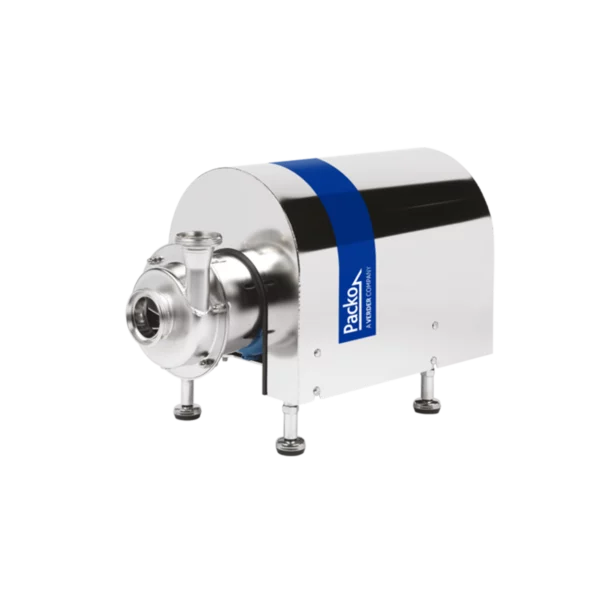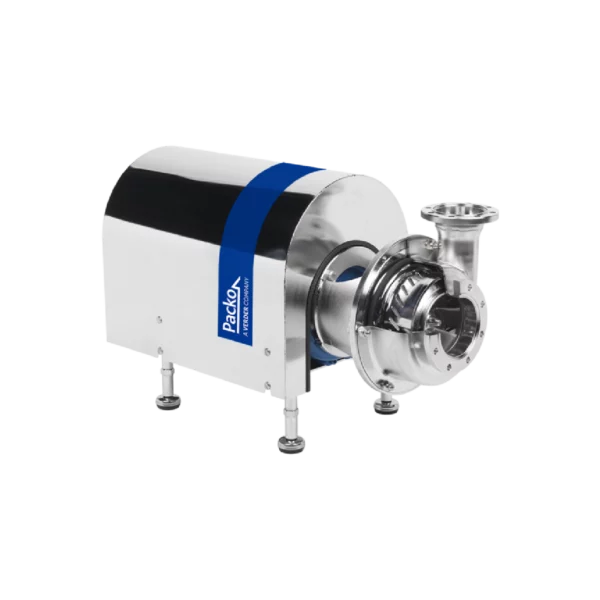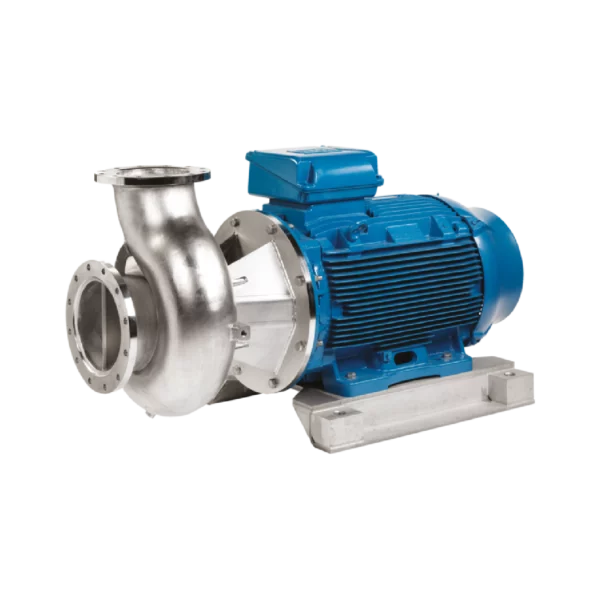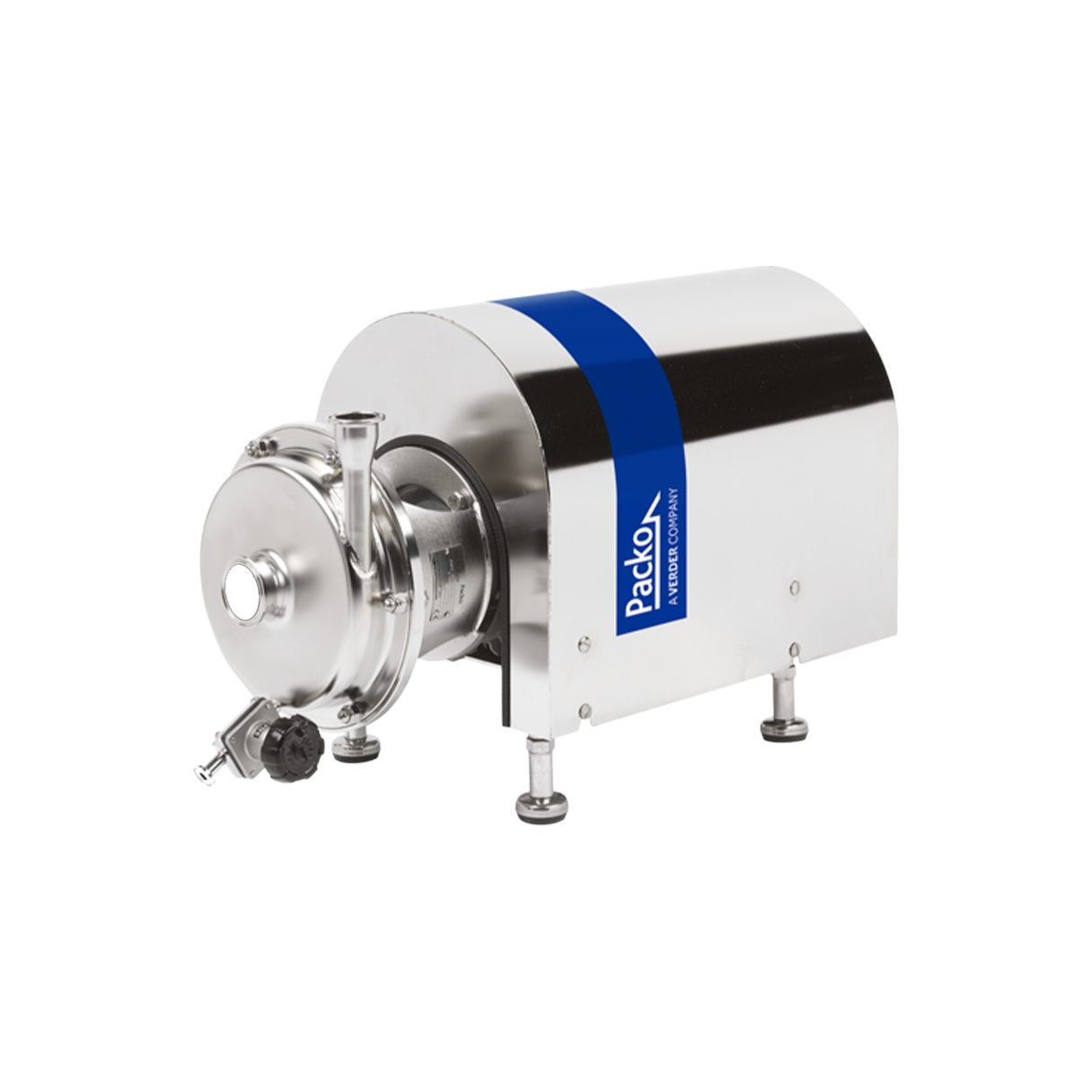
Packo – PHP2 and PRP2 series centrifugal hygienic pump for sterile processes (Pharmaceutical)
Packo pharmaceutical pump — these are two centrifugal series for sterile applications: PHP2 and PRP2. The manufacturer addresses them to the pharmaceutical, biotechnological and semiconductor industries.
The wetted surfaces are finished by mechanical polishing and electropolishing to a roughness of less than 0.4 µm and come with a full package of certificates.
Steiner Ukraine supplies Packo equipment in Ukraine: process-specific selection, delivery, service, and spare parts.
What is a Packo pharmaceutical pump?
These are open impeller centrifugal pumps, designed to meet the requirements of sterile processes.
The casings are made of thick cold-rolled 316L stainless steel sheet. The manufacturer describes this material as one hundred per cent non-porous and extremely smooth. The impellers are fully machined from 1.4435 steel.
The construction has no crevices, and the finish is electropolishing. Together, this provides a surface from which the product and cleaning solution are completely wiped off.
Other equipment from this manufacturer can be found on the page Verder – Packo.
Which two models are in the series?
| The model | Manufacturer designation | Max delivery | Pressure | Viscosity |
|---|---|---|---|---|
| PHP2 | 3-A certified process pharmaceutical pumps | 110 m³/h | 110 m head of water | up to 1000 cP |
| PRP2 | air-liquid mixture transfer pumps | 80 m³/h | 75 m water head | up to 10 cP |
Common to both parameters: maximum inlet pressure 13 bar, temperature up to 140 °C, open impeller, free passage up to 22 mm, speed 3000 or 3600 rpm at 50 or 60 Hz.
How does PRP2 differ from PHP2?
The difference is not in the size, but in what the pump is pumping.
PHP2 — a classical process pump. The manufacturer designates it for media: pure water, water for injection (WFI), CIP solutions, syrups. Typical tasks include pure water circulation loops and cleaning systems.
PRP2 — pump for liquid-air mixtures. The manufacturer explicitly states: "primarily used for pumping liquid-air mixtures." Hence the viscosity limit of 10 cP: this is not a pump for thick products, it is a pump for flow with a gas phase.
| Parameter | PHP2 | PRP2 |
|---|---|---|
| Max delivery | 110 m³/h | 80 m³/h |
| Pressure | 110 m head of water | 75 m water head |
| Viscosity | up to 1000 cP | up to 10 cP |
| Max drive power | 45 kW | 22 kW |
| What does it pump | purified water, WFI, CIP solutions, syrups | liquid-air mixture |
Rule of thumb: there is trapped air or foam in the line — that is PRP2. A standard sterile circuit with a viscosity of up to 1000 cP is PHP2.
What are the technical parameters of the Packo pharmaceutical pump?
| Parameter | PHP2 | PRP2 |
|---|---|---|
| Type | centrifugal, open impeller | centrifugal, open impeller |
| Maximum flow rate | 110 m³/h | 80 m³/h |
| Differential head | 110 m head of water | 75 m water head |
| Maximum inlet pressure | 13 bar | 13 bar |
| Maximum viscosity | 1000 cP | 10 cP |
| Maximum temperature | 140 °C | 140 °C |
| Maximum free passage | 22 mm | 22 mm |
| Maximum drive power | 45 kW | 22 kW |
| Revolutions | 3000 / 3600 rpm | 3000 / 3600 rpm |
| Frequency | 50 / 60 Hz | 50 / 60 Hz |
| Accession | sterile | sterile |
A free passage of 22 mm is the maximum particle size that passes through the pump without jamming. For a centrifugal pump with an open impeller, this is a wide passage.
What materials is the pump made from?
Materials are distributed according to component function, and the distribution is the same for both models.
| Node | Material |
|---|---|
| Body and backplate | 316L stainless steel |
| Impeller | 1.4435 |
| Metal sealing parts and wheel bolt | duplex 1.4462 |
| Sealing rings | EPDM, FKM, FEP-FKM, FFKM, silicone |
| Mechanical seal | single, quenched, double |
1.4435 it is a low-carbon version of 316L with a higher molybdenum and nickel content. In pharmaceuticals, it is used where the validation protocol dictates the material composition.
Duplex 1.4462 in the seal components and the impeller screw is higher strength within the same dimensions. These parts bear the greatest mechanical load.
FEP-FKM — FEP-encapsulated fluoroelastomer O-ring. The sheath contacts the product and provides chemical resistance close to that of PTFE, while the core retains resilience.
The quench seal supplies fluid from the atmospheric side. It washes crystals from the friction face, but does not isolate the product — double is required for isolation.
What does Ra < 0.4 µm and full certification mean?
Ra is the arithmetic mean deviation of the surface profile. Values below 0.4 µm are the level considered in pharmaceuticals to be suitable for sterile processes.
The logic is simple. On a surface with high roughness, product residues are held in the micro-irregularities and are not washed away by the flow. A biofilm forms there. Reducing the roughness means removing the places where it can take hold.
The manufacturer achieves the value through two operations: first mechanical polishing, then electropolishing. Electropolishing is the electrochemical removal of a micro-layer of metal; following it, the surface is also passivated.
Fully certified means a specific package of documents: EN 10204 3.1 material certificates, roughness measurement reports and pump performance test reports. For equipment qualification at a pharmaceutical facility, these documents are required by name.
What compliance documents does the Packo pharmaceutical pump have?
| Document | What confirms |
|---|---|
| 3-A | US sanitary standard for processing equipment |
| EHEDG | European assessment of clean-in-place suitability |
| FDA | material suitability for food contact |
| USP Class VI | biocompatibility of polymeric materials according to the United States Pharmacopeia |
| EC 1935/2004 | European regulation on food contact materials |
| ATEX | explosion-proof design |
| EAC | compliance with the technical regulations of the Customs Union |
| EN 10204 3.1 | material certificates with test report |
| ASME BPE | compliance with the guidelines of the standard for biopharmaceutical equipment |
Roughness measurement reports and pump performance test reports are supplied additionally.
USP Class VI is the highest of the six classes of biological reactivity of the United States Pharmacopeia.
What environments are these pumps designed for?
The manufacturer specifies four environments for the PHP2.
| Environment | Where is it used |
|---|---|
| Clean water | circulation loops |
| WFI (water for injections) | pharmaceutical manufacturing |
| CIP solutions | cleaning systems |
| Syrups | pharmaceutical and food liquid forms |
Typical PHP2 tasks - clean water circulation loops and cleaning applications.
For PRP2, the manufacturer specifies one category: liquid-air mixture.
Industries for both series: pharmaceutical, biotechnological, semiconductor.
Frequently asked questions about the Packo pharmaceutical pump
How many models are in the series?
Two: PHP2 and PRP2.
What is the maximum flow rate?
PHP2 — 110 m³/h. PRP2 — 80 m³/h.
What is the maximum head?
PHP2 — 110 m head PRP2 — 75 m head
What is the maximum pressure?
13 bar at the inlet in both models.
What is the surface roughness?
Less than 0.4 µm for wettable surfaces, mechanical polishing plus electropolishing, with a measurement protocol.
Are there 3-A and EHEDG certificates?
Yes, both. Along with FDA, USP Class VI, EC 1935/2004, ATEX, EAC and EN 10204 3.1.
Does the pump comply with ASME BPE?
The manufacturer declares compliance with ASME BPE guidelines.
Can WFI be transferred?
Right, water for injections has been named by the manufacturer among the PHP2 media.
What should I do if there is air in the flow?
The PRP2 model is designed for liquid-air mixtures. Its limitation is a viscosity of up to 10 cP.
What is the maximum temperature?
140 °C in both models.
Enquiry for selection and price via ContactsOther equipment from the manufacturer — Verder – PackoPharmaceutical-grade lobe pump — ZLCRelated sections: Pumps for food production, Industrial pumps, Spare parts.
Manufacturer: Packo
Category: Centrifugal (hygienic)
Industries: Pharmaceutical, Other
Model range: 2 positions