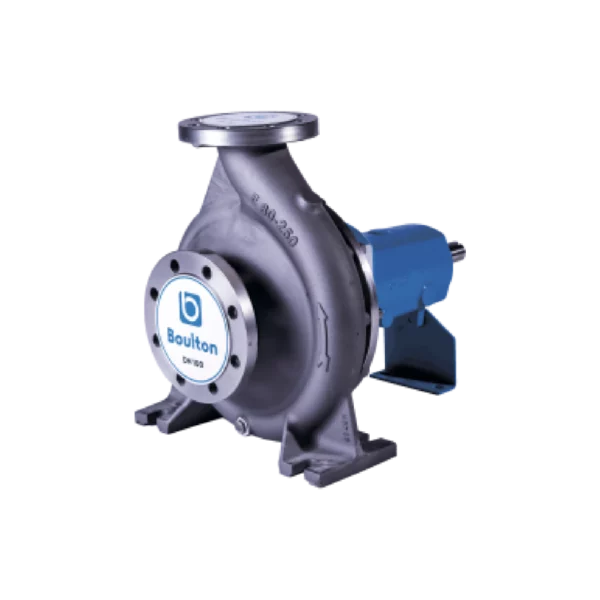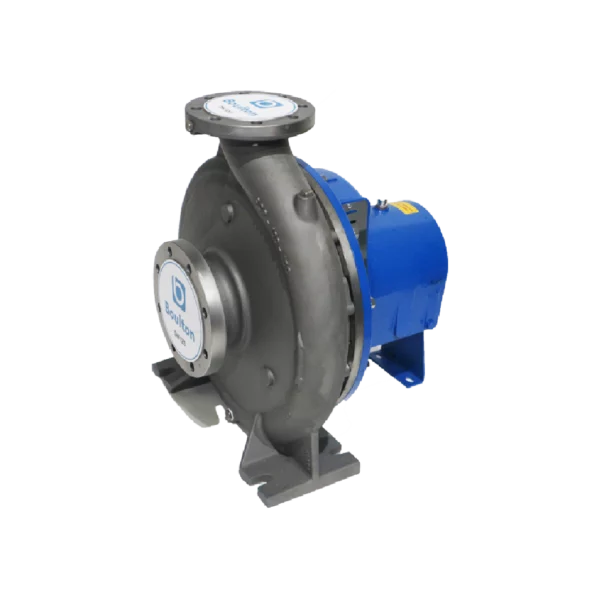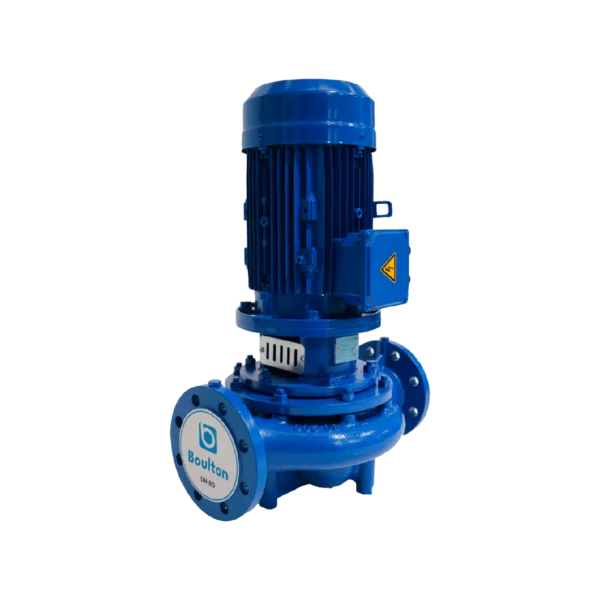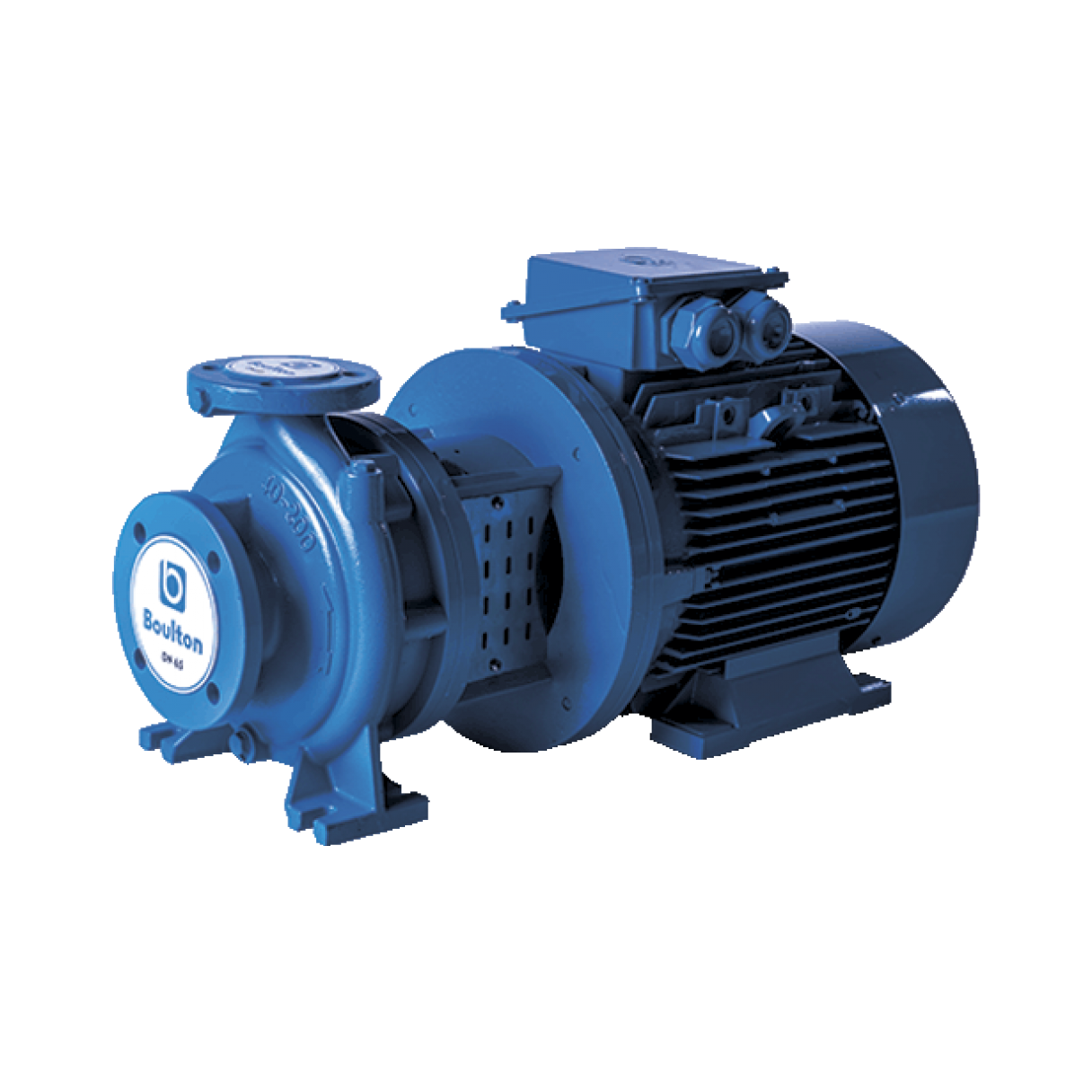
Boulton pumps – ESM close-coupled centrifugal pump to EN 733
The Boulton ESM pump is a single-stage close-coupled centrifugal pump manufactured to the DIN 24255 standard, also known as EN 733. The manufacturer is Boulton Pumps, Polígono Industrial de Santelices 7, 48550 Muskiz, Vizcaya Province, Spain.
The series is designed for clean or moderately polluted low-viscosity liquids. Capacity is up to 1750 m³/h, head is up to 105 m, and DN standard sizes range from 32 to 150. The medium temperature ranges from −10 to +140 °C. Casing pressure is 10 bar, with a 16 bar version available. The rotational speed is up to 3600 rpm.
Boulton ESM pump: technical specifications
| Parameter | Value |
|---|---|
| Type | single-stage centrifugal, close-coupled |
| Standard | DIN 24255 (EN 733) |
| Flow rate, max. | 1,750 m³/h |
| Pressure, max. | 105 metres |
| Standard sizes | DN 32–150 |
| Medium temperature | from −10 to +140 °C |
| Casing pressure | 10 bar, 16 bar version |
| Rotational speed | up to 3600 rpm |
| Revolutions, 50 Hz | 1,450 or 2,900 rpm |
| Revolutions, 60 Hz | 1,750 or 3,500 rpm |
| Engine power | from 0.22 to 90 kW |
| Engine dimensions | from 71M to 280M |
| Connection to the motor | rigid, monobloc |
| Impeller | closed, open, vortex or duct-type |
| Materials | cast iron, steel, bronze, stainless steel, Hastelloy, other alloys |
| Workmanship | made entirely or partly from cast iron, AISI 316, DUPLEX, SUPERDUPLEX |
| Shaft seal | end-face, various types, in accordance with API specifications |
| Flanges | DIN 2632 / PN 10 or DIN 2633 / PN 16 |
A water head of 105 m corresponds to approximately 10.3 bar, which is consistent with a casing pressure of 10 bar. For higher heads, a 16-bar version is used.
What monoblock execution provides
In a monoblock pump, the impeller is mounted directly on the extended shaft of the electric motor. There is no intermediate shaft, coupling, bearing housing or support frame.
First consequence: a shorter unit and a smaller footprint. This matters in pump rooms where floor space is at a premium.
Second consequence: alignment is not carried out during installation. In a pump with a coupling, misalignment of the motor shaft and pump shaft is a typical cause of premature bearing and seal wear. Here, this is eliminated by design.
Consequence three: fewer maintenance points. There is no coupling or flexible components, and the pump has no bearings of its own.
Fourth consequence: replacing the engine simultaneously means replacing the bearing assembly, because it is a single part.
There are also limitations. The maximum standard size for a close-coupled pump is DN 150, whereas in the separate-motor design the same manufacturer goes up to DN 250. This is a direct consequence of the motor shaft bearing the hydraulic load of the impeller.
The pump is manufactured in accordance with the EN 733 standard, so its connection and overall dimensions are the same as those of pumps from other manufacturers that comply with the same standard. What does this mean when replacing it — on the Boulton Pumps page.
Standard sizes from 32–125 to 150–400
The designation indicates the diameter of the discharge pipe and the nominal diameter of the impeller.
| DN | Standard sizes |
|---|---|
| 32 | 32-125, 32-160, 32-200, 32-250 |
| 40 | 40-125, 40-160, 40-200, 40-250, 40-315 |
| 50 | 50-125, 50-160, 50-200, 50-250, 50-315 |
| 65 | 65-125, 65-160, 65-200, 65-250, 65-315, 65-400 |
| 80 | 80-160, 80-200, 80-250, 80-315, 80-400 |
| 100 | 100-160, 100-200, 100-250, 100-315, 100-400 |
| 125 | 125-200, 125-250, 125-315, 125-400 |
| 150 | 150-200, 150-250, 150-315, 150-400 |
Each frame size is available in two speed options. The fine pitch of the range allows the duty point to be selected close to the optimum of the curve, without an excessive safety margin on capacity.
Impeller, materials and seals
The manufacturer offers four impeller designs: closed, open, vortex, and channel. The closed one provides the highest efficiency on clean liquids. The open one allows small inclusions to pass through. The vortex and channel designs are intended for media with large or fibrous particles. The impeller type changes the pump curve, so it is determined at the selection stage along with the model size.
The body is manufactured from cast iron, steel, bronze, stainless steel, Hastelloy alloy or another metal alloy. Construction can be full or partial: a cast iron body with wetted parts made of AISI 316, DUPLEX or SUPERDUPLEX. Partial construction reduces cost where expensive material is not required everywhere.
Mechanical shaft seals of various types, manufactured in accordance with API piping plans. API plans define the flushing, cooling and drainage scheme for the seal and determine its service life in hot and aggressive media.
Flanges — DIN 2632 at PN 10 or DIN 2633 at PN 16.
Boulton ESM or ESN pump: which to choose
Both series are manufactured to the same standard, DIN 24255 (EN 733), and have the same hydraulic ratings. The difference lies in their design.
| Parameter | ESM | ESN / ESH |
|---|---|---|
| Layout | monoblock, wheel on the motor shaft | separate motor via a coupling |
| Standard sizes | DN 32–150 | DN 32–250 |
| Flow rate, max. | 1,750 m³/h | 1,750 m³/h |
| Pressure, max. | 105 metres | 105 metres |
| Engine power | 0.22–90 kW | as per the specification |
| Alignment during installation | not required | needed |
Rule of thumb. Up to DN 150 and where compactness and ease of installation are important, ESM is chosen. Above DN 150, as well as where the motor needs to be replaced separately from the pump or a non-standard drive is to be fitted, ESN / ESH are chosen.
Another two series from the manufacturer to the same standard and in accordance with the process standards: IL — vertical in-line for pipeline mounting, ESK — in accordance with ISO 5199 and ASME B73.1.
For which environments is the series designed?
The manufacturer specifies this series for clean or moderately contaminated, low-viscosity fluids.
Stated applications: general water supply for air conditioning, industry, irrigation and other services for clean or slightly contaminated liquids.
The temperature range from −10 to +140 °C covers cooling media, process water and hot circuits. Versions made from AISI 316, DUPLEX and SUPERDUPLEX extend the range of applications to corrosive media, whilst the vortex and channel impellers extend it to liquids containing solids.
How to choose a Boulton ESM pump at Steiner Ukraine
Six pieces of information are required for selection: flow rate in m³/h, required head in metres, the name or composition of the fluid, its temperature, the presence and size of solid particles, and the system pressure.
Three positions are defined separately: the impeller type according to the medium composition, the material in full or partial execution, the seal type and the API plan.
If you are replacing an existing pump in accordance with EN 733, please specify its model number — selection in accordance with the standard is carried out without the need to modify the pipework.
Steiner Ukraine supplies Boulton equipment, including design, configuration, commissioning and spare parts. The scope is described in the section services. Industrial pumps — in the section industrial pumps, centrifugal — in the section centrifugal pumps. Sector-specific recruitment — in sector-specific solutions.
Frequently Asked Questions
What is a monoblock pump?
A pump in which the impeller is mounted directly onto the electric motor shaft. There is no coupling, intermediate shaft, or base frame, so the unit is shorter and does not require alignment during installation.
What is the maximum flow rate of the Boulton ESM pump?
1,750 m³/h at a head of up to 105 m.
Up to what diameter is the monoblock version available?
Up to DN 150. For larger diameters, Boulton offers the ESN/ESH series with a separate motor, up to DN 250.
What is the engine power?
From 0.22 to 90 kW, dimensions from 71M to 280M. Speed: 1,450 or 2,900 at 50 Hz and 1,750 or 3,500 at 60 Hz.
What impellers are available?
Enclosed, open, vortex and channel. The type is selected according to the composition of the medium.
What materials are available?
Cast iron, steel, bronze, stainless steel, Hastelloy and other alloys. The design may be either full or partial — made from AISI 316, DUPLEX or SUPERDUPLEX.
What is the permissible ambient temperature?
From −10 to +140 °C.
What pressure is the casing designed for?
10 bar as standard, 16 bar as an option. Flanges in accordance with DIN 2632 / PN 10 or DIN 2633 / PN 16.
What is the difference between ESM and ESN?
The standard and hydraulic limits are the same. ESM is a monoblock up to DN 150, ESN is a separate motor via coupling up to DN 250.
How much does a Boulton ESM pump cost?
The price depends on the size, material design, impeller type, seal, and motor power. Versions made of DUPLEX or SUPERDUPLEX are significantly more expensive than cast iron. Send us the flow rate, head, medium, and temperature, and we will prepare a quotation.