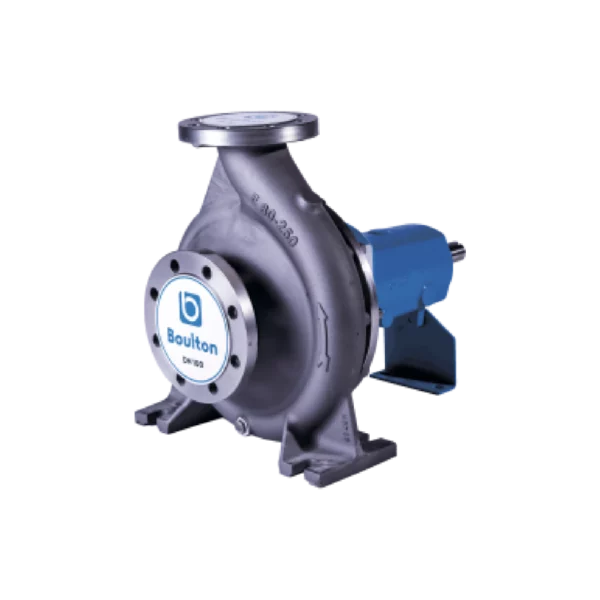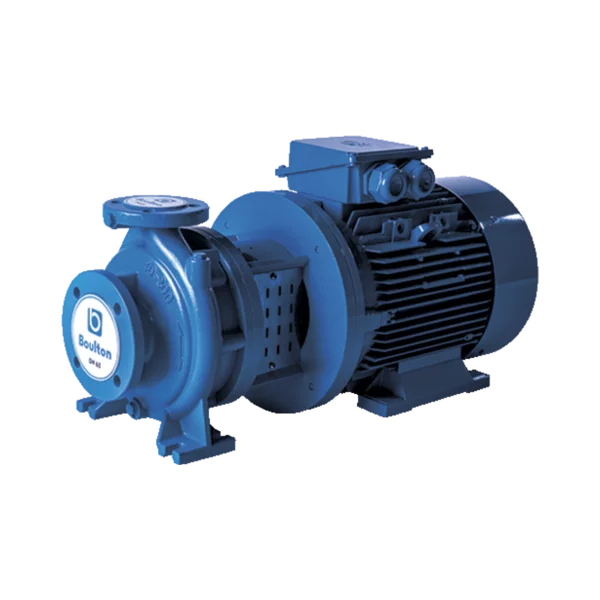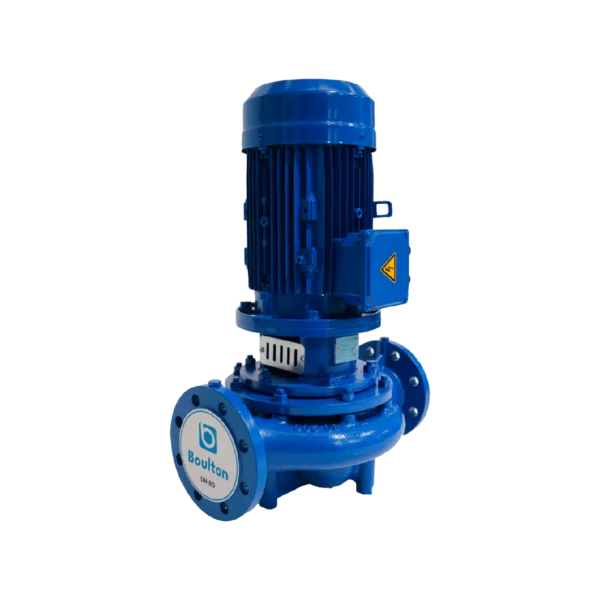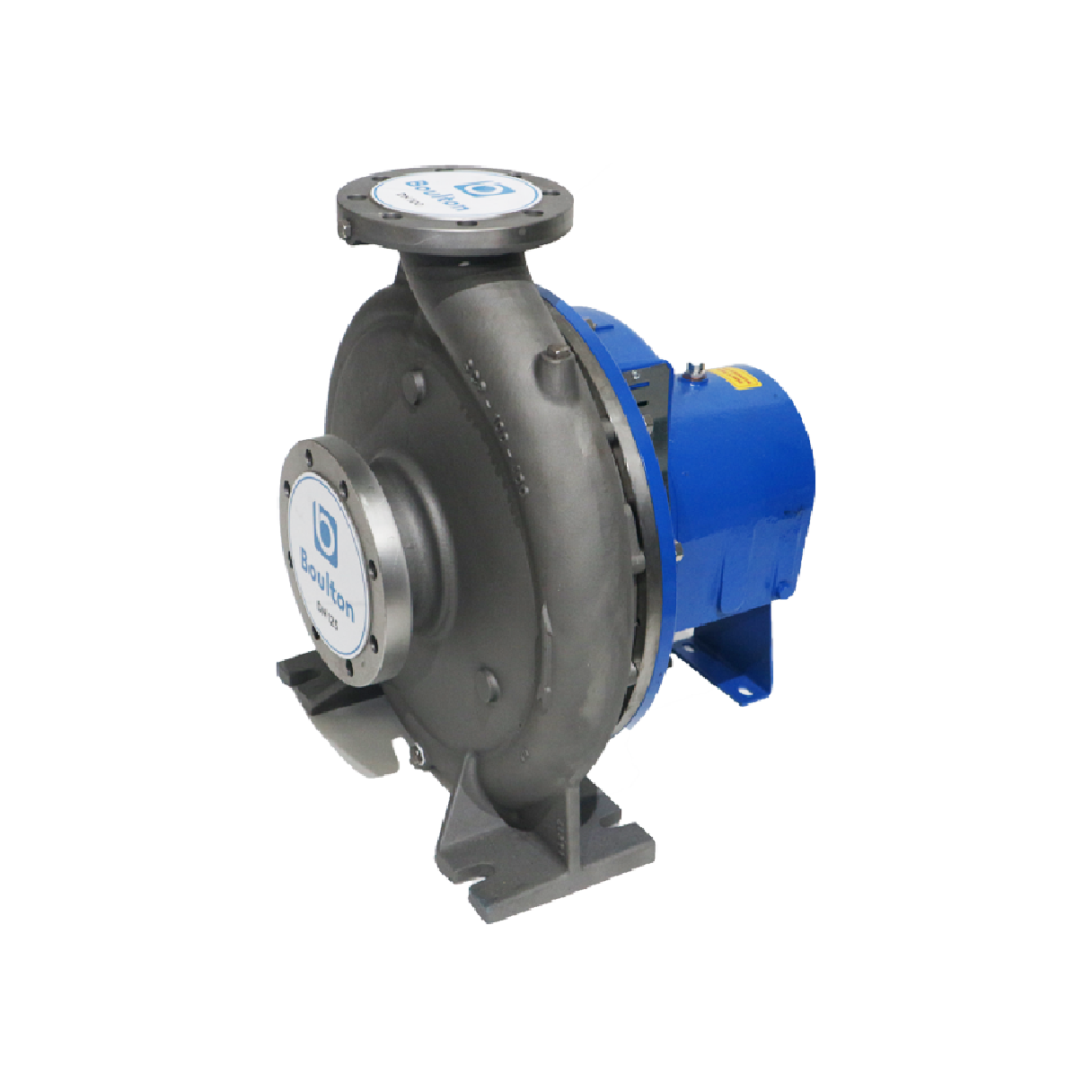
Boulton pumps – ESK / PK process centrifugal pump to ISO 2858
Boulton ESK / PK pump is a single-stage centrifugal pump designed to the ISO 2858 standard for the chemical and process industries. Manufacturer: Boulton Pumps, Polígono Industrial de Santelices 7, 48550 Muskiz, Vizcaya Province, Spain.
Capacity up to 1700 m³/h, head up to 160 m, standard sizes DN from 32 to 250. Medium temperature from −10 to +175 °C. Casing pressure 16 bar, with a 25 bar option. Rotation speed up to 3600 rpm.
Boulton ESK pump: technical specifications
| Parameter | Value |
|---|---|
| Type | single-stage centrifugal, process |
| Standard | ISO 2858 |
| Flow rate, max. | 1700 m³/h |
| Pressure, max. | 160 m |
| Standard sizes | DN 32–250 |
| Medium temperature | from −10 to +175 °C |
| Casing pressure | 16 bar, test pressure 25 bar |
| Rotational speed | up to 3600 rpm |
| Revolutions, 50 Hz | 1,450 or 2,900 rpm |
| Revolutions, 60 Hz | 1,750 or 3,500 rpm |
| Impeller | closed |
| Materials | cast iron, steel, bronze, stainless steel, nodular cast iron, other alloys |
| Workmanship | wholly or partly of cast iron, AISI 316 (L), DUPLEX |
| Shaft seal | end-face, various types, in accordance with API specifications |
| Flanges | DIN 2632 / PN 10 or DIN 2633 / PN 16 |
A head of 160 m of water corresponds to approximately 15.7 bar, which is consistent with a 16 bar casing pressure. For higher heads, a 25 bar version is used.
What does the ISO 2858 standard provide?
ISO 2858 specifies the connecting and overall dimensions of single-stage centrifugal pumps for the chemical industry: flange diameters and positions, shaft axis height, distance between supports, and baseplate dimensions.
The practical consequence is the same as in EN 733, but for a heavier duty class of equipment: a pump from any manufacturer built to this standard will fit into the place of another without modifying the piping and foundation.
The difference between the two standards lies in what they are designed for. EN 733 describes general industrial pumps for water and similar media. ISO 2858 sets the dimensional range for chemical processes, where requirements for pressure, temperature, and corrosion resistance are higher. About EN 733 and the rest of Boulton's standards — at the Boulton Pumps page.
Why ESK withstands harsher conditions than the rest of the Boulton series
The difference from the manufacturer's other series is not declarative, but in numbers.
| Parameter | ESK / PK | Series according to EN 733 |
|---|---|---|
| Medium temperature | up to +175 °C | up to +140 °C |
| Casing pressure | 16 bar, execution 25 | 10 bar, version 16 |
| Pressure, max. | 160 m | 105 metres |
| Standard | ISO 2858 | DIN 24255 (EN 733) |
The temperature is 35 °C higher, the pressure is one and a half times higher, and the head is greater by more than half. This is the limit beyond which pumps conforming to EN 733 are no longer suitable, while the ESK still operates.
For high-temperature technological circuits, pressure processes and systems with high pipeline resistance, these three parameters determine the choice.
Frame sizes from 32-125 to 250-500
The designation indicates the diameter of the discharge pipe and the nominal diameter of the impeller.
| DN | Standard sizes |
|---|---|
| 32 | 32-125, 32-160, 32-200, 32-250 |
| 40 | 40-200, 40-250 |
| 50 | 50-160, 50-200, 50-250, 50-315 |
| 65 | 65-160, 65-200, 65-250, 65-315 |
| 80 | 80-200, 80-250, 80-315, 80-400 |
| 100 | 100-200, 100-250, 100-315, 100-400 |
| 125 | 125-200, 125-250, 125-315, 125-400 |
| 150 | 150-200, 150-250, 150-315, 150-400, 150-500 |
| 200 | 200-260, 200-315, 200-400, 200-500 |
| 250 | 250-315, 250-400, 250-500 |
Each frame size is available in two speed variants. The ESK range is shorter than the EN 733 series range: small frame sizes with a small impeller are not manufactured in the back pull-out design.
Materials, impeller and seal according to API plans
The casing is manufactured from cast iron, steel, bronze, stainless steel, ductile iron or another metal alloy. Separately, the manufacturer indicates that the execution can be full or partial: in cast iron, AISI 316 (L) or DUPLEX.
Partial construction means that the expensive material is used only on the parts that come into contact with the medium, whilst the housing remains made of cast iron. This reduces costs without compromising strength where it is needed.
Low-carbon AISI 316L is used where there are welded joints and a risk of intergranular corrosion. DUPLEX is used in chloride-containing environments where AISI 316 suffers from pitting corrosion.
The impeller in this series is exclusively closed. This corresponds to the application: the process pump is designed for clean or slightly contaminated media, and a closed impeller provides the highest efficiency.
Mechanical seal – various types, manufactured to API piping plans. API plans define the flush, cooling and drainage layout for the seal. For temperatures up to +175 °C, this is not an option but a necessity: without cooling, a seal at such a temperature will not last.
Flanges — DIN 2632 at PN 10 or DIN 2633 at PN 16.
What industries is the Boulton ESK pump designed for?
The manufacturer defines the series for the chemical and process industry.
Declared applications: supplies for industry, petrochemistry, cogeneration, air conditioning, irrigation and other services for clean or lightly loaded liquids.
Cogeneration stands apart in this list, and not by chance: a temperature of up to +175 °C and a pressure of 16 bar cover the heat recovery circuits on cogeneration plants.
Petrochemistry is the second application where defining material performance with duplex and sealing according to API plans.
ESK among the manufacturer's other series
| The series | Standard | Flow rate, max. | Pressure, max. | Temperature |
|---|---|---|---|---|
| ESK / PK | ISO 2858 | 1700 m³/h | 160 m | up to +175 °C |
| ESN / ESH | DIN 24255 (EN 733) | 1,750 m³/h | 105 metres | up to +140 °C |
| ESM | DIN 24255 (EN 733) | 1,750 m³/h | 105 metres | up to +140 °C |
| IL | EN 733, in-line | 200 m³/h | 100 m | up to +140 °C |
In terms of flow rate, the ESK is slightly inferior to the EN 733 series, but it wins on head, temperature, and pressure. The selection logic is simple: if the medium and parameters fit within EN 733, the ESN, ESM, or IL are chosen—they are cheaper. If not—the ESK.
How to select a Boulton ESK pump at Steiner Ukraine
Six pieces of data are required for selection: flow rate in m³/h, required head in metres, name or composition of the medium, its temperature, system pressure, and presence of solids.
Three positions are defined separately. The first is the material in full or partial execution: cast iron, AISI 316, AISI 316L, or DUPLEX. The second is the seal type and API plan for the temperature and medium. The third is the casing execution for 16 or 25 bar.
If it is a case of replacing an existing pump according to ISO 2858, please state its model size – selection according to the standard is carried out without piping modifications.
Steiner Ukraine supplies Boulton equipment, including design, configuration, commissioning and spare parts. The scope is described in the section services. Industrial pumps — in the section industrial pumps, centrifugal — in the section centrifugal pumps. Sector-specific recruitment — in sector-specific solutions. The technical specifications of the original source are published at the Boulton Pumps website.
Frequently Asked Questions
What does the ISO 2858 standard mean?
This is the standard for connection and dimensional sizes of single-stage centrifugal pumps for the chemical industry. A pump built to this standard can be installed in place of another manufacturer's pump without modifying the piping and foundation.
What is the maximum flow rate of the Boulton ESK pump?
1700 m³/h at a head of up to 160 m.
What is the maximum ambient temperature?
+175 °C. This is 35 °C higher than for Boulton series to EN 733.
What pressure is the casing designed for?
16 bar in standard design, 25 bar in special design.
What materials are available?
Cast iron, steel, bronze, stainless steel, high-strength cast iron and other alloys. Execution can be full or partial — in cast iron, AISI 316 (L) or DUPLEX.
What impeller is in this series?
Closed. Unlike the EN 733 series, the manufacturer does not offer an open, vortex or channel design for the ESK.
What are API compression plans?
Standard mechanical seal piping plans: barrier fluid supply, flushing, cooling, drainage. At temperatures up to +175 °C, seal cooling is mandatory.
What is the difference between ESK and ESN?
By standard and limits. The ESN is built to EN 733: up to 105 m, +140 °C, 10 bar. The ESK is built to ISO 2858: up to 160 m, +175 °C, 16 bar.
Is ESK suitable for abrasive media?
The manufacturer designates the series for clean or lightly loaded liquids, and the impeller is exclusively closed. For abrasive media, this is not the right series.
How much does the Boulton ESK / PK pump cost?
The price depends on the dimensions, material design, body pressure class, seal type and API plan. A DUPLEX design is significantly more expensive than a cast-iron one. Send us the flow rate, head, medium, temperature and pressure — and we will prepare a quotation.