
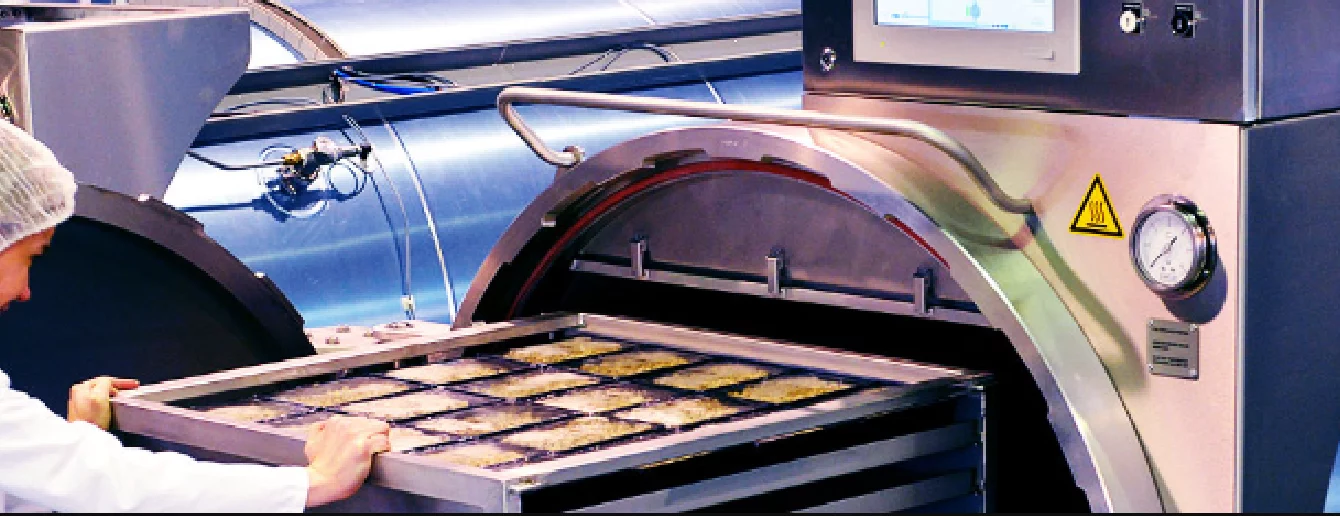
A modern industrial autoclave is high-tech equipment on which the safety of the product, the stability of the production process and the cost price of the finished products directly depend. That is exactly why, when choosing an autoclave for production, it is necessary to assess not only the price or the capacity, but the whole complex of technical and operational parameters.
Autoclaving remains the most widespread and reliable method of pasteurisation and sterilisation in the food industry. However, the efficiency of this process is largely determined by how correctly the equipment is selected.
Where to start when choosing an autoclave
Before considering specific models, it is important to define clearly the technological tasks that the autoclave has to solve at your enterprise. Mistakes at this stage often lead to excessive energy consumption, unstable product quality or a limitation of production capabilities in the future.
Key parameters for analysis:
1. The type and volume of sterilisation
It is necessary to take into account:
- the type of product (meat, fish and vegetable preserves, baby food, sauces and so on);
- the type of packaging (tin can, glass, retort pouch, plastic containers);
- the required capacity and the number of cycles per day.
These factors determine the required volume of the autoclave chamber and the heat treatment regime.
2. Technical integration
The autoclave must match the infrastructure of the enterprise:
- the power supply parameters;
- the water and steam supply systems;
- the requirements for ventilation and condensate removal.
3. Quality and uniformity of sterilisation
It is critically important that the autoclave ensures:
- a uniform temperature distribution throughout the whole chamber;
- minimal temperature deviations between packages;
- control and recording of the cycle parameters for traceability and auditing.
4. Ease of operation
Modern autoclaves must have:
- automated control;
- an intuitive interface;
- minimal maintenance requirements;
- quick access to the assemblies for servicing.
5. Energy efficiency and operating costs
Low consumption of steam, water and electricity directly affects the cost price of the products, especially in continuous production.
6. Reliability and service support
The reputation of the manufacturer and the availability of service support and spare parts are mandatory criteria for industrial equipment.
The main types of industrial autoclaves
Depending on the technological requirements, different types of autoclaves are used in production:
Autoclaves with gravity cooling
Simple and reliable in design, but they have a longer cooling cycle, which limits capacity.
Autoclaves with forced circulation
They use pumps for active cooling, significantly shortening the cycle time and increasing production efficiency.
Vacuum autoclaves
Used for products and materials that require the complete removal of air from the chamber before sterilisation.
Pre-vacuum autoclaves
They combine vacuum and circulation technologies, ensuring fast, uniform and controlled sterilisation under high loads.
Steriflow — the benchmark in industrial sterilisation
Company STERIFLOW (France) is the world leader in the production of horizontal autoclaves and the developer of the “water cascade” technology, which provides:
- extremely uniform temperature distribution;
- minimal temperature deviations;
- reduced energy and water consumption;
- preservation of product texture, color, and nutritional value.
Steriflow autoclaves are widely used in the production of canned goods, ready meals, sauces, animal feed, and other products where quality and process stability are critical.
Engineering support from Steiner
Company Steiner Ukraine helps select an autoclave considering:
- product and packaging type;
- required capacity;
- sterilization or pasteurization requirements;
- energy and spatial constraints of the facility.
We support the project from equipment selection to commissioning and service maintenance.


