
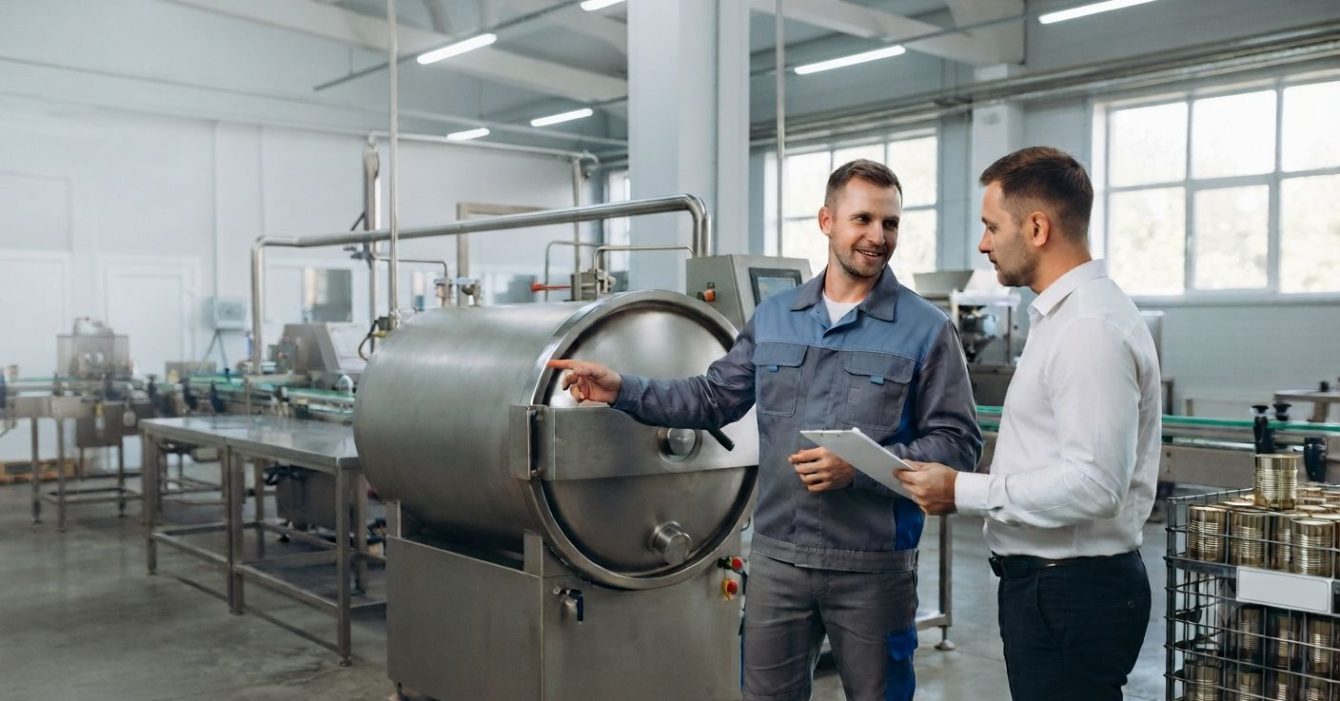
Heat treatment is one of the most critical stages in the production of canned foods: microbiological safety, shelf life and, ultimately, the manufacturer's reputation on the market all depend on it. A mistake at this stage is not always visible straight away — insufficient sterilisation may only show up after several weeks of storage of the finished product, when the batch has already been sold. That is why the choice of an autoclave for a production line is a decision that should be taken on the basis of the technical parameters of the process, and not on the cost of the equipment alone.
What an industrial autoclave is and how it works
An industrial autoclave is a sealed chamber in which packaged products are treated with elevated temperature and pressure in order to destroy pathogenic microflora. Unlike domestic sterilisation, an industrial autoclave works with large batches at once and provides precise control of temperature, pressure and cycle duration for each type of product and packaging.
The industry standard today is water cascade technology — the principle whereby superheated water is fed onto the product from above in the form of an intensive shower under overpressure. This approach ensures uniform heating of the pack from every side and at the same time maintains a pressure that compensates for the internal pressure inside the sealed container during heating — critically important for cans, bottles and flexible packaging, which could otherwise deform or lose their seal.
The main types of industrial autoclaves
The choice of the type of autoclave depends above all on the nature of the product — its viscosity, its sensitivity to mechanical action during processing and the type of packaging.
- Static autoclaves — the baskets with product remain stationary throughout the entire processing cycle. This mode suits products in rigid packaging — cans, glass containers — where movement could damage the container or compromise the integrity of the product.
- Rotary autoclaves — the baskets rotate around their own axis during processing, which speeds up the heating of liquid and semi-liquid products thanks to constant agitation.
- Autoclaves with longitudinal movement (for example, the Dali model) — provide slow horizontal rocking of the basket, which suits products of low viscosity — milk, sauces, beverages — and prevents the formation of a skin or darkening of the product during heating.
- Shaka-type autoclaves with horizontal movement — intensive horizontal agitation significantly shortens the sterilisation cycle time and ensures more uniform heating, while preserving the texture and taste of the product better than traditional processing modes.
Key parameters when choosing an autoclave for production
Before choosing a specific model it is worth assessing several technical factors that directly affect the efficiency and the running costs of subsequent operation:
- The type and viscosity of the product — determines whether active agitation is needed during processing or whether the product requires complete stillness.
- The type of packaging — a glass jar, a metal container, flexible packaging or a bottle requires a different balance of pressure and temperature during the cycle.
- Production volumes — the standard chamber diameters (900–2000 mm) and the number of baskets determine the real throughput of the line.
- Energy efficiency — modern models with a water cascade significantly reduce electricity and water consumption thanks to faster heat transfer compared with older steam systems.
- Flexibility of the control system — the ability to fine-tune temperature and time profiles for a specific product range.
Why water cascade technology remains the industry standard
Compared with classic steam sterilisation, the water cascade gives the manufacturer several practical advantages at once. First, the uniformity of heating reduces the risk of local overheating or, conversely, of insufficient treatment of individual areas of the pack. Second, controlled overpressure makes it possible to process delicate packaging — flexible pouches, plastic containers — without the risk of losing the seal during heating. Third, faster heat transfer shortens the overall processing cycle, which directly affects the throughput of the line and the saving of energy resources per unit of product.
Steriflow autoclaves: French expertise in industrial sterilisation
Among the manufacturers of equipment for the heat treatment of food products, the French company Steriflow has been working in this field for more than fifty years and is one of the developers of water cascade technology itself. The range Steriflow includes both static autoclaves for classic canning in cans and glass containers and models with longitudinal or horizontal movement of the basket — Dali and Shaka — for products that require active agitation during processing. Each model is adapted to specific production tasks: the type of product, the packaging format and the required line capacity.
Instead of a conclusion
Choosing an autoclave is not about comparing general technical specifications in a price list, but about the precise match of the equipment to the real product, packaging and production volumes of a specific enterprise. A mistake at this stage costs far more than the difference in price between models — it shows up in lost product, line downtime or, in the worst case, in claims about the quality of goods that have already been sold. That is why an autoclave should be selected together with engineers who understand the specifics of your particular production process, rather than choosing a model on catalogue parameters alone.


