
Plate heat exchangers – are indispensable equipment at any production facility. After all, the cooling – and heating of working media are the main factors in the course of the technological process. And what is a plate heat exchanger? Let us look at it in more detail.
A plate heat exchanger is special equipment designed for cooling or heating a working medium by transferring heat from a hot heat carrier to a cold one through corrugated plates (stainless steel, titanium, graphite and other materials) that are connected to each other. The plates are assembled in such a way that the hot and the cold medium do not mix with each other but move along opposite sides of the plate. The set of plates and their number depend on the features of the process and on the working media that take part in it.
How it works
The first modern heat exchanger was assembled by the founder of APV (Richard Seligman) in 1923, but according to other available data the «father» of the modern heat exchanger is Gustaf de Laval, who in 1938 released the first pasteurisation unit.
The heat exchanger plate is the main structural element. They are produced by cold stamping from alloys resistant to corrosion. At the same time a thickness of 0,4 – 1,0 mm is maintained. The plate has 4 openings, 2 of which are intended for supplying the cold and the hot medium, the other 2 are additionally sealed with contour gaskets so as not to let the media mix with each other (special drainage grooves are also provided for this). Since the movement in the channels does not follow a straight line, the flow of the working medium moves turbulently. Add to this the counterflow of the two media (hot and cold ) – and we obtain an increased temperature head, which in turn intensifies the heat exchange process. This also has a positive effect on the surface of the plates – the scale layer is reduced.
What heat exchangers are needed for
Heat exchangers are necessary to perform the following functions:
- use of residual heat resulting from the application of electrical energy;
- control of the chemical processes necessary for maintaining a normal temperature regime.
The new models are simple and safe to use. In the food industry they are needed for pasteurisation, and in metallurgy they act as coolers. In shipbuilding they are necessary to support the functioning of the engine cooling system. In the oil industry – for cracking.
Types of heat exchangers
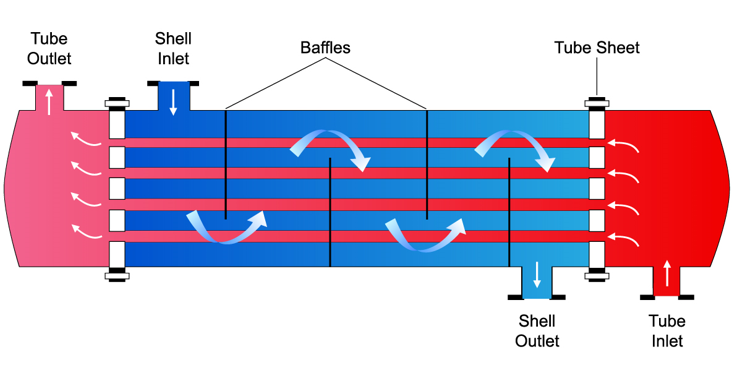
- Shell-and-tube

Advantages:
- High pressure
- Extreme temperature difference
- Ultra-high capacity
Disadvantages:
- Overall dimensions
- Complexity of maintenance
- Complexity of cleaning
2. Double-tube heat exchanger
3. Brazed heat exchanger
4. Condensers/Evaporators
5. Condensers
Interesting to know
If there is a large difference in the flow rate of the media, or the difference of the final temperatures is minimal, then a variant of multiple heat exchange is possible. This is achieved by directing the flows along a «loop». Such heat exchangers are additionally equipped with nozzles for supplying the working media, and the media move in the same direction along the baffle plates.
The number of corrugated plates and their appearance depend directly on the working medium and the technological process. This also applies to the plate material: they can be made both of ordinary stainless steel and of special alloys that can be used for working with very aggressive liquids. The material of the seals depends on these parameters and is selected in accordance with the physico-chemical and technological features of the process.
- Working pressure (maximum): 1,6 MPa
- Working temperature (maximum): 160 oC (200 oC)
- Heat exchange surface (maximum): 1500 m2
- Plates: stainless steel AISI316, titanium and others
- Seals: rubbers of various grades (EPDM, VITON, NBR )
- Frames: stainless steels AISI304 and AISI316, carbon steel and others
- Nozzles: stainless steel AISI304 and AISI316, titanium and others
The process of selecting a heat exchanger is quite painstaking and labour-intensive, because the materials must be selected correctly, otherwise the heat exchange equipment will fail or will work incorrectly, since for many technological processes a difference of a few degrees completely disrupts the whole process and makes it impossible to obtain a product with the specified parameters.
Our specialists will help you with the selection and will answer any questions you may be interested in.
tel.: +38 (044) 390 73 38
e-mail: info@steiner.com.ua


