
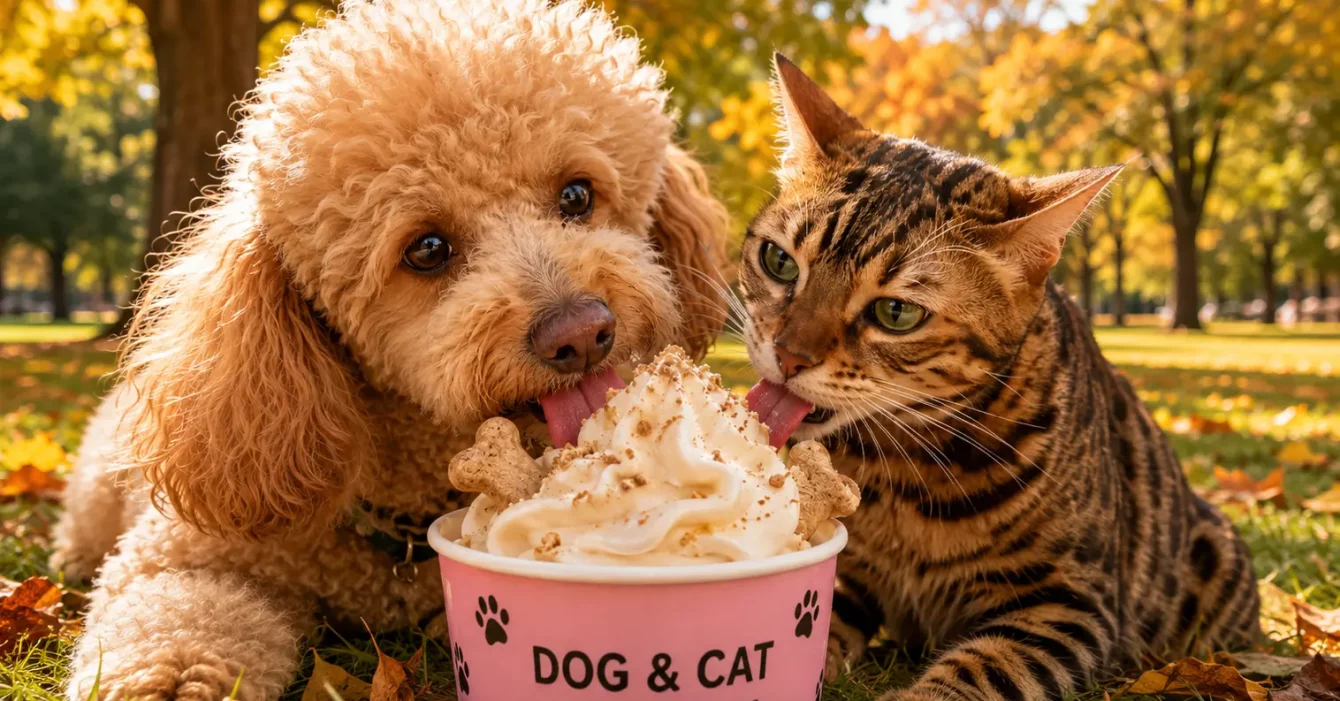
An analytical overview of the market for ice cream (frozen treats) for pets: the world, Europe, Ukraine. For producers of pet food and producers of ice cream who are looking for where to grow next.
In the summer of 2025 something appeared on the shelves of Ukrainian pet shops and supermarkets that a few years earlier would have looked like a marketing joke — ice cream for dogs and cats. «Rud» launched the Happy Tail brand and called it «the first ice cream for pets in Ukraine». In parallel, imported and local items appeared in chains such as MasterZoo: Pup-Ice, Woof & Brew Paw Pops, «Samokus» by Bark&Tail.
This is not a one-off curiosity. It is a local echo of a global shift that has been under way for more than ten years. And for two groups of producers — those who make pet food and those who make ice cream — a thoroughly practical question is hidden here: is this a niche seasonal hype or the beginning of a new product category that is worth entering now.
Let us look at the substance of it.
What ice cream for pets is and why it is not «human ice cream in a different wrapper»
The main mistake when looking at this category is to assume that it is ordinary ice cream with a dog drawn on the label. In reality the product solves a technological task: to make a frozen dessert that an animal is physiologically able to eat without harm.
Classic ice cream for a dog or a cat is a problem on three fronts at once. First, lactose: most adult animals lose the ability to break it down properly after weaning, and milk sugar causes digestive disorders. Second, the direct toxicity of a number of familiar ingredients — chocolate (theobromine) and the sweetener xylitol, which even in small doses causes hypoglycaemia and liver damage in dogs. Third, an excess of sugar and fat, which hits the pancreas and leads to obesity.
That is why «ice cream for pets» is in fact a separate recipe discipline: without components toxic to animals, with a controlled content of fat and carbohydrates, often on a base alternative to ordinary milk, sometimes with functional additives. In other words, it is closer to the treats and snacks segment than to dairy gastronomy.
The global context: how much the market is worth and who drives it
Ice cream for pets did not grow out of nowhere, but on the shoulders of the huge market of frozen snacks and treats for pets. The global market for frozen petfood is estimated at approximately 16.1 billion dollars in 2025 with a forecast of up to 26.8 billion by 2035. The narrower segment of pet ice cream itself is estimated differently — from hundreds of millions to about 1.5 billion dollars a year — but almost all analysts agree on one thing: it is growing at double-digit or close to double-digit rates (CAGR estimates range from ~8% to 15% on the horizon to 2033–2035).

The global market for frozen petfood: growth from 16.1 billion dollars in 2025 to 26.8 billion in 2035
One more telling fact: more than 70% of the pet ice cream market is accounted for by products for dogs, while cats are a smaller but growing share. This is logical: a dog is more often a «participant» in walks, trips and family rituals, where ice cream becomes a natural episode.

More than 70% of the world pet ice cream market is accounted for by products for dogs
The category is being pulled upwards by two processes. The first is humanisation: owners increasingly perceive the animal as a member of the family and transfer their own consumer habits to it, in particular the wish to «spoil» it. The second is premiumisation: people are ready to pay more for food and treats with a clean composition, recognisable ingredients and functional benefit. A telling signal of the market’s maturity is that not only niche start-ups have entered the category, but also heavyweights: Purina has held the Frosty Paws brand since the 1990s, and Ben & Jerry’s launched the Doggie Desserts range in 2021.
Europe: from «spoiling» to a functional dessert
The European market of treats for pets in 2025 is estimated at about 10.2 billion dollars with a forecast of up to ~14 billion by 2030 (CAGR approximately 6.7%). But what is interesting is not so much the figure as the direction of movement: the European consumer reads the composition ever more actively and looks in treats not simply for pleasure, but for the solution of a specific task — the health of teeth, joints, digestion, hydration in the heat.
This shifts ice cream for pets from the category of «a toy for the owner» towards a functional product. And it is precisely here that room opens up for non-commodity positioning: not «cold and sweet», but «a balanced summer addition to the diet with a specific benefit».
Ukraine: who is already on the shelf
The Ukrainian market matured for such a product not by chance. The pet goods market grew in 2024 by 20%, to UAH 45.4 billion, while the segment of food for dogs and cats added 13%, reaching about 350 million dollars — and has been growing for the ninth year in a row. In Ukraine there are about 17.7 million pets, of which cats and dogs make up two thirds (approximately 7.6 million cats and 4.9 million dogs). An important cultural shift: the number of animals on prepared food grew by 14% over the year, and more than half of owners are ready to pay extra for environmental friendliness and a quality composition.

Ukraine: growth drivers for 2024 — pet goods market +20%, animals on prepared food +14%, food for dogs and cats +13%
In other words, the base for a premium impulse purchase in Ukraine has already been formed. Let us look at what exactly has come onto the shelf.
Happy Tail («Rud») — the most noticeable player, because behind it stands an industrial dairy company with distribution in the national retail chains. The format is ready portioned ice cream with apple and blueberry flavours, the positioning is «approved by veterinarians», without artificial colourings and flavour enhancers, with a table of daily norms according to the animal’s weight. It is interesting that «Rud» deliberately leaves lactose in the composition, emphasising its easy digestibility — a recipe choice that differs from the «lactose-free» canon of the global brands.
Pup-Ice (on sale in MasterZoo) — a different format: not a ready dessert but a dry concentrate mix with flavours (strawberry–banana and others) which the owner dilutes with water and freezes at home. This is «DIY ice cream», where what is sold is not the dessert itself but the convenience of preparing it.
Woof & Brew Paw Pops — a British import, portioned ice cream «lollies» of 50 ml; an example of how the category is already standardised on developed markets into convenient single-use formats.
«Samokus» (Bark&Tail) — a local product with apple flavour, playing in the same field of functional frozen treats.
Together these four items already outline the whole product typology of the future market.
Typology: four formats of one product
If we systematise it, ice cream for pets exists in four basic formats, and each one is a separate production and distribution model:
Ready portioned ice cream — cups, briquettes, «paws». Maximum convenience for the buyer, but it requires a cold chain from the producer to the shelf. This is the model of Happy Tail and Frosty Paws.
Dry mixes «add water and freeze» — powder is sold, and the ice cream is «born» in the owner’s freezer. It does not require a cold chain in logistics and has a longer shelf life. The Pup-Ice model.
Functional frozen treats — on the border between ice cream and a snack: enriched with probiotics, fibre and vitamins, positioned for a specific benefit.
Formats «for the owner and the animal together» — desserts that a person and an animal can eat as a pair; a strong emotional and content hook, although a narrower niche.
The technological watershed
The key divergence in the category is what to build the base on. Global brands mostly go for lactose-free and dairy-free recipes (vegetable oils, sunflower paste instead of peanut because of allergies, thickeners). The Ukrainian Happy Tail demonstrates an alternative approach — with a controlled lactose content and a bet on bioavailability.
Both paths are viable, but they determine different production requirements: control of fat and sugar content, texture stability after refreezing, safety of the composition, and for ready formats — a maintained cold chain. For a producer entering the category, the choice of the recipe base is in fact the choice of the entire technological and logistical model, and not simply of a flavour.
Forecast: what the potential in Ukraine is
A sober view: over the next 2–3 years ice cream for pets in Ukraine will remain a niche seasonal product of impulse demand — with a sales peak in May–September and concentration in the premium segment of the large cities. This is not a mass essential product, and one should not expect from it the volumes of the basic pet food.
But the potential of the category lies not in volume, but in its role. This is an image-building, high-margin, content-friendly product, which works for brand loyalty and recognition more strongly than yet another dry food SKU. Three factors play in its favour: the established habit of Ukrainians of buying prepared food, the readiness of a proportion of owners to pay for premium quality, and also the warming climate with longer hot seasons.
The realistic scenario is that the category establishes itself as a seasonal premium addition to the main treat lines, first with the large players that have distribution and a cold chain, and later with niche craft producers. The window for entry is open right now, while the shelf is not yet occupied and the first brand has not yet become a synonym for the category.
What this means for producers
For producers of pet food and treats. Ice cream is a logical extension of the product matrix inside the treats segment, which is already growing fastest. It does not cannibalise the main range, but adds a seasonal premium anchor and an occasion for communication. The question is rather not «whether to enter» but «in which format» — a ready product with a cold chain, or a dry mix without one.
For ice cream producers. This is an opportunity for diversification based on already existing competences — recipe work with fat and sugar, work with texture, filling, cold logistics. The technological barrier to entry is lower for a dairy producer than for a pet company; the main thing is to rebuild the recipe to suit the animal’s physiology and the safety of the composition.
The common conclusion for both is that this is a category where the winner is not the one who makes something «cold and sweet», but the one who makes a well-founded, safe and functional product — and is able to prove it to the consumer. Non-commodity here is not a slogan but a condition of survival: novelty in itself will give the first season of sales, but only what is backed by real recipe and technological work will stay on the shelf.
In brief: frequently asked questions
Can a dog or a cat be given ordinary ice cream? No. Classic ice cream contains lactose and a lot of sugar and fat, and some kinds contain chocolate or xylitol, which are toxic to animals. Specialised ice cream for pets is developed without these risks.
How does ice cream for pets differ from human ice cream? By its controlled content of fat and carbohydrates, the absence of toxic components, often a lactose-free or dairy-free base and functional additives. This is closer to the treats segment than to an ordinary dessert.
How big is this market? The global market for frozen petfood is about 16 billion dollars in 2025. The pet ice cream segment is smaller, but is growing at rates of approximately 8–15% a year; more than 70% is accounted for by products for dogs.
Is there demand in Ukraine? Yes, the base has been formed: the pet goods market grew by 20% in 2024, and more than half of owners are ready to pay for quality. In 2025 Happy Tail, Pup-Ice, Woof & Brew and others already appeared on the shelves.
Is it worth a producer entering the category now? As a seasonal premium addition to a treats range — yes, the entry window is open. But the product must be technologically well-founded and safe, and not simply «ice cream for dogs» on the label.
The material was prepared by the Steiner Ukraine team — an engineering company with more than 20 years of experience in supplying and selecting equipment for the food industry, beverage production and the petfood category.


