
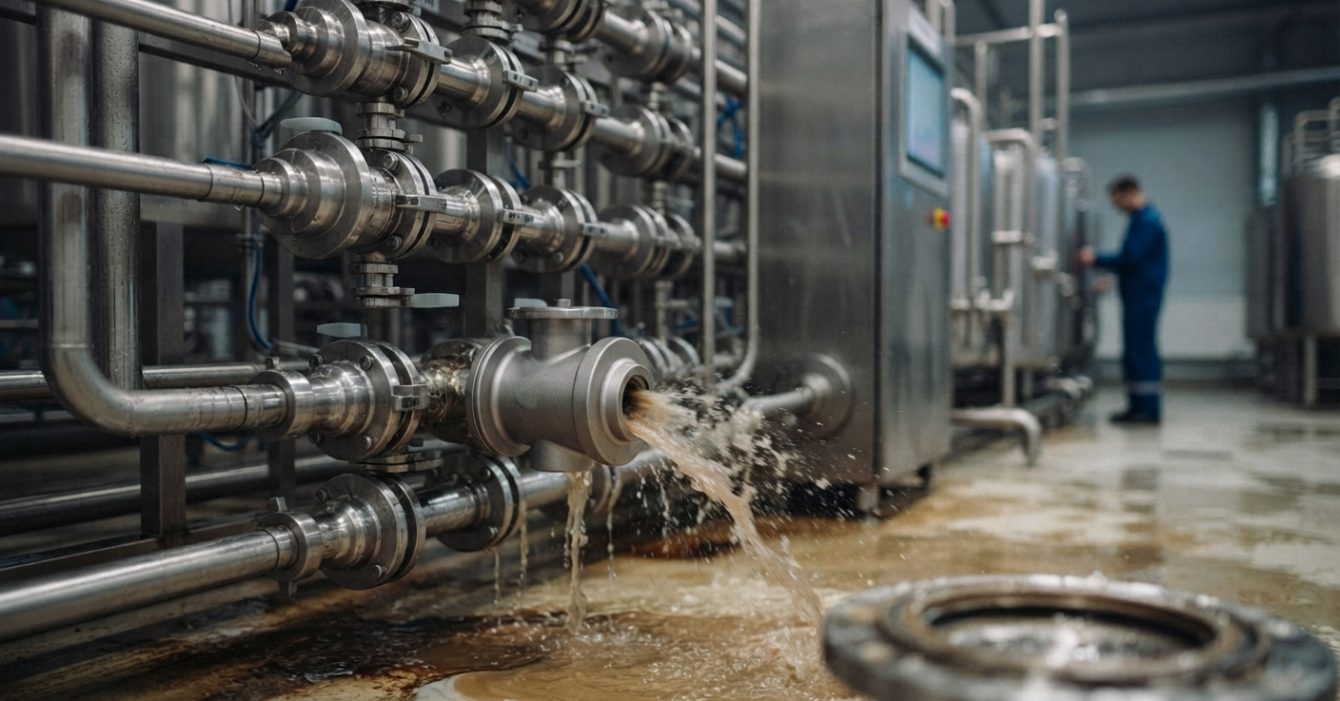
Imagine the situation. The production line has been running flawlessly for the past two years. The pumps are transferring the product, the heat exchangers are maintaining the temperature, and the dispensers are filling containers with gram-level precision. And then, one morning, a batch of yoghurt is rejected – not because of the raw materials, not because of the staff, but because a single valve in the pipework has started to let air through. A minor issue that nobody had noticed for years. Until it caused an entire production line to shut down.
Valves are perhaps the most underrated component in food and pharmaceutical production. Pumps and filling lines are the talk of every trade fair. Valves, however, are largely overlooked. And that’s a shame: it is the valves that determine whether a product will be hermetically sealed off from the external environment, whether the line will withstand sanitisation, and whether a ‘dead zone’ will form in the pipework where microorganisms will feel right at home.
Why bother learning about different types of valves at all?
An engineer who has decided once and for all that ‘a valve is just a valve’ will, sooner or later, run into a problem. This is because, in reality, there are dozens of design solutions, each of which was created for a specific task — and none of them is universal.
Ball valves — the workhorses of industry. Simple, reliable, able to withstand pressure and wear and tear, they are well suited for shut-off valves on main pipelines. But they have a weakness: the design, with a ball inside the body, creates areas that are difficult to clean thoroughly. For sterile production, this is a problem.
Diaphragm valves — address this very problem. A flexible membrane separates the mechanism from the product, ensuring the inner surface remains as smooth as possible and free from stagnant areas. This is precisely why they are so popular in the pharmaceutical and dairy industries — sectors where hygiene is not merely a consideration, but a requirement.
Butterfly valves (disc valves) — compact, lightweight, and quick to open and close with a single lever movement. They are often installed where the speed of flow switching is important, for example at junctions on production lines.
Check valves — the system’s silent guardians. Their role is unobtrusive but crucial: to prevent the product or air from flowing in the wrong direction and disrupting the entire production process.
Control valves — It’s no longer just a matter of ‘open/closed’, but precise, metered flow control. Wherever there is a need to smoothly regulate pressure or flow rate, they are indispensable.
The material matters more than it seems
This is where simple engineering ends and chemistry begins. The product that comes into contact with the valve dictates its own terms. Acidic sauces react with stainless steel in a completely different way to milk. Pharmaceutical solutions can be so sensitive to even the slightest traces of metal that ordinary ‘stainless steel’ proves to be insufficiently inert.
That is why engineers do not simply refer to ‘stainless steel’, but to specific grades — AISI 316L rather than 304, for example, when greater corrosion resistance is required. Seals, on the other hand, are selected individually: EPDM performs well with aqueous solutions and steam, and is preferable for hot CIP cycles, whilst FKM (Viton) is indispensable where there is contact with fats and oils. An error in this selection is not always immediately apparent – it becomes evident after months of operation, when the seal begins to degrade from the inside.
Hygienic design is not a preference, but a requirement
In the food and pharmaceutical industries, a valve is assessed not only on how effectively it shuts off the flow, but also on how easily it can be cleaned. Hence the term ‘hygienic design’ — a design with no threaded connections inside the product passage, no sharp corners and no dead spaces where product residue can accumulate.
A valve that cannot be thoroughly cleaned in a single CIP cycle is not a cost-saving measure, but a hidden cost. Sooner or later, you will either have to shut down the line for manual dismantling and cleaning, or risk compromising the microbiological purity of the product. Neither of these scenarios fits with the concept of efficient production.
How to make the right choice
Here’s a tip that’s rarely stated outright: don’t try to select a valve from a catalogue based solely on the pipe diameter and system pressure. These are necessary, but insufficient, parameters. Ask yourself — or, more precisely, your equipment supplier — about the compatibility of materials with the product, the frequency and type of sanitisation, the operating temperature limits, and the permissible frequency of opening and closing cycles if the valve is operating in automatic mode.
And above all — do not skimp on this link in the chain just to save a few per cent on the project’s cost. The valve costs a fraction of the price of a batch of products that will have to be scrapped if it fails at the wrong moment.
A good valve is one you forget about. It simply works, year after year, without any surprises, allowing engineers to focus on things that seem more important: performance, formulations and scalability. But that is precisely why choosing a valve deserves meticulous attention to detail — after all, the cost of a mistake here is almost always greater than the cost of the valve itself. Steiner Ukraine helps you select valve fittings tailored to a specific product, hygiene requirements and process – so that you really can forget about them.


