
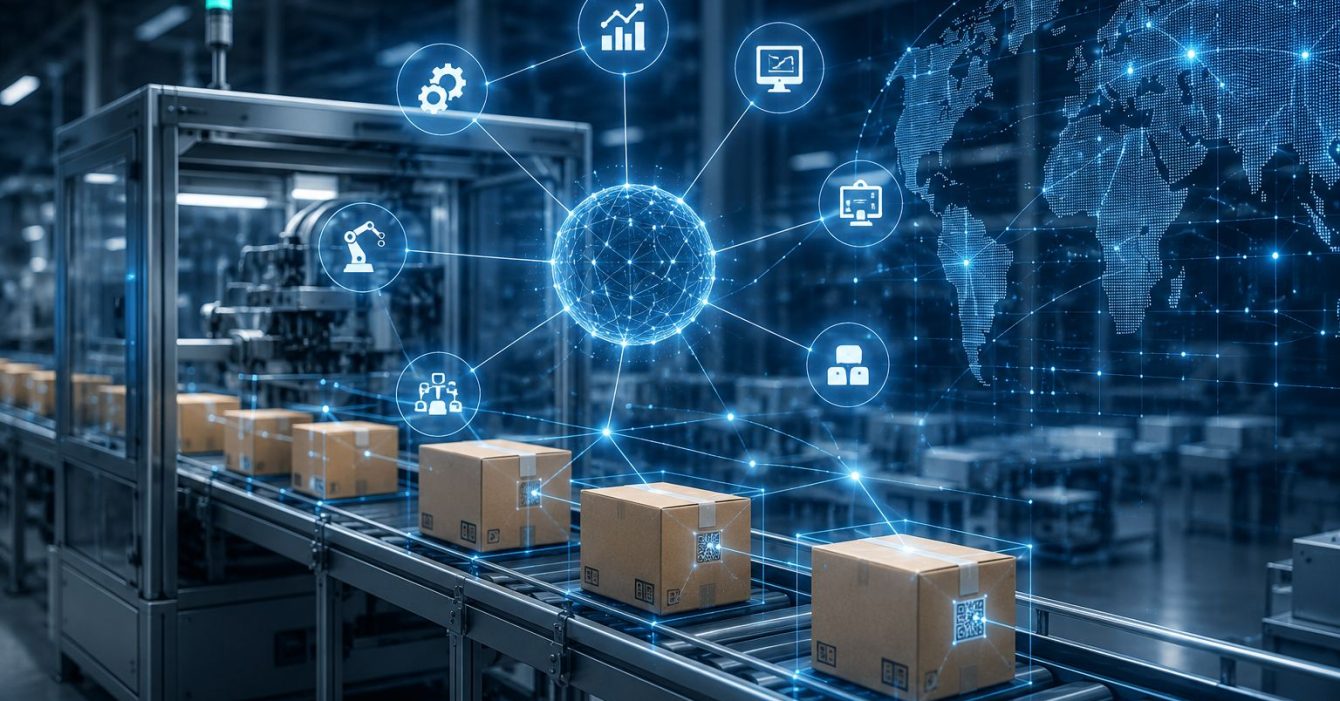
Modern production long ago ceased to be a set of separate machines and isolated processes. In 2026 the efficiency of an enterprise is determined not only by packaging speed or conveyor capacity, but by the ability to receive data in real time and respond promptly to any deviations.
That is exactly why the integration of packaging lines into an ERP system is becoming one of the key stages of the digital transformation of industry. Manufacturers of food products, beverages, pharmaceuticals, pet food and chemical products are increasingly moving to a model in which every unit of production has its own digital trace.
This approach makes it possible to control production not after the fact, but directly while the line is running.
Why separate packaging lines no longer meet modern requirements
At many enterprises the packaging equipment still works autonomously. Some of the data is recorded manually, reports are generated with a delay, and information about a specific production batch is often spread between different systems or files.
As a result, the business faces typical problems:
- it is difficult to determine the cause of a defect;
- it is impossible to localise a problem batch quickly;
- operators spend time on manual reporting;
- errors arise because of the human factor;
- management receives data with a delay;
- it is hard to control productivity in real time.
For production facilities with high requirements for product traceability this becomes a critical risk. Especially in pharmaceuticals, the food industry and export-oriented enterprises, where quality control standards are constantly being tightened.
How the integration of a packaging line with an ERP system works
Integration involves combining packaging equipment, scanners, weighing systems, marking printers, sensors and PLC controllers into a single digital ecosystem of the enterprise.
The ERP system receives data directly from the production line:
- production time;
- batch number;
- quantity of production;
- packaging parameters;
- equipment status;
- serial numbers;
- quality control results;
- downtime data;
- consumption of materials.
In effect, every unit of production becomes part of a digital chain in which its entire journey can be traced — from raw material to shipment to the customer.
Product tracking in real time
One of the main advantages of ERP integration is Real-Time Tracking — control of production in real time.
An operator or production manager can see instantly:
- how much product has already been packed;
- which batches are currently on the line;
- where delays are arising;
- which equipment is running unstably;
- what percentage of defects is being recorded at a particular section.
If an error occurs, the system automatically records the problem and makes it possible to localise its source quickly.
For example, if a marking defect has arisen on a certain batch, the ERP system makes it possible to determine within seconds:
- the exact production time;
- the operator’s shift;
- the operating parameters of the equipment;
- the materials used;
- the quantity of product that has come under risk.
This substantially reduces the costs of complaints, product recalls and audits.
ERP integration and automation of quality control
Modern packaging lines are no longer limited to the mechanical packaging process alone. They are becoming a source of a large array of production data.
Connection to ERP makes it possible to automate:
Weight control
The system automatically records deviations from the set parameters and can stop the line in the event of critical errors.
Marking verification
Scanners and cameras check the correctness of barcodes, QR codes, production dates and serial numbers.
Productivity control
The ERP system analyses OEE indicators, shift efficiency and the level of equipment downtime.
Automatic reporting
All production reports are generated without manual data entry.
Which enterprises benefit most from ERP integration
Integration gives the greatest effect at production facilities with a large flow of products and high requirements for traceability.
Most often these are:
- the food industry;
- beverage production;
- pharmaceuticals;
- the cosmetics sector;
- pet food;
- chemical production;
- logistics centres;
- enterprises of the FMCG sector.
For such companies ERP integration ceases to be a competitive advantage and becomes a necessary condition for scaling the business.
Which technologies are used for integration
Modern integration systems are based on a combination of industrial automation and software.
Most often the following are used:
- PLC controllers;
- SCADA systems;
- MES solutions;
- industrial IoT platforms;
- RFID and QR marking;
- machine vision systems;
- automatic weighing complexes;
- API integration with ERP.
Depending on the scale of production, the architecture of the system can be adapted to specific production processes.
What results does a business get after integration
After implementing ERP integration, enterprises usually obtain:
- a reduction in manual work;
- a decrease in the number of errors;
- faster production analytics;
- greater transparency of production;
- rapid detection of defects;
- improved quality control;
- optimisation of costs;
- reduced downtime;
- increased staff efficiency.
For management this means the ability to take decisions on the basis of up-to-date data rather than reports “from yesterday”.
ERP and packaging lines as the basis of Industry 4.0
The integration of production equipment into the digital infrastructure of an enterprise is one of the basic elements of the Industry 4.0 concept.
In the coming years the role of automated data collection will only grow. Enterprises that are implementing ERP integration today already gain a considerable advantage:
- they scale up faster;
- they pass audits more easily;
- they control quality more effectively;
- they reduce production risks;
- they obtain full transparency of production processes.
That is exactly why modern packaging lines are increasingly seen not as separate equipment, but as part of a single digital ecosystem of production.


