
At first glance the situation looks like an ordinary defect: a bottle of water or juice that has just come off the line suddenly “collapses” on the pallet a few hours later — the walls draw in, the shape deforms, and on the shelf such a product looks as if someone has already squeezed it with their hands. Process engineers often blame the quality of the preform or an error in the blow-moulding machine. In reality the cause usually lies elsewhere — the container simply lacks the internal pressure needed to withstand the weight of the upper rows on the pallet and the temperature swings during transport. And the problem is solved not by changing the bottle design or thickening the walls, but by a metered drop of liquid nitrogen that enters the container a fraction of a second before capping.
What actually happens inside the bottle
Liquid nitrogen boils at –196 °C. When a drop enters a freshly filled container it instantly begins to turn into gas — and during this transition the volume of the substance expands by roughly 700–850 times. This is not a chemical reaction and not the addition of a foreign component: nitrogen makes up about 78% of ordinary air, so it is inert and does not change the taste, smell or composition of the product. But it is precisely this instantaneous change of physical state that creates what the whole process is undertaken for — excess internal pressure inside the sealed container.
For a thin-walled PET bottle this pressure is not a bonus but a structural necessity. Beverage producers have spent years lightening their packaging: less plastic per unit of product means lower cost, lower raw material spend and a smaller carbon footprint. But a lightweight preform physically cannot withstand the mechanical loads of stacking without additional rigidity. Nitrogen dosing makes it possible to keep the lightweight container where otherwise you would have to either thicken the walls (which directly raises the cost of every bottle) or put up with deformed goods and returns from retail chains.
The second task — not mechanics, but the chemistry of product preservation
Besides pressure, nitrogen performs one more function which, for juices, wines, oils and certain types of preserves, matters more than container rigidity — displacing oxygen from the headspace above the product. Residual oxygen in the bottle means a slow but relentless oxidation process: loss of vitamins and flavour in juice, oxidation of fats in oil, growth of unwanted microflora where it would otherwise stand no chance. An inert nitrogen blanket above the product level substantially slows these processes and has a direct effect on the real shelf life, rather than the one declared on the label.
These two effects — mechanical rigidity and chemical inertness — are rarely needed by a producer in isolation from one another. That is why liquid nitrogen dosing has become a standard process solution for a wide range of products: still and carbonated water, juices and nectars, wine, vegetable oils, and in food processing also for certain types of preserves.
Why this is a question of precision, not simply “adding a bit of nitrogen”
The main difficulty of the process lies not in the physical principle itself but in its execution. The dose must be calculated precisely for the specific container volume, line speed and moment of injection. Too small a dose — and there is no effect: the pressure does not reach the required value and the container remains vulnerable to deformation. Too large a dose, or a loss of synchronisation with the moment of capping — and the result is the opposite: excess pressure deforms the bottle the other way, in the worst case blows the cap off or, on high-speed lines, causes loss of seal integrity across the batch.
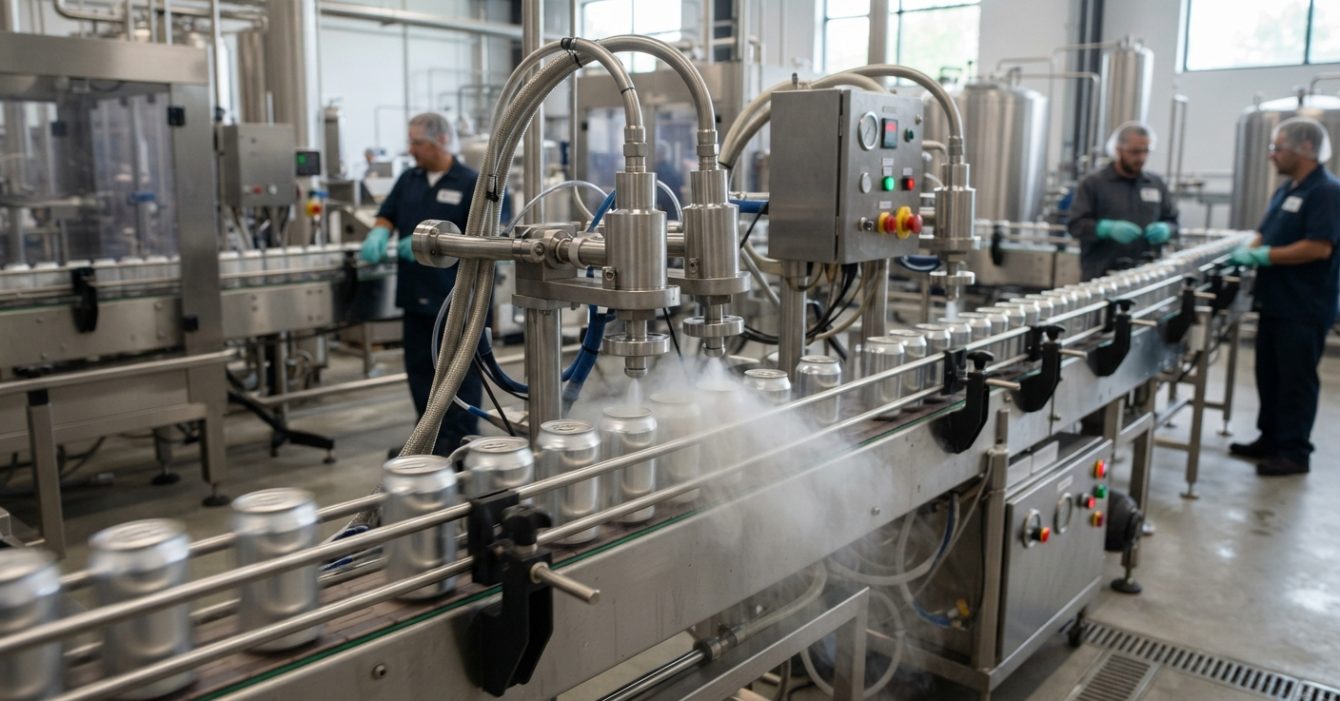
That is why a doser is not simply a valve releasing a portion of cryogenic liquid. It is a precision system synchronised with the movement of the conveyor, capable of holding dose stability to fractions of a second while working with a substance at a temperature close to absolute zero by the practical standards of food production. Any deviation in the thermal insulation of the system, in valve response speed or in volume sensor calibration immediately turns into batch instability — and on a line producing tens of thousands of bottles per hour, the cost of such instability is counted not in individual rejects but in pallets.
What to look at when choosing a doser
When a plant comes to selecting specific equipment, a mistake at the selection stage costs more than the price difference between models. It is worth focusing on several practical parameters.
Speed and synchronisation with the line. The doser must keep up with the actual filling speed, not with the rated speed of the bottle washer or blow-moulder. On lines running at the limit of 40,000–60,000 bottles per hour, the requirements for valve response speed and for accurate synchronisation with the capping rotor are completely different from those on a small wine or craft production filling line.
Dose range and repeatability. For a line working with containers of various sizes — from small juice bottles to large water carboys — what matters critically is not the minimum dose in itself, but the stability with which it is reproduced during frequent format changeovers. A system that requires lengthy readjustment or loses accuracy when switching between container volumes creates hidden downtime, which is not always visible in daily reporting but is clearly felt in the annual OEE figures.
Thermal insulation and product losses. Liquid nitrogen is a costly and volatile resource: poor vacuum insulation of the system means that part of the nitrogen boils off before it is even dosed, and the plant pays for lost product rather than for useful work. The quality of vacuum insulation of the pipework and of the dosing unit itself directly determines the operating economics of the equipment over several years, not just at the purchasing stage.
Integration into existing automation. A modern doser must “speak” the same automation language as the rest of the line — integrate with the PLC, transmit diagnostic data, and allow remote monitoring and calibration without stopping production.
European experience in this niche
Vacuum Barrier Systems (VBS Europe) is a Belgian company that has specialised since 1978 in cryogenic systems for transporting and dosing liquid nitrogen, and acts as the exclusive distributor of the American Vacuum Barrier Corporation in Europe, the Middle East, Africa and India. Over more than four decades the company has built up engineering expertise rarely found among manufacturers of adjacent equipment: VBS vacuum-insulated systems reduce liquid nitrogen losses to a minimum, and the product range covers both compact dosers for laboratory batches and small lines and full turnkey plant-wide systems for the largest beverage producers.
Technical range of Vacuum Barrier Systems liquid nitrogen dosers covers solutions of every scale — from micro-dosing systems for test batches and laboratory research to high-output industrial lines, as well as related products: vacuum-insulated pipelines for safely transporting LN2 around production areas and the Flavordose system for precisely introducing flavourings into the beverage stream without mixing flavours between batches.
Instead of a conclusion: an investment you cannot see on the label
A liquid nitrogen doser is the kind of equipment whose effect the consumer never sees directly. Yet it is exactly what stands behind the straight, undeformed bottle on the shelf, behind juice that keeps its taste and colour to the end of its shelf life, and behind the absence of retail chain complaints about “crushed” containers on the pallet. For the producer this is not spending on an exotic technology but a way of controlling two things that directly affect profitability — container weight and the real shelf life of the product. And, as with any precision equipment, the key decision here is made not during operation but when choosing the right dosing system for the specific line, product and container format.


