

Industrial screw pumps
-
 Exclusive partner
Equipment
Showing the single result
Frequently asked questions about industrial screw pumps
Where are industrial screw pumps used?
Where the medium is viscous, non-homogeneous or contains solid inclusions: pumping of sludge and slurry at treatment plants, feeding of polymers and flocculants, work with bitumen, oils, paints and adhesives, dosing of reagents in chemical production, transport of dewatered sludge.
How viscous a product can they handle?
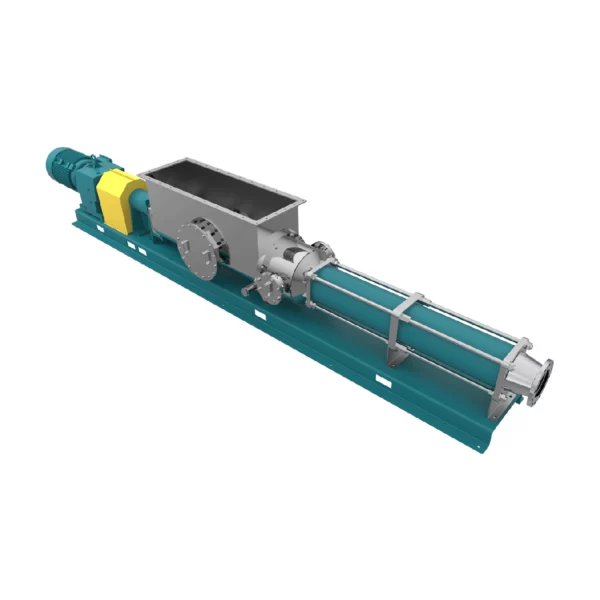
The positive displacement principle makes it possible to work with media considerably more viscous than a centrifugal pump can withstand, including paste-like masses. The limitation is determined not so much by the pump as by the filling of the suction chamber — for very thick products, versions with a feed hopper and a feed auger are used.
Is such a pump suitable for precise dosing?
Yes. The delivery of a positive displacement pump depends linearly on the speed and hardly depends on the back pressure, therefore, paired with a frequency converter, a screw pump works as a doser. This is a standard solution for feeding reagents and flocculants.
How is the stator material selected for chemicals?
According to the resistance of the elastomer to the specific substance, its concentration and temperature: NBR, EPDM, FKM, HNBR, and for individual tasks — PTFE versions. A mistake in the stator material leads to its swelling or destruction within a few shifts, so the composition of the medium is needed as early as the selection stage.
What should be taken into account during installation and maintenance?
Free space is needed along the pump axis for pulling the rotor out of the stator, protection against dry running and a safety valve or pressure monitoring — with the gate valve closed, a positive displacement pump will raise the pressure until the pipeline is destroyed. The rest of the maintenance comes down to the scheduled replacement of the rotor-stator pair and the shaft seal.