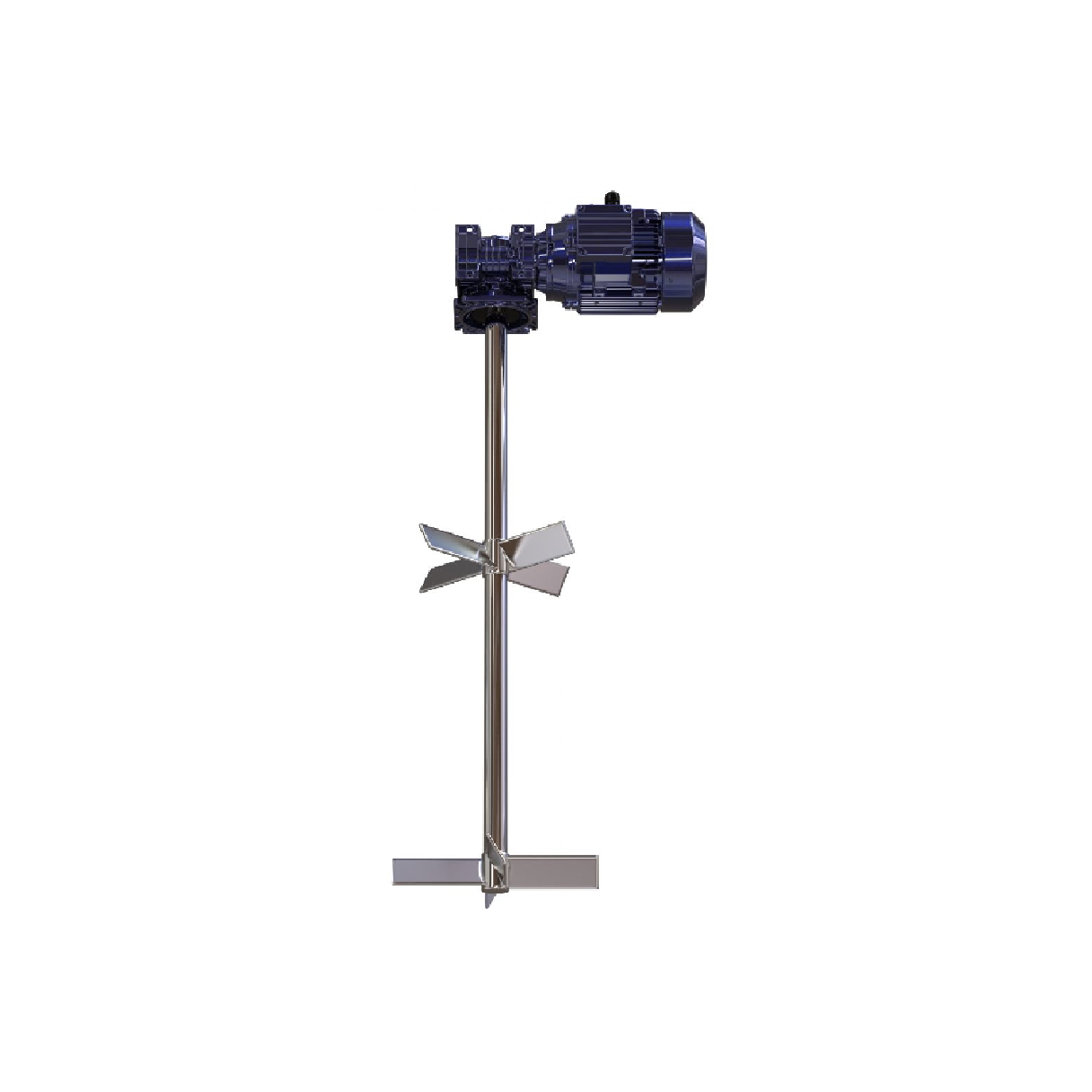
TMXFLOW - Agitator (SKDS)
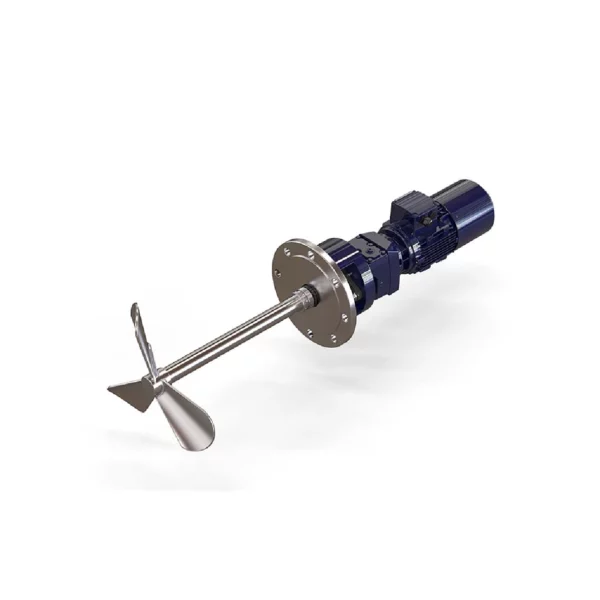
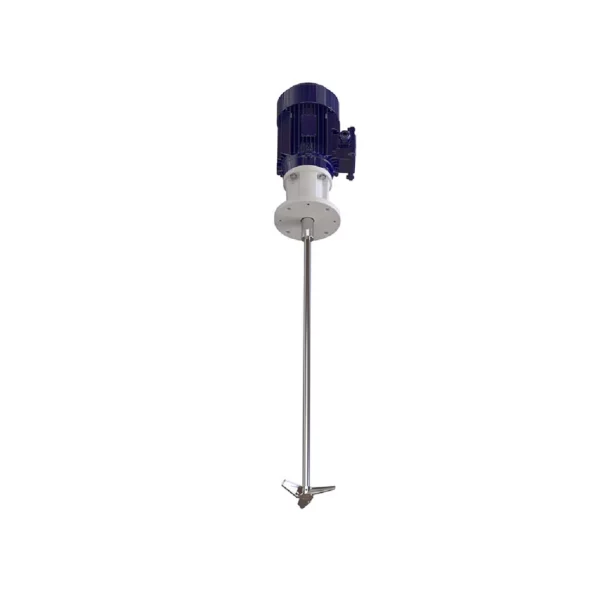
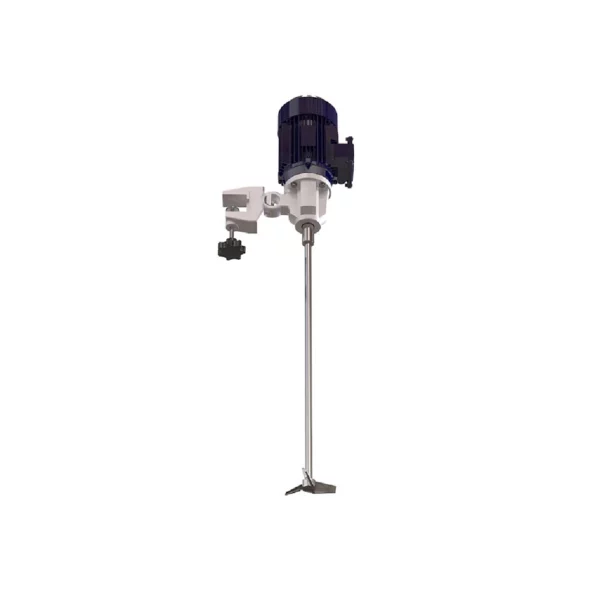
The TMXFlow SKDS series vertical mixer is a top-mounted mixer with a submerged shaft, designed for small and medium-sized vessels. Parts in contact with the product are made from AISI 316L stainless steel with a standard surface roughness of Ra ≤ 0.8 µm. The design is compatible with CIP cleaning, and versions with an ATEX-certified motor and a pneumatic actuator are available.
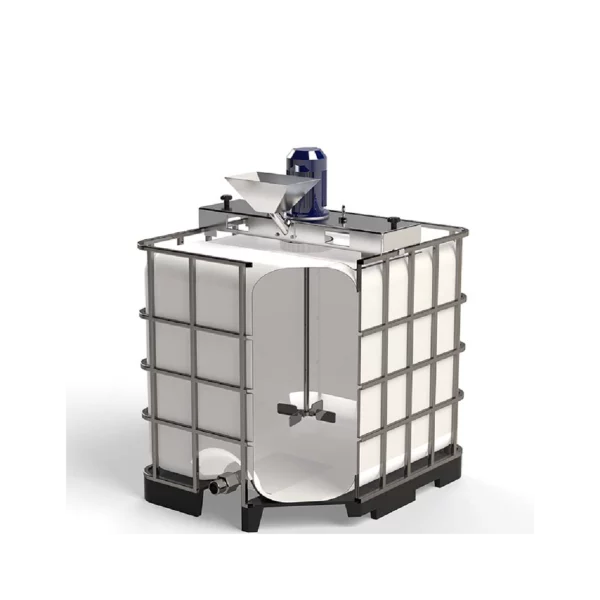
TMXFlow vertical mixer: top-mounted installation and flow diagram
The agitator is mounted on top of the tank, with the shaft and impeller immersed in the product. The propeller creates an axial flow: the liquid moves downwards through the working element and rises upwards along the walls of the tank, completing the circulation cycle.
The position of the shaft is important. With a central mounting, the flow tends to rotate with the agitator rather than circulate throughout the volume — this results in a vortex forming within the vessel, and the mixing process is reduced to simply rotating the contents. To prevent this, one of two methods is used: central mounting with baffles on the walls, or off-centre positioning of the agitator shaft. Both options disrupt the rotational movement and convert it into axial circulation.
In practice, this means that the installation method is determined not by ease of fitting, but by the geometry of the tank, and must be agreed upon before the order is placed.
Two drive configurations: direct and via a gearbox
TMXFlow vertical mixers are available in two fundamentally different drive configurations, and their area of application depends on this.
Direct drive — the working component is driven directly by the motor, without a gearbox. The rotational speed is high, whilst the torque on the shaft is moderate. This solution is suitable for low-viscosity fluids, for dissolving and dispersing, where speed is required rather than force.
Gearbox version — a horizontal motor with a worm gearbox; the shaft is inserted directly into the gearbox’s hollow shaft and secured by a main bolt and a key, so a rigid coupling is not required. The rotational speed is low, whilst the torque is higher. This solution is designed for larger volumes and denser media where slow but powerful mixing is required.
A worm gear reducer is compact and lightweight, but has a lower mechanical efficiency than other types of gearboxes; the manufacturer therefore recommends it for moderate power applications.
Materials, seals and surface quality
| Parameter | Value |
|---|---|
| Type | vertical, top-mounted, submersible shaft |
| Drive design | directly or via a worm gearbox |
| Details regarding the product | AISI 316L |
| Surface roughness | Ra ≤ 0.8 µm; for the propeller, Ra ≤ 0.5 µm is available |
| Shaft seal | NBR V-ring with retainer; optionally, a flange with a lip seal or a face seal |
| Bearing housing | anodised aluminium |
| Working body | propeller; serrated propeller (optional) |
| Shaft length | based on the geometry of the container |
| Dishwasher-safe | CIP |
The shaft seal in a gear-driven mixer serves two purposes: it maintains the pressure within the tank and separates the product from the gearbox oil. This is precisely why versions with a lip seal or a mechanical seal are provided — without them, the gearbox oil could, in theory, enter the product.
TMXFlow vertical mixer and CIP washer
The design is intended for on-site cleaning. This is ensured by three factors: the material of the parts in contact with the product, the standardised surface roughness, and a geometry that prevents the formation of stagnant areas.
Roughness is not merely a cosmetic issue here. On a highly rough surface, product residues become trapped in micro-irregularities, and the flow of the cleaning solution fails to remove them. The standard limit is Ra ≤ 0.8 µm, whilst for the propeller the permissible value is Ra ≤ 0.5 µm – as it is the propeller that operates in the area of greatest contact with the product.
The modular design allows separate access to the motor, gearbox, shaft and working component, so any unit requiring maintenance can be removed without dismantling the entire mixer.
Options: working components, ATEX, pneumatic actuator
The series is available with various types of working elements. A standard propeller creates an axial flow for homogenisation. A serrated propeller generates shear in the blade zone — this is used when a component needs not only to be distributed but also broken down into finer particles, for example when introducing powder.
An ATEX-certified motor is available for use in potentially explosive atmospheres. If a premises is classified as such, a standard motor must not be used there, regardless of its other specifications.
A pneumatic actuator is an alternative to an electric one where electrical equipment is undesirable in the area or where a compressed air network is already in place on site. Motor protection covers are also available.
What products is the TMXFlow vertical mixer designed for?
The manufacturer cites the food industry, the dairy sector, cosmetics, pharmaceuticals, chemicals and brewing.
Specific products mentioned in the documentation: milk and cream-based products, syrups and sauces, creams, gels and emulsions, suspensions and pharmaceutical formulations, fermented liquids and additives.
Typical operations include homogenisation, dissolving dry components, dispersing and maintaining the suspension to prevent the components from settling between process stages.
Selection and service from Steiner Ukraine
When selecting a mixer, the choice is determined by the mixing task rather than the power output. The volume and geometry of the vessel, the viscosity of the product at operating temperature, and the required outcome — whether to homogenise, dissolve, disperse or keep in suspension – and the cycle time all determine the drive specification, the type of mixing element and the shaft length.
We clarify these conditions, as well as the installation method, sealing requirements under pressure within the vessel, CIP parameters, zone classification and the availability of compressed air. Based on this, we determine the model and configuration. Next come supply, service and spare parts. Steiner Ukraine has been operating in the industrial equipment market since 2006.
A portable version from the same manufacturer — SKP mixer. Other items — in the section pumping and mixing systems and in the catalogue pumps for the food industry.