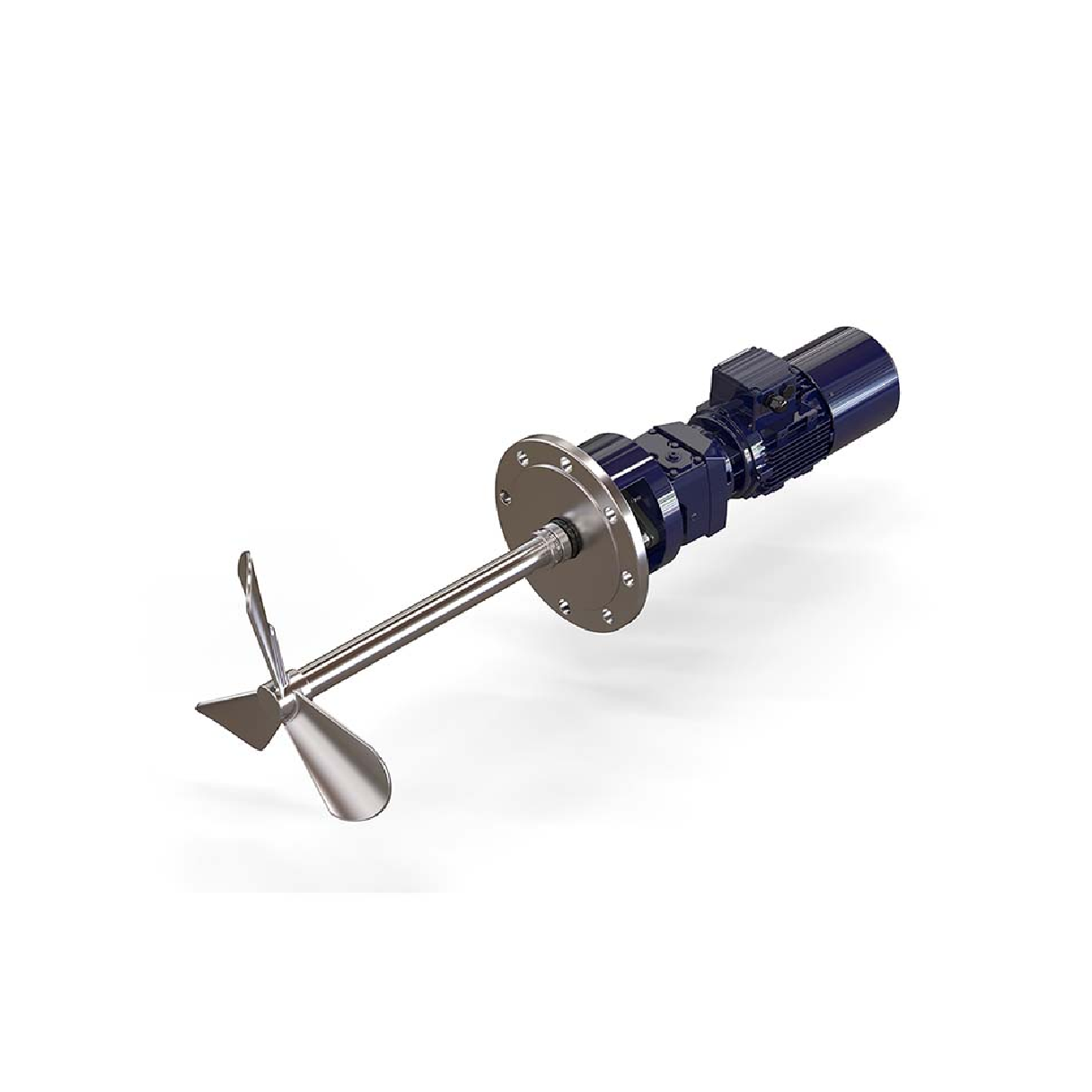
TMXFLOW - Agitator (Bottom Side Entry)
The TMXFlow side-entry mixer is installed through the wall of the tank at its base and is designed for circulation, homogenisation and sedimentation control in medium- and large-capacity tanks. The hygienic version is designed for tanks up to 14 metres high, whilst the industrial version is suitable for tanks up to 17 metres high. The shaft seal is a mechanical seal, operating within the product zone. Versions are available for ATEX Zones 1 and 2.
Side-entry mixer tap: when to choose it instead of a top-mounted one
An upper agitator on a tall tank requires a shaft extending the full height of the tank. Such a shaft requires support, precise centring and a roof capable of supporting the weight of the drive together with the dynamic load caused by rotation.
A side-entry agitator removes these requirements. The drive is mounted to the bottom of the tank wall; the shaft is short, and the load is transferred to the wall rather than the roof. For tanks with limited structural load-bearing capacity, this is often the only suitable solution, and the manufacturer explicitly cites the modular design as a factor that simplifies installation in such tanks.
The second scenario is when there is no space above: the tank is situated beneath the floor slab, there is other equipment on the roof, or access to the top is blocked.
Thirdly — costs. Side-mounted installation reduces the demands placed on the tank’s design and on the installation process, and the manufacturer cites this as one of the series’ advantages.
Tanks up to 14 and up to 17 metres
The two versions of the series differ not only in their design but also in their maximum height.
The hygienic design is intended for tanks up to 14 metres in height. It is designed for storage tanks and pipelines with low process loads where hygienic integrity is required.
The industrial version is designed to handle tall tanks up to 17 metres in height. These are large storage tanks, where the main objective is not to mix the components, but to prevent the product from separating.
In both cases, the manufacturer specifies the ratio of the tank’s height to its diameter separately: this must be within controlled limits, as it determines the stability of the hydraulic system, the efficiency of axial circulation, and the load on the shaft and drive. Therefore, the tank’s geometry is agreed upon at the time of ordering, rather than selecting an agitator based solely on its volume.
Sedimentation control: the main function of a side-entry mixer
The product remains in the storage tank for a long time. During this time, the solid phase settles to the bottom, whilst components of different densities separate into layers along the height of the tank.
The side-entry agitator is installed at the bottom of the tank precisely for this reason: the flow travels along the bottom and stirs up the sediment, preventing it from forming a compact layer. The top agitator performs less effectively for this task — its flow is mainly confined to the upper part of the tank.
The manufacturer identifies sedimentation control as a key function of the industrial model, alongside circulation and homogenisation. In practice, this means that the agitator does not operate prior to product withdrawal, but runs continuously or according to a schedule throughout the entire storage period.
Side-entry mixer: shaft seal
On a side-entry mixer, the seal is the component under the greatest strain. It is situated below the liquid level, meaning it is constantly under pressure from the column of product, and its failure results in a leak from the tank, rather than merely a drip.
The seal in this series is a face seal and operates within the product zone, resulting in a compact design. The standard industrial version features a graphite and stainless steel combination. For heavy-duty applications, a graphite and silicon carbide combination is available, offering superior wear resistance.
Separate versions are available for specific environments. For viscous and sugar-containing products — sealing surfaces with a hard facing and increased resistance to abrasive wear. For hygienic applications, there are sterilisable seals with a protected spring to prevent product residues from accumulating on it. For corrosive environments, sealing materials with enhanced chemical resistance are available.
There is also a version with a flanged housing and a cartridge seal: this is replaced as a complete assembly, without the need to dismantle it or adjust the friction pairs.
Bearing assembly and shaft
The axial load from the working component is transmitted to the shaft and then to the seal. This series offers two ways of handling this load.
The traditional configuration consists of a cast aluminium bearing housing with a thrust bearing. The thrust bearing absorbs the axial force, relieving the seal of this load and thereby extending its service life.
The second configuration, for lower output levels, features a shaft with an increased diameter and no separate bearing housing. Rigidity is provided by the shaft itself, simplifying the design and making it lighter.
The drive is based on a worm gear reducer connected via a hollow shaft, which ensures stable centring. The shaft is secured by a main bolt without the need for a separate coupling.
Foldable working body and attachments
The mixer is fitted with a hygienic connection in accordance with DIN or the Garolla standard.
A fold-down working element is available. This allows the agitator to be removed from an emptied tank via the connection pipe without dismantling the tank wall or entering the tank. For storage tanks, this ensures ease of maintenance: the seals and the working element are inspected during routine emptying.
Side-entry mixer and potentially explosive atmospheres
The series is available in versions for ATEX Zone 1 and Zone 2 with an explosion-proof motor.
The classification of zones is practical in this context. Zone 1 refers to areas where an explosive atmosphere may occur during normal operation; Zone 2 refers to areas where such an atmosphere is unlikely and, if it does occur, will be of short duration. The classification determines the equipment category; therefore, the zone must be specified at the time of ordering, and equipment designed for Zone 2 must not be used in Zone 1.
Selection and service from Steiner Ukraine
For a side-entry agitator, the selection is determined by the tank geometry and the properties of the product. The height and diameter specify the application range and circulation pattern; viscosity, abrasiveness and tendency to settle determine the impeller and, most importantly, the seal design.
We determine the height and diameter of the tank, its volume and fill level, the product and its viscosity, the presence of solids and abrasive particles, sterilisation requirements, the explosion hazard classification of the area, and the load-bearing capacity of the tank structure. Based on this, we determine the design, seal type, bearing assembly configuration and connection method. Next come supply, service and spare parts. Steiner Ukraine has been operating in the industrial equipment market since 2006.
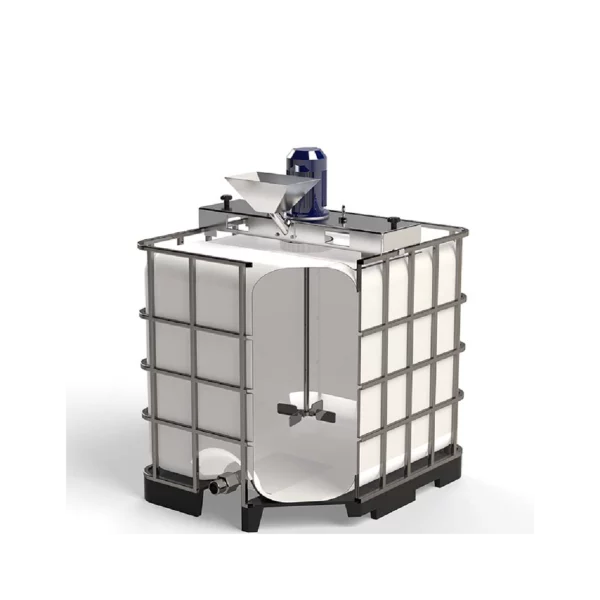
Vertical agitators are designed for top-access vessels SKD and SKDS, for containers — IBC mixer, for small containers — portable SKP. Other items — in the section pumping and mixing systems.