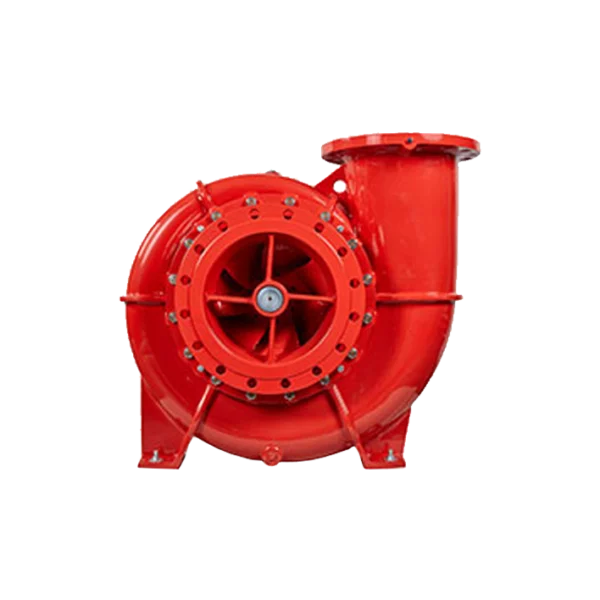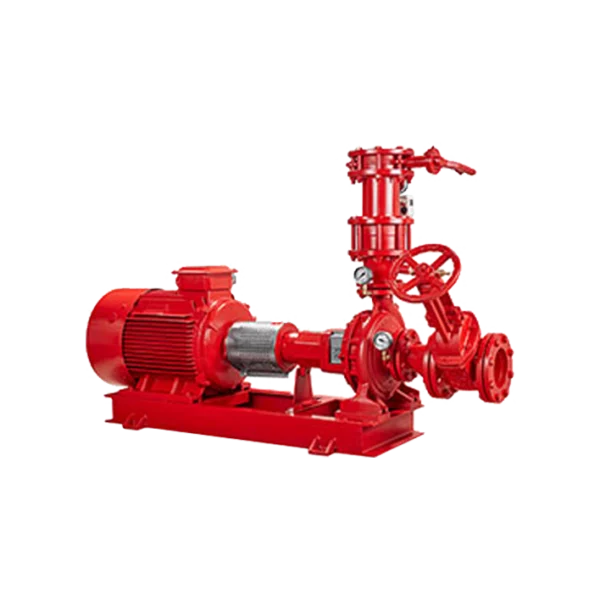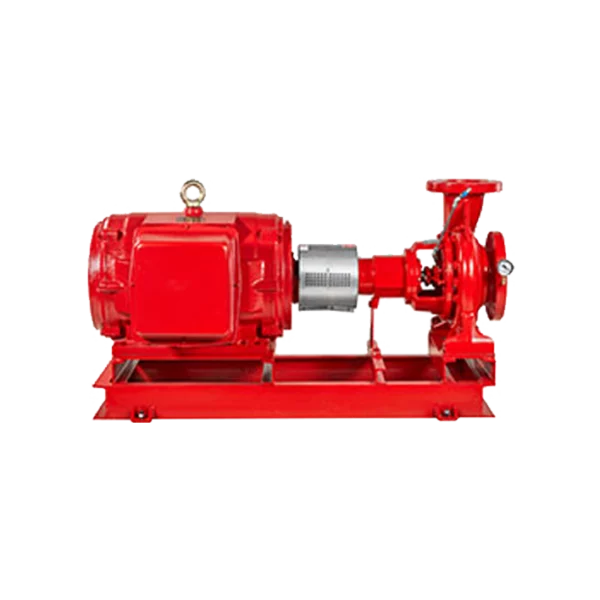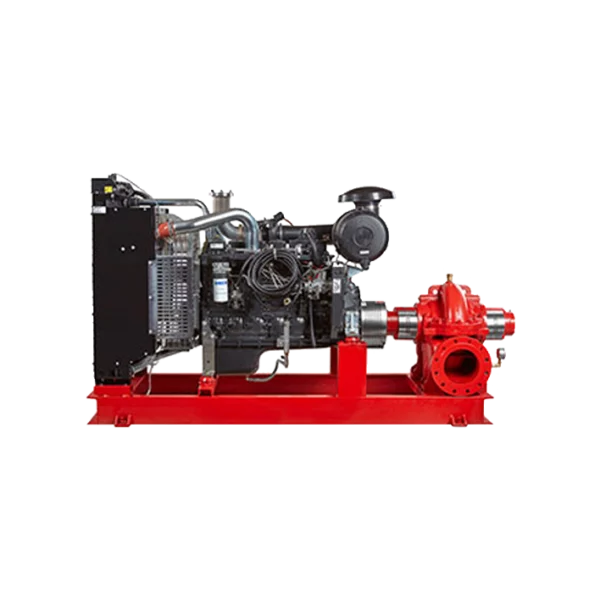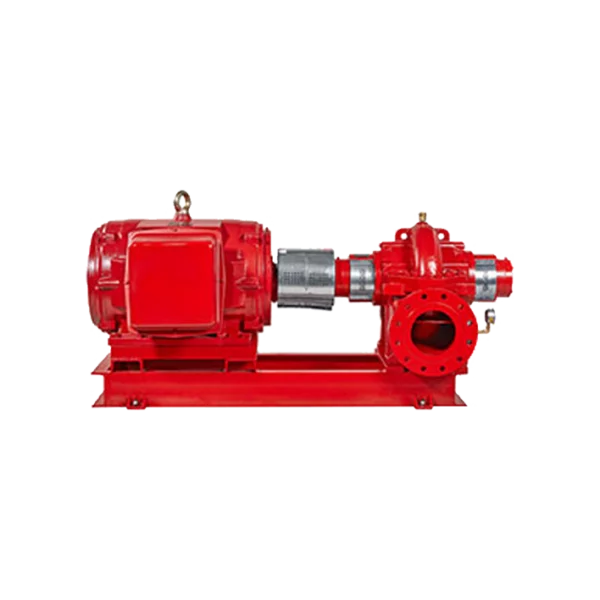
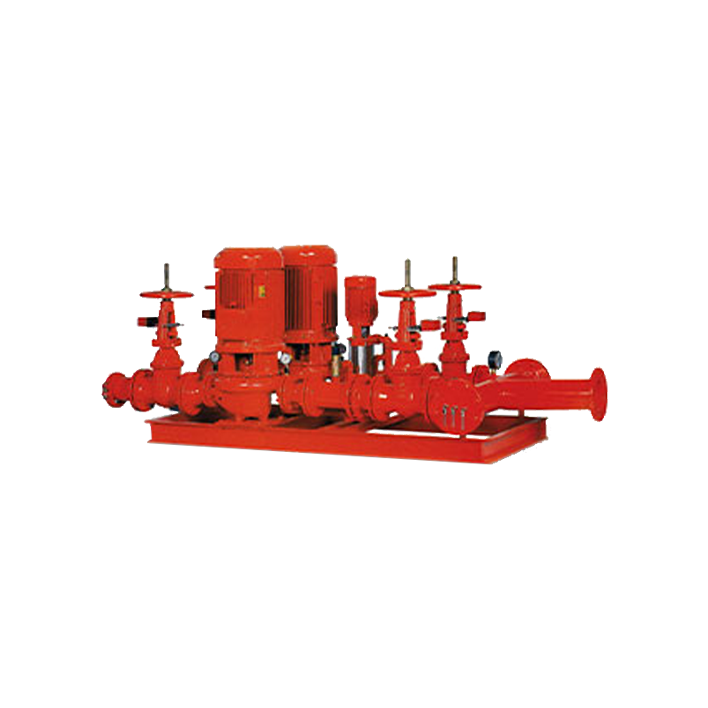
Masdaf - Fire pumps (YPH)
The YPH fire pump is a single-stage, vertical, in-line centrifugal pump designed by Masdaf in accordance with the NFPA 20 standard for electric drive operation. The series has a flow rate ranging from 20 to 260 m³/h, a head ranging from 50 to 115 m, and a speed of 3,000 rpm. The pump is designed for water at temperatures ranging from 0 to 60 °C.
What does ‘in-line layout’ mean, and why is it useful in a fire alarm system?
‘In-line’ means that the suction and discharge pipes are aligned on the same axis, and the shaft is positioned vertically. This type of pump is installed directly into a straight section of pipework without the need for a separate support frame for a horizontal unit or any transition bends. In a pumping station, this provides the key benefit — compactness: the vertical unit occupies an area comparable to that of the pipework assembly itself. For premises where the pump room is allocated on a residual basis, this is often a decisive factor.
How the YPH fire pump works
The impeller is a single-flow, closed-type design, dynamically balanced; axial forces are compensated for by balancing holes and rear wear-resistant rings. The pump and motor are connected via an adapter using a special rigid coupling, meaning that no separate support is required for the motor. The casing remains fixed to the base, whilst the pump itself can be removed for maintenance without disconnecting the pipework. Components within the series are standardised across model sizes, which simplifies the selection and storage of spare parts.
YPH NFPA Technical Specifications
| Parameter | Value |
|---|---|
| Type | single-stage vertical centrifugal pump, in-line type |
| Standard | NFPA 20 |
| Drive | electric motor |
| Capacity | 20 – 260 m³/h |
| Pressure | 50–115 m |
| Rotational speed | 3,000 rpm |
| Suction flange | DN 80 – DN 150 |
| Discharge flange | DN 65 – DN 100 |
| Fluid temperature | 0–60 °C |
| Impeller | sealed, single-flow, with balancing holes and rear wear-resistant rings |
| Shaft seal | soft gasket as required by the NFPA |
| Certification | CE; TSE ‘Centrifugal pump, Class 3’ |
We will agree on the material specification, the size and model for a specific operating point, and the motor configuration using the questionnaire.
Why does an NFPA-compliant fire pump have a gland seal rather than a mechanical seal?
This is not a simplification of the design, but a requirement of the standard. The mechanical seal allows for a controlled drip leak along the shaft, and it is precisely this leak that cools and lubricates the packing. A fire pump spends most of its service life on standby and is rarely started, but when it is, it runs at full load immediately — in this mode, a dry start is more dangerous for a mechanical seal than for packing. Furthermore, the condition of the packing can be assessed visually, and it can be tightened or replaced without dismantling the unit. Therefore, in systems designed in accordance with NFPA standards, dripping from the gland is an expected operating condition rather than a defect.
Where are YPH pumps used?
The manufacturer defines the scope of application of the series as fire suppression systems for low and medium risk levels. In practice, these are fixed sprinkler and valve-assembly systems for premises where the design flow rate does not exceed the capacity of the series, and the certification requirements are limited to NFPA 20 without separate UL/FM approval.
How does the YPH differ from other Masdaf fire pumps?
In the Masdaf range, the YPH series comprises vertical in-line models compliant with NFPA 20 and featuring an electric drive. The YNM series consists of horizontal end-suction pumps, available in versions compliant with NFPA and UL/FM-approved. The YPSP series comprises complete diesel-driven units, required where regulations stipulate independence from the mains power supply. The ENM series is a special case: a high-flow pump for shipboard and trailer-mounted Fi-Fi systems. The selection process begins not with the type of pump, but with the regulations to which the system must comply and the availability of a guaranteed power supply.
Selection, supply and service from Steiner Ukraine
A fire pump is selected based on the system’s design flow rate, taking into account the safety margin specified in the standard and losses in the pipework, rather than the maximum performance figures for the series. To carry out the calculation, Steiner Ukraine requires: the standard against which the system is being designed, the design flow rate and pressure at the control point, the characteristics of the water source, the supply diagram and the redundancy requirements. Based on this data, we determine the YPH model and size, finalise the configuration of the motor and control panel, and provide the specification together with CE and TSE certificates. Spare parts for the series are standardised, so the packing, wear rings and coupling are ordered based on the technical data sheet for the specific unit.