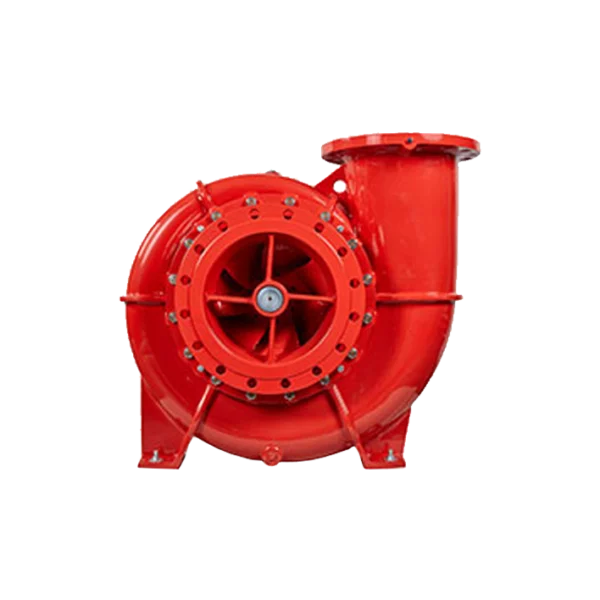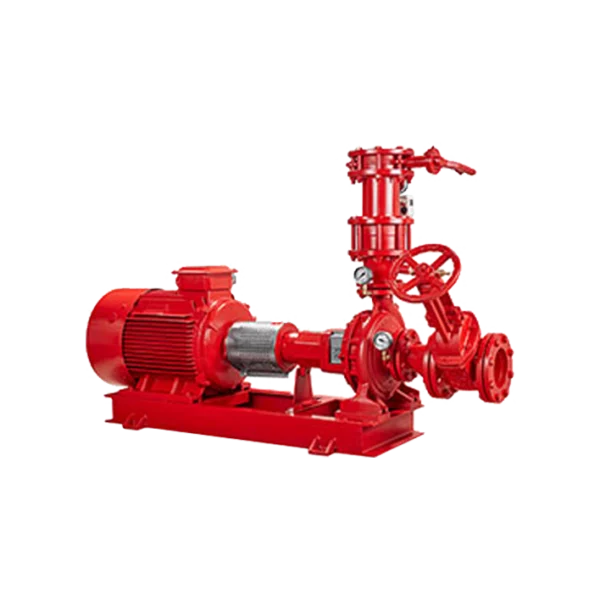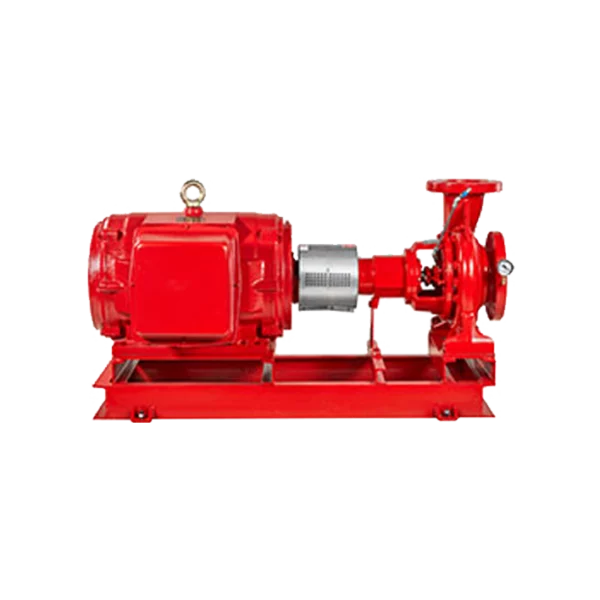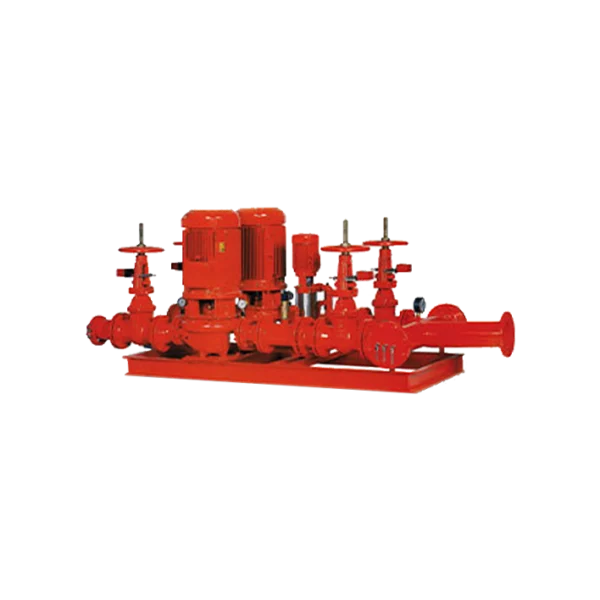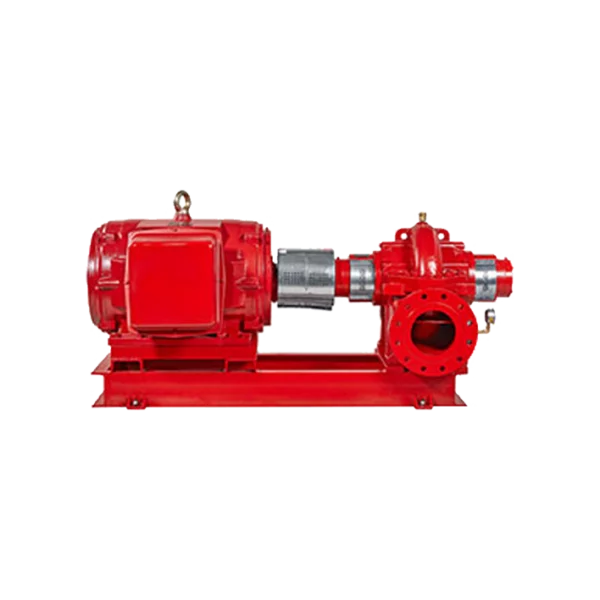
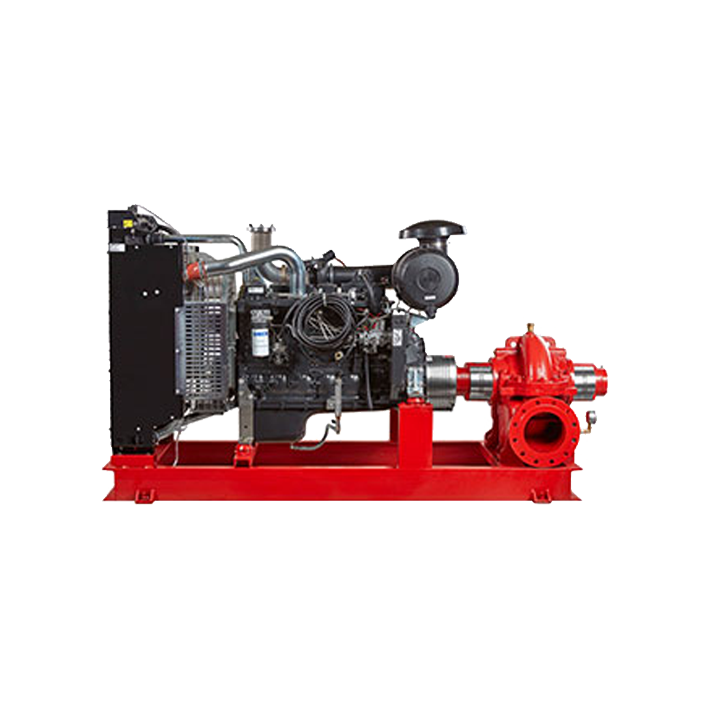
Masdaf – YPSP NFPA fire pump with split casing
The YPSP NFPA fire pump is a horizontal centrifugal pump with a split casing and double-suction design, manufactured by Masdaf in accordance with the NFPA 20 standard. According to the manufacturer’s specifications, the series has a flow rate of 30 to 2,500 m³/h, a head of 15 to 180 m, and a speed of 960 to 3,600 rpm. The pump is available with either an electric or diesel drive and is used in fire-extinguishing systems for low, medium and high-risk applications.
How a pump with a split casing works
The casing is split horizontally: the top cover can be removed, and the entire impeller is accessible without dismantling the pipework or moving the motor. The impeller is enclosed, with Francis-type blades, and is statically and dynamically balanced. As the impeller has double-suction, the axial force is automatically balanced and the shaft does not require a unloading device. The suction and discharge flanges are concentric and manufactured to DIN 2533 PN 16. The standard direction of rotation is clockwise from the drive end: suction on the right, discharge on the left. Versions with reverse rotation are manufactured to order.
YPSP NFPA Technical Specifications
| Parameter | Value |
|---|---|
| Type | horizontal centrifugal pump with a split casing and double-suction |
| Standard | NFPA 20 |
| Capacity | 30 – 2,500 m³/h (manufacturer’s specifications) |
| Pressure | 15 – 180 m (manufacturer’s guidelines) |
| Rotational speed | 960–3,600 rpm (manufacturer’s specifications) |
| Suction flange | DN 80 – DN 500 |
| Discharge flange | DN 65 – DN 350 |
| Flange standard | DIN 2533 PN 16 |
| Pressure limits | The pressure at the discharge flange must not exceed 150 per cent of the pump head |
| Fluid temperature | 0–60 °C |
| Impeller | enclosed, Francis-type blades, static and dynamic balancing |
| Shaft seal | seal chamber with Teflon braided packing and a lantern ring, water-cooled |
| Bearings | NU series cylindrical roller bearing on the motor side, 63-C3 ball bearing on the opposite side, grease lubrication |
| Drive | electric or diesel |
| Certification | CE; TSE ‘Centrifugal pump, Class 3’ |
According to the series page on the Masdaf website, the ranges are narrower: flow rate 50–1,800 m³/h, head 20–185 m, speed 1,500–3,600 rpm. In any case, the operating point is confirmed by the performance curve for the specific model.
What is included in the pump unit?
| Node | Manufactured in accordance with the manufacturer’s specifications |
|---|---|
| Electric motor | three-phase, enclosed, fan-cooled, squirrel-cage; DIN 42673 IM 1001 B3; complies with DIN, IEC and VDE |
| Insulation class | F |
| Engine protection rating | IP 54 – IP 55 |
| Frequency / operating mode | 50 Hz, S1 mode |
| Start-up procedure | up to 4 kW — 3×380 V (Y); over 4 kW — 3×380 V (Δ) with Y/Δ switching |
| Coupling | flexible, in accordance with DIN 740 |
| Coupling housing | in accordance with EN 294 |
| Frame | U-section steel, in accordance with DIN 24259 |
| Alternative drive | diesel engine |
Up to what temperature does standard packing operate?
The operating temperature range for the fluid in this series is 0…60 °C. The manual also specifies the temperature limit for the packing itself: standard Teflon packing without cooling is permitted up to 90 °C, whilst the stuffing box is water-cooled. The practical conclusion is simple: the limiting factor in the fire suppression system is not the packing, but the requirements for the water itself, and one should not exceed the specified 60 °C without consulting the manufacturer.
How to read manufacturer’s curves
The YPSP specifications are given for water with a density of 1 kg/dm³ and a kinematic viscosity of 1 sSt. For liquids with a different density or viscosity, the curves shift, and the manufacturer carries out the recalculation. The second mandatory check is the discharge pressure: this must not exceed 150 per cent of the pump head. This restriction applies both to operation with a closed valve and to situations where the pump is operating under backpressure.
Where are YPSP NFPA pumps used?
The manufacturer specifies the scope of application for this series as fire-extinguishing systems for low, medium and high-risk areas. The flow rate range of up to 2,500 m³/h covers both small sprinkler systems and large facilities with an extensive network, where a single powerful unit is required instead of a group of smaller ones.
How does the YPSP NFPA differ from the YPSP UL/FM?
The hydraulic design and split casing are identical in both series. The difference lies in the regulatory framework. The YPSP NFPA is manufactured to the NFPA 20 standard. The YPSP UL/FM also has UL 448 and FM 1311 approvals, along with associated approvals for the motor (UL 1004-5), the diesel engine (UL 1247, FM 1333) and the control cabinet (UL 218, FM 1321 / FM 1323); the flanges are manufactured to ANSI/ASME B16.1 Class 250. The choice is not dictated by the pump itself, but by the requirements of the client or insurer: if the specification calls for UL/FM, the NFPA version will not pass acceptance testing, and conversely, requiring UL/FM where NFPA 20 is sufficient means paying more than necessary.
Selection, supply and service from Steiner Ukraine
The calculation begins with the design standard and the system’s design flow rate, and concludes with a check of the operating point against the size curve. To select an YPSP NFPA, Steiner Ukraine requires: the system acceptance standard, the design flow rate and pressure at the control point, the characteristics of the water source and the available suction head, the drive type and power supply redundancy requirements. Based on this data, we determine the size, agree on the direction of rotation and the unit’s configuration, and provide a specification with certificates. Maintenance of this series is limited to checking the packing and lubricating the bearings — both operations are carried out without dismantling the casing.