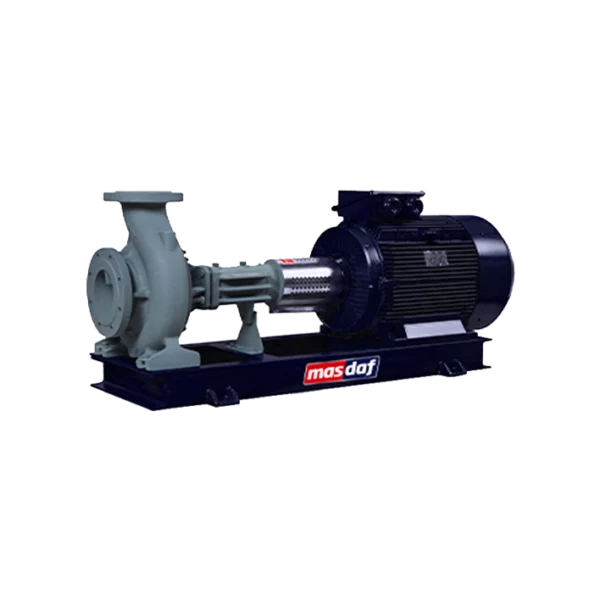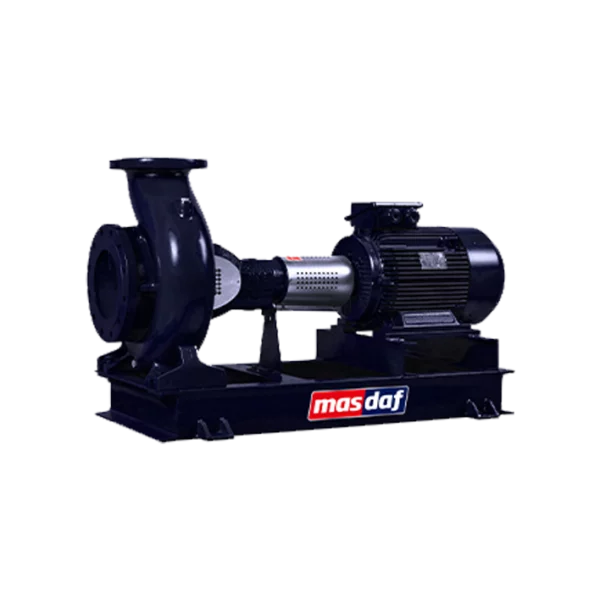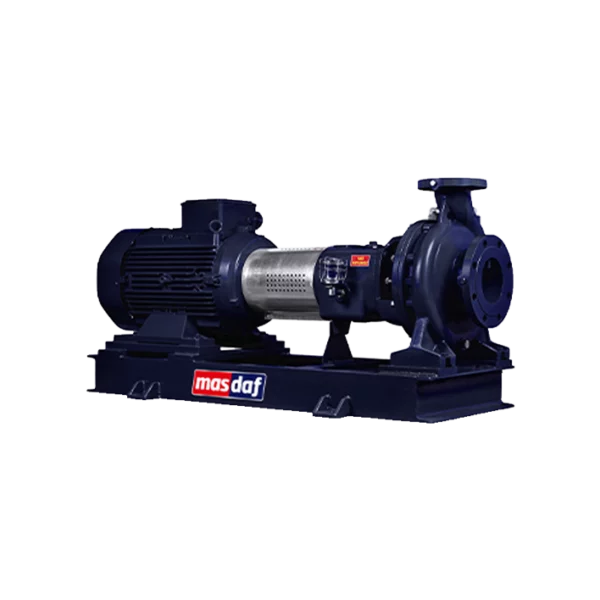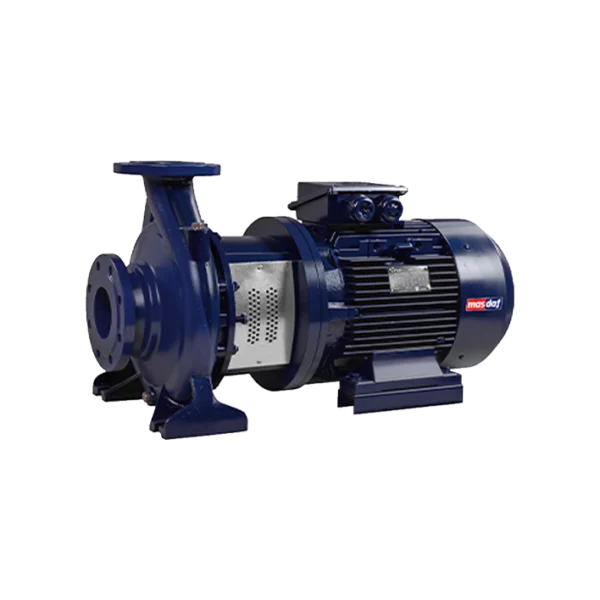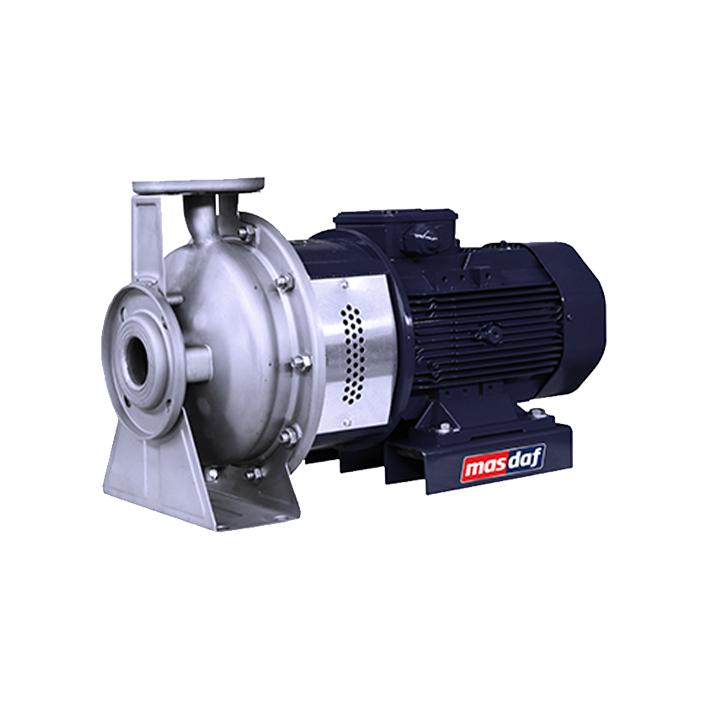
Masdaf - End suction pumps (NMP)
The NMP pump is a single-stage, end-suction centrifugal pump in a monoblock design with a stainless steel sheet casing. Flow rate from 3 to 200 m³/h, head from 10 to 70 m, suction flange DN 50–DN 150, discharge flange DN 32–DN 125, speed 3,000–3,600 rpm, temperature of the pumped liquid from −20 to +100 °C.
NMP pump: the benefits of a stainless steel casing
The housing and main components are made from sheet stainless steel rather than cast iron. This results in two differences in terms of application.
Firstly, resistance to corrosion from the pumped fluid and from external sources. A cast-iron casing in a circuit supplied with fresh water, or in a room with high humidity, will corrode over time, and the corrosion products will enter the system. Stainless steel prevents this, which is why the NMP pump is installed where the requirements for water composition are determined by the process itself, rather than solely by hydraulic considerations.
Secondly, weight and dimensions. A sheet-metal construction is lighter than a cast version of the same capacity, which explains the unit’s compact size and lower operating noise levels.
The material construction also determines the scope of application: the NMP pump is designed for water and process fluids within the temperature range of −20 to +100 °C. The specific operating conditions must be agreed separately.
NMP Pump: Technical Specifications
| Parameter | Value |
|---|---|
| Type | centrifugal, end suction, monobloc |
| Levels | one |
| Housing material | stainless steel sheet |
| Capacity | 3–200 m³/h |
| Pressure | 10–70 m |
| Revolutions | 3,000–3,600 rpm |
| Suction flange | DN 50–DN 150 |
| Discharge flange | DN 32–DN 125 |
| Fluid temperature | −20…+100 °C |
| Connection to the motor | drive shaft |
| Installation | modular design, without a foundation slab |
Why does the NMP pump only run at 3,000–3,600 rpm?
The 3,000–3,600 rpm range corresponds to a two-pole induction motor: 3,000 rpm at 50 Hz and 3,600 rpm at 60 Hz. There is no four-pole version operating at 1,500 rpm in this series.
The practical implication is the performance curve. With the same impeller dimensions, a higher rotational speed results in greater head; therefore, the series starts at 10 metres rather than a few metres. A pump operating at 3,000 rpm is not designed for circuits requiring a high flow rate at low head – a low-speed version is used in such applications.
The second consequence relates to control. If the flow rate in the system changes, the operating point is shifted by the frequency converter, reducing the speed below the rated value, rather than by throttling the valve.
How to service the NMP pump
The back-pull-out design means that access to the impeller and seal is gained from the motor side. The casing remains in the pipework, and the suction and discharge lines are not disconnected.
The NMP pump is also designed to minimise installation errors: the discharge pipe is centred at the top of the casing, and the support feet are fitted beneath the casing. The pump rests on its support in a single, defined position, and there is no need to centre the shaft during installation — the motor shaft is a push-on type, and there is no separate coupling.
How does the NMP pump differ from the NMM?
Both series are end-suction monoblock pumps, but are designed for different applications.
NMM Manufactured to DIN 24255 and EN 733 standards, it operates within a speed range of 1,500–3,600 rpm and delivers a head of up to 110 metres at a flow rate of up to 400 m³/h. Standardised dimensions mean that the pump can be replaced with an equivalent model from another manufacturer without the need to modify the pipework.
The NMP pump has a stainless steel casing, operates only at 3,000–3,600 rpm and delivers a flow rate of up to 200 m³/h at a head of up to 70 m.
The two-criteria selection rule. Based on the material: if the composition of the fluid or the process requirements rule out cast iron, the model is NMP. Based on the operating conditions: if a head of over 70 m, a flow rate of over 200 m³/h or a low-speed version at 1,500 rpm is required, the model is NMM.
Where is the NMP pump used?
The manufacturer classifies the series as industrial technology.
The NMP pump is used in water supply, filtration and water transport systems, as well as in industrial processes and as part of equipment supplied by machinery manufacturers.
This determines the standard method of supply: the pump is integrated into the system as a component, so its dimensions, weight and noise level are included in the specifications on a par with the hydraulics.
Selection and service from Steiner Ukraine
When selecting a stainless steel pump, the process begins with the fluid being pumped, rather than the head. The material of construction determines whether the pump is suitable for use at all, and only then is the model size selected to match the operating point.
We determine the composition and temperature of the fluid, the design flow rate and head, the system resistance characteristics, the available inlet head, the diameters of the existing pipework, the installation method and the need for variable speed control. Based on this, we determine the model size, flange diameters and seal type. Next come supply, service and spare parts. Steiner Ukraine has been operating in the industrial equipment market since 2006.
The following helps to identify where energy is being lost in the existing system Energy audit of pumping stations. Other items — in the section Masdaf pumps and in the catalogue industrial pumps and hydraulic systems.