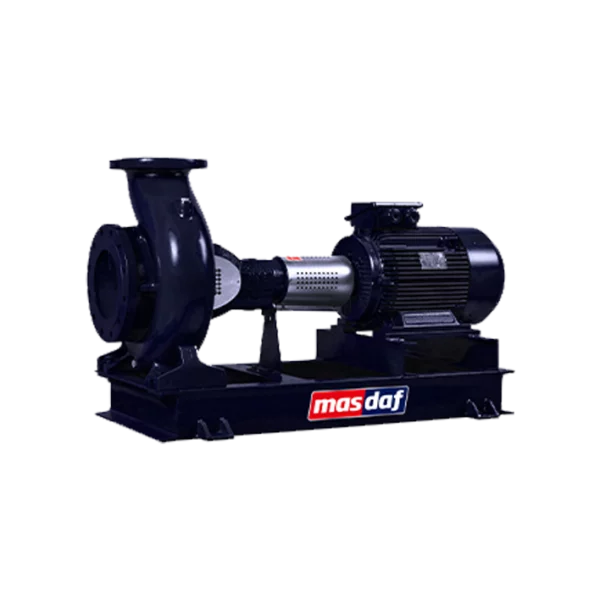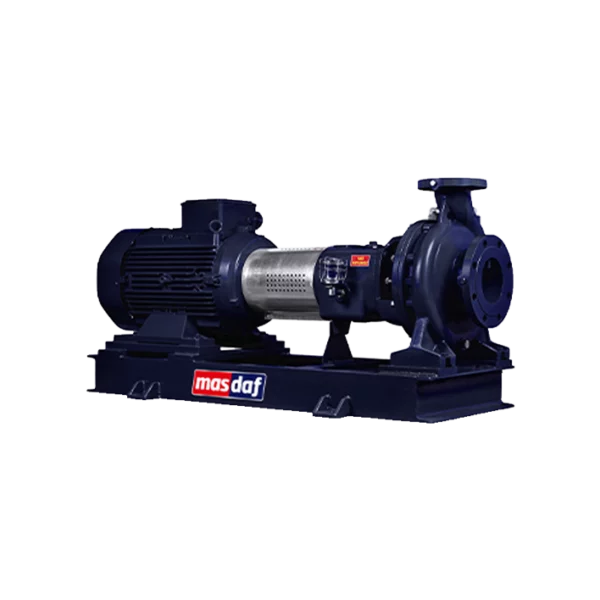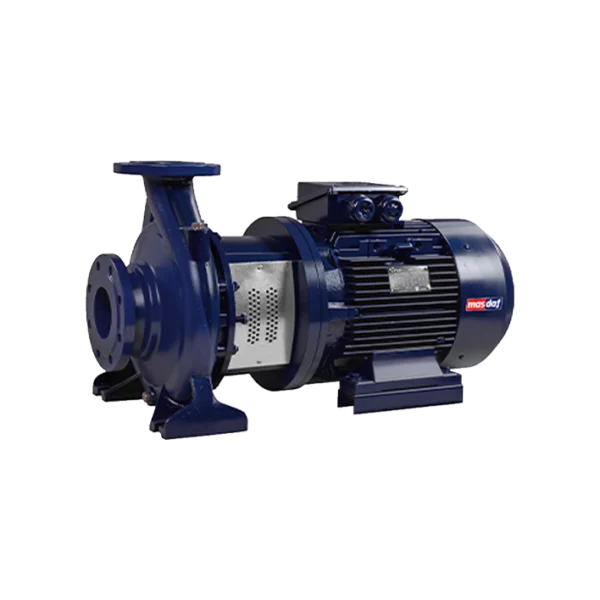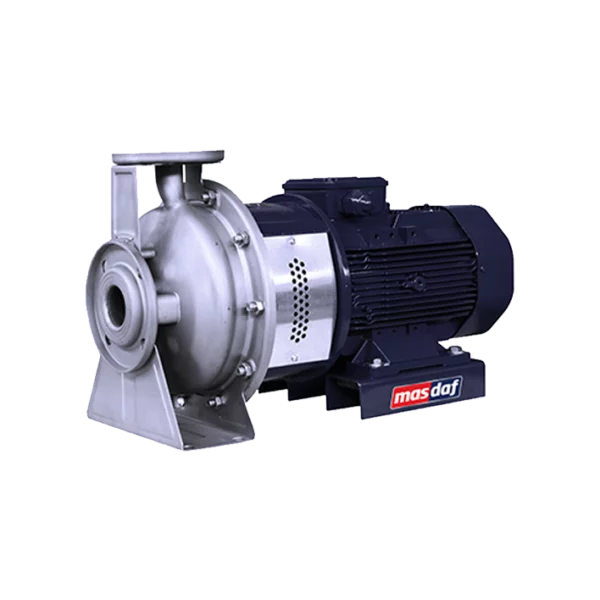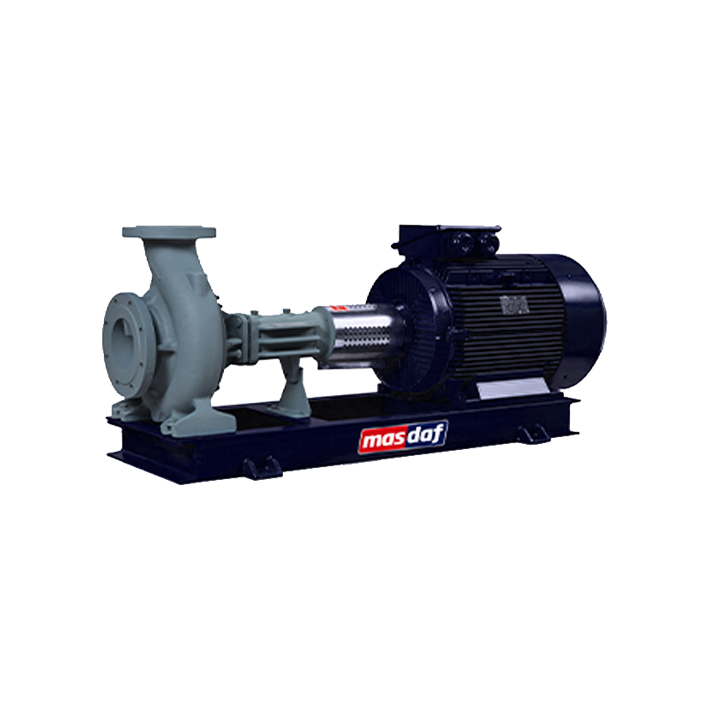
Masdaf - End suction pumps (KYP)
The KYP pump is a single-stage, end-suction centrifugal pump designed for hot heat transfer fluids. Flow rate from 10 to 400 m³/h, head from 10 to 100 m, operating pressure 16 bar, suction flange DN 50–DN 125, discharge flange DN 32–DN 100, speed range 1,500–3,600 rpm. The main dimensions comply with DIN 24256, which corresponds to ISO 2858.
The KYP pump: why external cooling is not required
Pumps for hot heat transfer fluids are traditionally fitted with a cooling circuit for the seal and bearing assembly: a separate water line is connected to the pump to remove heat from components that cannot withstand the temperature of the working fluid.
The KYP pump is designed in such a way that external cooling is not required. This eliminates the need for a separate water circuit with shut-off valves and flow control, and with it the risk of a failure scenario where cooling ceases but the pump continues to operate.
For the facility, this means a simpler piping layout: only the heat transfer fluid lines are connected to the pump, with no auxiliary connections.
KYP Pump: Technical Specifications
| Parameter | Value |
|---|---|
| Type | centrifugal, end suction |
| Levels | one |
| Capacity | 10–400 m³/h |
| Pressure | 10–100 m |
| Working pressure | 16 bar |
| Revolutions | 1,500–3,600 rpm |
| Suction flange | DN 50–DN 125 |
| Discharge flange | DN 32–DN 100 |
| Impeller | closed |
| Balancing the impeller | dynamic, in accordance with ISO 21940-11 |
| Connection to the motor | flexible coupling |
| Key dimensions | in accordance with DIN 24256 (ISO 2858) |
| Cooling | No external one is required |
What do DIN 24256 and ISO 2858 mean?
DIN 24256 and ISO 2858 specify the basic installation dimensions and nominal flow rates for end-suction centrifugal pumps. ISO 2858 is an international standard, whilst DIN 24256 is its German equivalent.
Practical benefits when replacing a pump. A pump manufactured to ISO 2858 has the same connection dimensions as a pump from another manufacturer of the same size: centre line height, distance between flanges and the position of the mounting holes. When replacing a pump in a coolant circuit, there is no need to modify the pipework or the foundation, which is particularly important on hot lines — dismantling and reassembling insulated pipework costs more than the pump itself.
It is important to distinguish between the two standards in the product range: KYP pumps are manufactured in accordance with ISO 2858, whilst the series NMM Complies with DIN 24255 and EN 733. These are different size series, and the pumps from these series are not interchangeable.
KYP pump: why are there radial vanes behind the impeller?
This series features radial blades on the rear side of the impeller.
The principle is as follows. In a closed-impeller centrifugal pump, the pressure in the cavity behind the impeller is higher than at the inlet, and the pressure difference on either side of the impeller creates an axial force directed towards the suction pipe. This force is absorbed by the bearing assembly. The radial vanes on the rear disc spin the fluid in this cavity, reducing the pressure there, and the axial force is reduced.
In the case of a hot coolant, this is particularly significant: a lower load on the bearing means less heat is generated within it, and therefore a lower risk of the assembly overheating, given that it is already operating in close proximity to a hot fluid.
How to service a KYP pump
The pump and motor are mounted on a common base and connected by a flexible coupling. The shaft and rotating parts can be removed without dismantling the suction and discharge pipework — the casing remains in the pipework.
In hot-service applications, this is a crucial feature: the heat-transfer fluid pipeline is insulated, and the flanged joints on it operate at high temperatures; therefore, each time they are opened, the circuit must be cooled down, the gaskets replaced and the joints retightened. The design of this series allows the seals or the impeller to be replaced without touching these joints.
The series is based on standard components, so spare parts are available without a long wait.
Where is the KYP pump used?
The manufacturer classifies this series as industrial technology and specifies its use for heat transfer fluids with temperatures above the point at which water in the circuit is no longer effective.
Sectors: chemical plants and oil refineries; the textile, paper, sugar, food, pharmaceutical and leather industries; the manufacture of rubber, plastics and synthetic fibres; heat treatment and heating processes.
What these applications have in common is that they use a heat transfer fluid circuit rather than a water circuit: the process temperature exceeds the capabilities of a water-based system, so thermal oil is used as the heat transfer fluid, and the pump is selected to suit its viscosity and temperature.
Selection and service from Steiner Ukraine
When selecting a heat transfer fluid pump, the process begins with the fluid itself and its inlet temperature, rather than the flow rate. The viscosity of thermal oil varies significantly with temperature, so the pump’s operating characteristics differ from those specified in the catalogue, which are based on water.
We specify the type of coolant, the inlet and circuit temperatures, the design flow rate and head, the system resistance characteristics taking into account isolated sections, the available inlet head, and the piping layout. Based on this, we determine the size according to ISO 2858, the seal type and the motor specifications. Next come supply, service and spare parts. Steiner Ukraine has been operating in the industrial equipment market since 2006.
The following helps to identify where energy is being lost in the existing system Energy audit of pumping stations. Other items — in the section Masdaf pumps and in the catalogue industrial pumps and hydraulic systems.