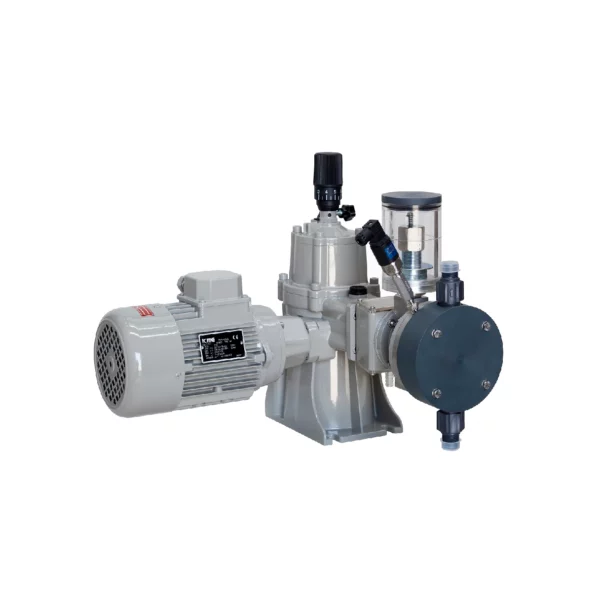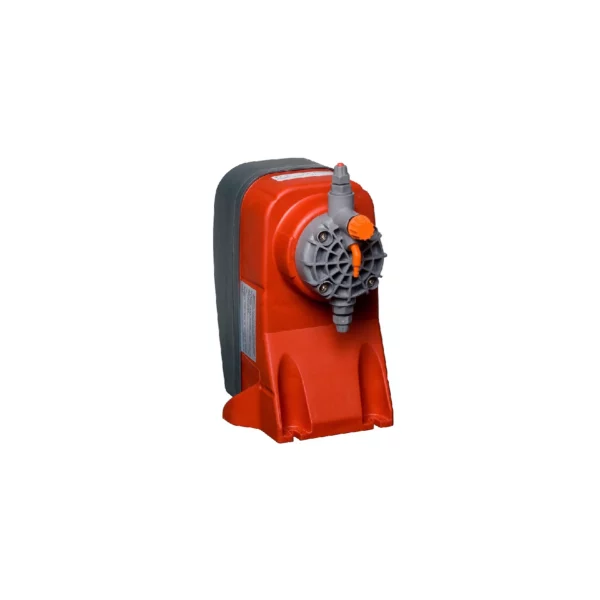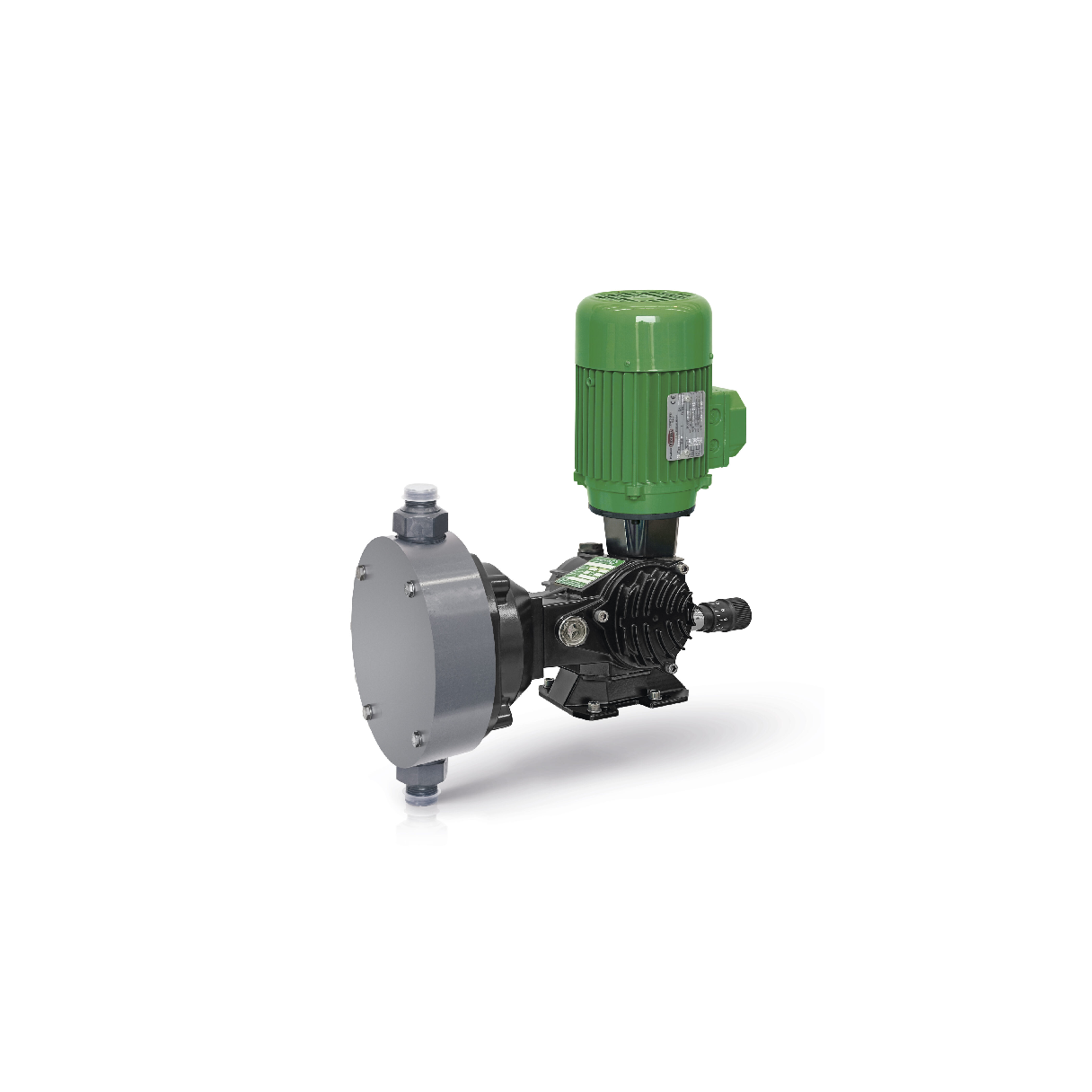
Doseuro - Dosing pumps (Spring return)
Doseuro SR dosing pump — spring return plunger family. Five head types cover flow rates from 14 to 1400 l/h and pressures from 3 to 250 bar.
This is the widest range of Doseuro models in terms of execution options: from a compact 14 l/h monoblock to a 250 bar plunger pump. ATEX execution is available.
Steiner Ukraine supplies Doseuro equipment to Ukraine: selection according to reagent and duty point, supply, service, spare parts.
What is a Doseuro SR dosing pump?
Spring return means that the working stroke of the plunger is driven by the actuator, while the return stroke is performed by the spring.
The design is simpler and cheaper than forced return. The trade-off is that at very high pressures, the spring force becomes the limiting factor, and for such operating conditions the manufacturer has a separate family PDP.
For the majority of industrial dosing tasks — water treatment, chemical processing, CIP, food processes — the capabilities of the SR are sufficient.
The family is part of the model range Doseuro, an Italian manufacturer in the FPZ group.
What five types of heads are in the series?
| Type | Head design | Flow rate, l/h | Pressure, bar |
|---|---|---|---|
| A | plunger | 15–57 | 250 |
| D | mechanical membrane | 49–1400 | 3–14 |
| B / BR | hydraulic diaphragm (single) | 108–1068 | 6,2–20 |
| SD | sandwich-type hydraulic diaphragm | 60–1068 | 7,2–40 |
| FM series | mechanical-membrane, all-in-one | 14–47 | 5–10 |
General limits of the product range: flow rate 14–1400 l/h, pressure 3–250 bar.
The pattern is the same as in all positive-displacement pumps: the higher the pressure, the lower the flow rate. Type A delivers 250 bar, but a maximum of 57 l/h. Type D delivers 1400 l/h, but up to 14 bar.
How to choose the type for the environment and pressure?
The choice is determined not by the delivery method, but by how hazardous the reagent is and whether its contact with the actuator is permissible.
| Condition | Type | Why |
|---|---|---|
| Safe liquid, high pressure required | A | The plunger contacts the reagent, yet it delivers 250 bar |
| Critical or hazardous liquid, leakage unacceptable | D | mechanical diaphragm isolates the reagent, largest capacity in the family |
| Toxic or corrosive environment with suspended particles | B / BR | hydraulic membrane, BR features a safety valve |
| Hazardous liquid, membrane integrity check required | SD | two membranes, accessible rupture detector |
| Compact, maintenance-free solution, low flow rate | FM series | sealed for life monoblock |
Plunger head (A) — the simplest and cheapest at high pressure, but the plunger works directly in the reagent. Suitable only for safe liquids.
Mechanical membrane (D) — the pusher moves the membrane directly. The reagent is separated from the drive, the design is simple.
Hydraulic membrane (B/BR) — hydraulic fluid is located between the plunger and the diaphragm. This removes mechanical stress from the diaphragm and extends its service life, which is why such heads are chosen for suspended solids.
"Sandwich" membrane (SD) — two membranes with a controlled space between them. If one ruptures, the reagent does not escape to the outside.
All-in-one PC (FM) — most compact design, lifetime lubrication, maintenance-free.
Why a vertical geared motor?
In the SR family, the engine is mounted vertically via a gearbox.
| Consequence | What does this achieve? |
|---|---|
| Vertical layout | Smaller pump footprint on the frame or in the cabinet |
| Gearbox | low plunger speeds are achieved mechanically, without a frequency converter |
| Engine on top | actuator further away from potential reagent leaks |
For a dosing skid, where multiple pumps, a tank, and pipework are mounted on a single frame, space-saving is a practical factor.
What safety devices are built-in?
A positive displacement pump with the discharge valve closed continues to deliver the same volume. The pressure rises until the pipeline bursts. The manufacturer builds in protection in several ways.
| Type | Defence |
|---|---|
| A, execution of AP | internal safety valve |
| BR | safety valve (difference from type B) |
| SD | internal pressure relief and discharge valve; available membrane rupture detector |
Designation BR differs from B precisely by the presence of a safety valve. This is not different hydraulics, but a different specification.
The membrane rupture detector in the SD type gives a signal when the first membrane is damaged — before the reagent escapes the pump.
What materials is the Doseuro SR dosing pump made from?
| Material | Where is it used |
|---|---|
| Stainless steel S.S. 316L | acids, alkalis, growth media, high pressure |
| PVC | moderately aggressive aqueous solutions |
| PP (polypropylene) | acids and alkalis |
| PVDF | strong acids, oxidising agents, hypochlorite |
| PTFE | broadest chemical resistance |
The manufacturer provides this list for types A, D and B/BR. The material is selected according to the specific reagent, its concentration and temperature.
What are the benefits of the Rapida 2.0 inverter motor?
Rapida 2.0 – a digital inverter motor developed by the manufacturer specially for the SR family.
| Function | Purpose |
|---|---|
| Graphical display | setup without external remote control |
| Manual mode | direct feed task |
| 4–20 mA analogue signal | controller management |
| RS485 / Modbus | integration into the process control system |
| Level control | stop on empty reagent container |
| Batch dosing | prescribed dose |
| Delay start | synchronisation with the process cycle |
| Alarm system | rejection notification |
| Fill tool | quick start after stopping |
Without an inverter, the feed rate is adjusted manually by the stroke length. With Rapida 2.0, speed control and remote control are added – the pump becomes a controllable element of the system rather than a manually adjusted device.
When to choose the Doseuro SR dosing pump and when other families?
| Condition | SR | Other families |
|---|---|---|
| Flow rate 14–1400 l/h | yes | — |
| Flow rate over 1400 l/h | no | PDP up to 4028 l/h |
| Flow rate up to 22 l/h, compact size, 230 V power supply | excessively | SDP |
| Pressure up to 250 bar at low flow rate | Type A | PDP type A-I at a higher feed rate |
| Compliance with API 675 is required | not specified | PDP |
| ATEX compliance is required | yes | PDP as well |
| I need a membrane rupture detector | SD type | PDP type SDI |
| A remote control is required | Rapida 2.0 | SDP has a built-in microprocessor |
Rule of thumb: SR is the working family for most industrial dosing tasks. PDPs are chosen when the process falls under API 675 or a flow rate of over 1400 l/h is required. SDPs are for when very little reagent is needed.
Frequently asked questions about the Doseuro SR dosing pump
spring return
Spring plunger return: the actuator provides the working stroke, while the spring performs the return stroke.
How many head types are in the family?
Five: A, D, B/BR, SD, FM.
What is the maximum flow rate?
1,400 l/h - Type D with mechanical diaphragm
What is the maximum pressure?
250 bar — type A plunger.
Why is it not possible to get 1400 l/h and 250 bar simultaneously?
These are different types of heads. Type A delivers 250 bar at a flow rate of up to 57 l/h, type D delivers 1400 l/h at a pressure of up to 14 bar.
What is the difference between BR and B?
By the presence of a safety valve. The hydraulics are the same.
What type should I choose for a toxic reagent?
SD type with a 'sandwich' diaphragm — if one diaphragm ruptures, the reagent does not escape, and a rupture detector is available. Type B or BR is also suitable for media containing suspended particles.
Is there an ATEX version available?
Yes, the manufacturer claims ATEX for the SR family.
What materials are available for contact with the reagent?
S.S. 316L, PVC, PP, PVDF and PTFE.
Can the pump be controlled remotely?
Yes, via the Rapida 2.0 motor inverter: 4–20 mA analogue signal, RS485 or Modbus, plus level control, batch dosing, and delayed start.
Which type is the most compact?
FM — monoblock design with lifetime lubrication, flow rate 14–47 l/h, pressure 5–10 bar.
Enquiry for selection and price via ContactsOther equipment from the manufacturer — DoseuroAdjacent families: Positive return and Solenoid. Sections: Pumps and systems, Pumps for food production, Spare parts.