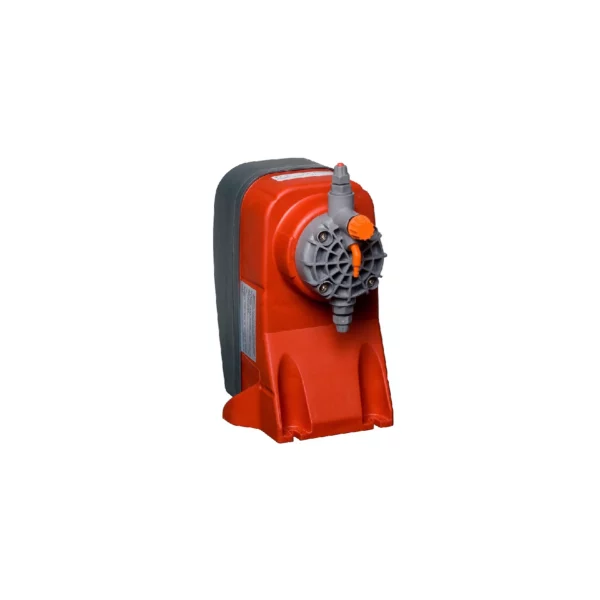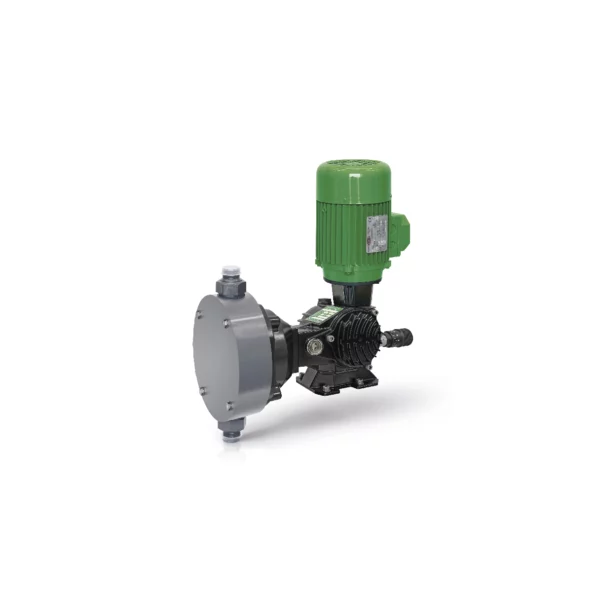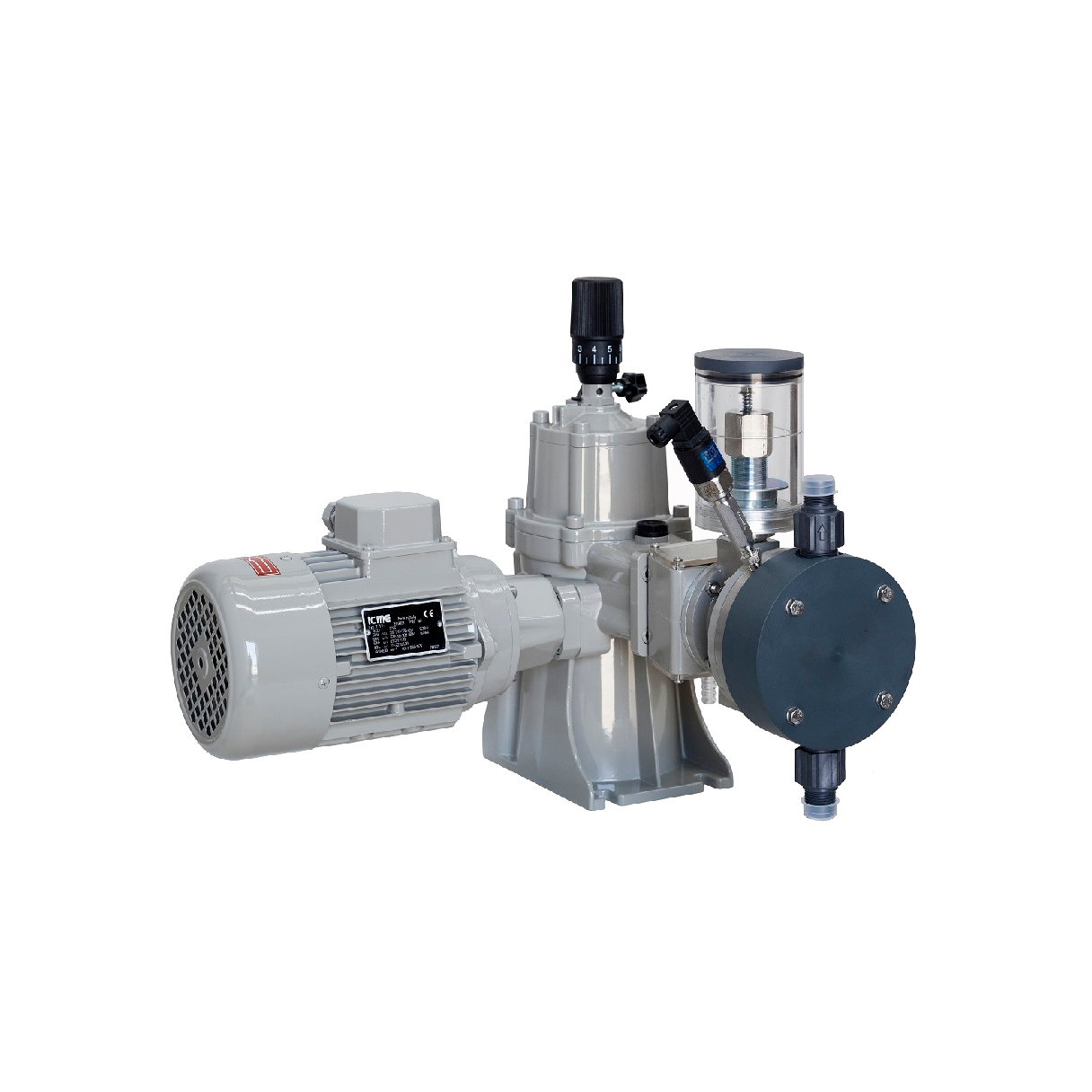
Doseuro – Dosing pumps with positive return to API (Positive return)
Doseuro PDP dosing pump — is a family with forced plunger return, designed to the API 675 standard. Three head types cover capacities from 44 to 4,028 l/h and pressures from 14 to 250 bar.
All three types are available in ATEX execution and are suitable for multi-head configurations. Dosing accuracy is ±1 % in the range from 10 to 100 % of nominal output.
Steiner Ukraine supplies Doseuro equipment to Ukraine: selection according to reagent and duty point, supply, service, spare parts.
What is a Doseuro PDP dosing pump?
A positive return, or forced return, means that the plunger moves in both directions from the actuator. In lighter designs, the plunger is returned by a spring.
The difference becomes apparent under pressure. The spring has a finite force, and at high back pressure, the plunger does not return completely—the dose "drifts". Forced return does not have this issue: the stroke is set by the drive mechanics and does not depend on the line pressure.
Hence the application range of the family: high pressure, large delivery rates, and processes where the flow rate must be maintained regardless of the operating mode.
This is the heaviest family in the lineup Doseuro.
What three types are in the family?
| Type | Head design | Flow rate, l/h | Pressure, bar | Materials |
|---|---|---|---|---|
| A-I | plunger | 44–3569 | 40–250 | 316L, PVC, PVDF |
| SDI | sandwich-type membrane | 231–4028 | 14–80 | 316L, PVC, PVDF |
| MR I | high-pressure sandwich membrane | 395–2390 | 200 (all models) | 316L |
All three types are manufactured using API 675available in the execution ATEX and share a common drive — an internal worm gear in an oil bath.
How to choose the type for the environment?
Choice is determined not by the feed, but by the nature of the reagent.
| Nature of the environment | Type | Why |
|---|---|---|
| Clean, safe liquids without suspended particles, high pressure required | A-I | The plunger contacts the reagent, yet delivers up to 250 bar |
| Toxic, corrosive, hazardous media, including those with suspended particles | SDI | The diaphragm isolates the reagent from the actuator, zero leakage |
| The same, but with very low inlet pressure | MR I | mechanical hydraulic topping up allows operation with minimal backpressure |
A-I — plunger head. The plunger moves directly in the reagent. This provides the highest pressure in the family, but requires the liquid to be clean and safe. Optionally, the manufacturer adds flushing and leak collection.
SDI — a membrane head with two membranes. The reagent does not come into contact with the actuator at all.
MR I — the same ‘sandwich’ diaphragm, but with mechanical hydraulic fluid replenishment and an internal safety valve. The key difference is its ability to operate at very low inlet pressure, when the reagent container is positioned below the pump or under vacuum.
What are the benefits of an oil-immersed worm drive?
All three types use an internal worm gear with full lubrication in an oil bath.
| Property | Practical consequence |
|---|---|
| Worm drive | large single-stage gear ratio, compact gearbox |
| Full immersion in oil | Gearing and bearings do not run dry |
| Enclosed gearbox housing | no periodic lubrication points |
The worm gear is self-locking: in the event of a power outage, the drive does not turn backwards under line pressure. For high-pressure dosing, this is an additional safety feature.
What does zero leakage and membrane rupture detector mean?
The manufacturer allocates Zero Leakage Technology for SDI and MR I types.
A sandwich-type membrane consists of two membranes with a controlled space between them. The reagent presses on the first one, and the actuator hydraulic fluid on the second.
| Event | What is happening |
|---|---|
| Working mode | The reagent is completely isolated from the drive and from the atmosphere. |
| Rupture of the first membrane | the reagent gets into the space between the membranes, it does not leak to the outside |
| Detector activation | the system signals a disconnection |
The manufacturer supplies the SDI type with a membrane rupture detectorThis means the damage is visible before the reagent moves beyond the pump.
For toxic and corrosive reagents, this is not a convenience but a safety requirement: a leak of a concentrated acid or oxidiser indoors is an emergency.
What materials is the Doseuro PDP dosing pump made of?
| Material | Where is it used |
|---|---|
| Stainless steel 316L | standard for all three types; the only declared material for MR I |
| PVC | A-I and SDI types; moderately aggressive aqueous solutions |
| PVDF | A-I and SDI types; strong acids, oxidising agents, hypochlorite |
Type MR I the manufacturer lists only 316L steel as the standard material.
The material is selected for a specific reagent, its concentration and temperature. This is the first thing that needs to be specified in the enquiry.
Can several dosing heads be fitted to a single drive?
Right. The manufacturer explicitly states the suitability of all three types for multi-head configurations.
This has two practical effects.
The first — simultaneous dosing of multiple reagentsOne drive, multiple heads, the dose ratio is set by the stroke length of each head and does not "drift" between them, because they all move from a single shaft.
The second — savingsOne gearbox and one motor instead of two or three sets. Less space on the frame, fewer cables, one maintenance point.
A typical case is a plant where coagulant and flocculant must be dosed simultaneously at a fixed ratio.
When is a Doseuro PDP dosing pump needed, and when is the lighter series required?
| Condition | PDP | Lighter series |
|---|---|---|
| Pressure over 40 bar | yes | SR up to 250 bar only in plunger type A |
| Flow rate over 1400 l/h | yes, up to 4028 | SR maximum 1400 |
| Compliance with API 675 is required | yes | not specified |
| Zero leakage with a rupture detector required | SDI, MR I | SD type in the SR series - "sandwich" without detector |
| Very low inlet pressure | MR I | not stated |
| Multiple heads on a single drive | yes | — |
| Flow rate up to 22 l/h, compact | excessively | SDP |
| Simple water treatment, moderate pressure | excessively | SR |
The rule is simple. PDPs are taken when the process falls under API 675, or when pressure and flow rate exceed the capabilities of the SR series, or when reagent leakage is unacceptable and diaphragm integrity monitoring is required.
Frequently asked questions about the Doseuro PDP dosing pump
What is a positive return?
Forced plunger return: the plunger is driven in both directions by the actuator rather than being returned by a spring. The dosing rate is independent of the backpressure in the line.
How many types are in the family?
Three: A-I, SDI and MRI.
What is the maximum flow rate?
4028 l/h — SDI type.
What is the maximum pressure?
250 bar — plunger type A-I.
What is the dosing accuracy?
±1 % in the range from 10 to 100 % of nominal flow rate.
Do API 675 pumps comply?
Yes, all three types of the family. This is the American Petroleum Institute standard for controlled-volume positive displacement pumps.
Is there an ATEX version available?
Yes, for all three types.
What type should I choose for a toxic reagent?
SDI or MR I. Both have a sandwich-type membrane and zero-leakage technology; the SDI is equipped with a membrane rupture detector.
How does MRI differ from SDI?
The MR I features mechanical hydraulic filling and operates at a very low inlet pressure. Its pressure is fixed at 200 bar for all models, whereas the SDI delivers 14–80 bar with a higher flow rate.
What's the occasion?
Internal worm gear with full lubrication in an oil bath, identical for all three types.
Can several reagents be dosed with a single pump?
Yes, the family is suitable for multi-head configurations — several dosing heads on a single drive.
What steel is the flow path made of?
Standard — 316L. For types A-I and SDI, PVC and PVDF are additionally available.
Enquiry for selection and price via ContactsOther equipment from the manufacturer — DoseuroLighter series: Spring return and Solenoid. Sections: Pumps and systems, Industrial pumps, Spare parts.