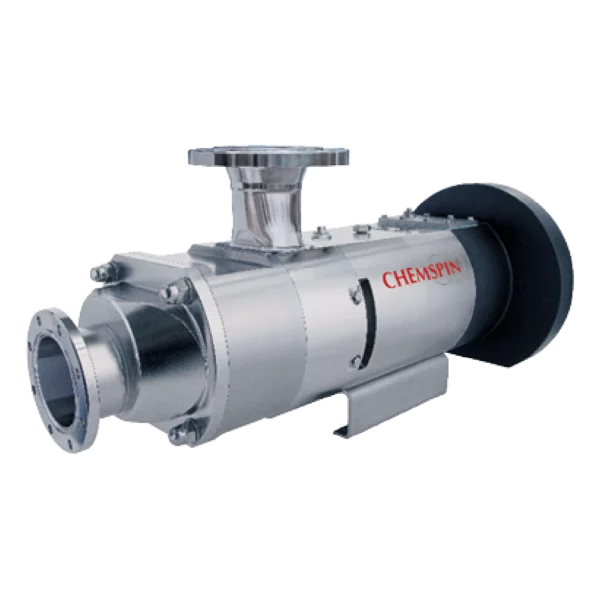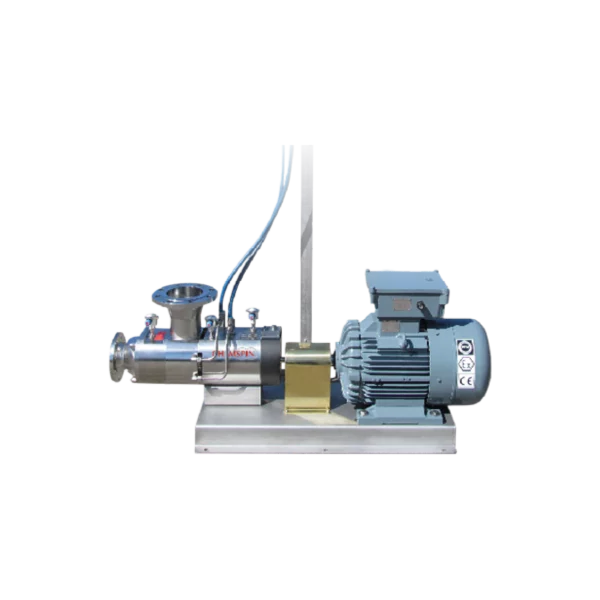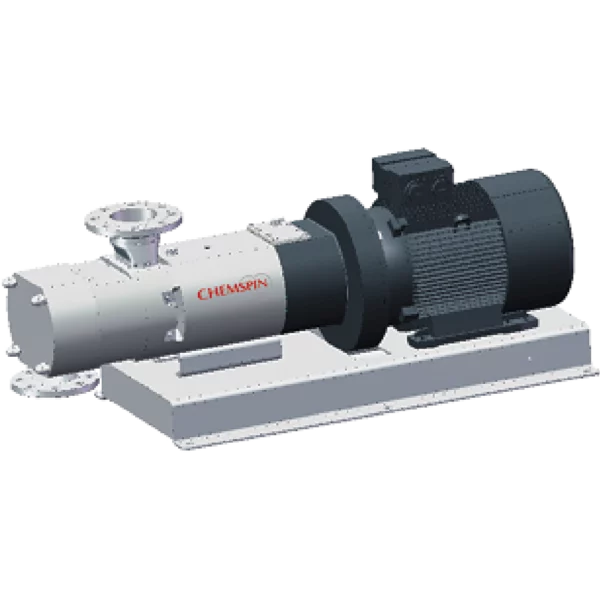

CHEMSPIN screw pump
Manufacturer: Jung Process Systems
Category: Industrial screw pumps
Industries: Chemicals, Paints and coatings, Adhesives, Detergents
Model range: 5 sizes: 50, 70, 90, 105, 125
CHEMSPIN screw pump — the base model of the industrial CHEMSPIN series by Jung Process Systems. The 1.4404 stainless steel twin screw pump handles aqueous and highly viscous media, suspensions with solids and gas-laden liquids. Flow rate up to 300 m³/h, differential pressure up to 35 bar, viscosity up to 1,000,000 mPa·s.
CHEMSPIN screw pump: technical data
| Size | Max. flow rate, m³/h | Max. differential pressure, bar | Max. solids size, mm |
|---|---|---|---|
| CHEMSPIN 50 | 20 | 20 | 16 (25) |
| CHEMSPIN 70 | 40 | 25 | 20 (30) |
| CHEMSPIN 90 | 100 | 30 | 28 (45) |
| CHEMSPIN 105 | 180 | 20 | 35 |
| CHEMSPIN 125 | 300 | 35 | 46 (67) |
| Parameter | Value |
|---|---|
| Viscosity | 0.5–1,000,000 mPa·s, higher on request |
| Medium temperature | -10…+180 °C, higher upon request |
| Absorption | NPSHr from 0.5 m, suction lift up to 9 m |
| Standard material | stainless steel 1.4404 |
| Design | block design or bare shaft end |
| Installation | horizontal, vertical, lateral; INLINE version |
| Accession | various sizes and standards on request |
What does CHEMSPIN offer in a chemical process?
- Wide range with one size. One pump covers a wide range of flow rates and pressures. According to the manufacturer, the same range would require several sizes of side channel pumps with up to 8 stages.
- Self-priming and gas. The pump is self-priming and handles gas-laden media. It is suitable for unloading and transfer between tanks.
- Low cavitation risk. NPSH values are low over the entire operating range, including near zero flow.
- Reversing. The pump runs in both directions, which reduces the number of pump types on site.
- Wear resistance. The screws are hardened and do not touch the casing. Abrasive and lumpy media are permitted.
- Quiet operation. Vibration and noise levels are very low.
- Installation. The ports are on opposite sides, which simplifies integration into an existing system.
Where is the CHEMSPIN screw pump used?
| Application | Pump task |
|---|---|
| Solvent-based adhesives | pumping media with high cavitation risk |
| Underbody protection coatings | gentle pumping of formulations with sensitive components such as glass beads |
| Tank farms | filling, emptying and circulation |
| Paints and coatings | pulsation-free pumping and filling |
| Cleaning products | pumping corrosive or abrasive liquids |
On selecting a pump for aggressive media — see the article “How to select a pump for aggressive and chemically active liquids”. Other items — in the section “Chemical pumps”.
Which CHEMSPIN version to choose?
| Task | Implementation |
|---|---|
| Flowable media, differential pressure up to 35 bar | base CHEMSPIN |
| Highly viscous media that do not flow by gravity | CHEMSPIN ES |
| Hazardous areas, zones 1, 2, 21, 22 | CHEMSPIN ATEX |
| Replacing a rotary lobe or circumferential piston pump in an existing line | CHEMSPIN INLINE |
Materials, elastomers, shaft seals and certificates are common to the whole range — see the Jung Process Systems page.
Selection and service from Steiner Ukraine
To select a CHEMSPIN, we clarify:
- the medium, its chemical aggressiveness and viscosity at operating temperature;
- gas and solids content;
- flow rate, differential pressure and suction conditions;
- need for reversing and duty modes — unloading, circulation, filling;
- the ATEX zone, if any.
Based on these data we define the size, version and seal. Then come supply, service and spare parts. Steiner Ukraine has been operating in the industrial equipment market since 2006.
FAQ about the CHEMSPIN screw pump
Can CHEMSPIN run dry?
Yes, with a suitable shaft seal. The manufacturer supplies dry-run safe variants.
Does CHEMSPIN handle gas-laden liquids?
Yes. The pump is self-priming and tolerates gas inclusions, so it is suitable for tank unloading.
Can the CHEMSPIN flow direction be reversed?
Yes, the pump operates in reverse mode.
What steel is CHEMSPIN made of?
Standard: stainless steel 1.4404. Optional: 1.4539 or 1.4462; other materials on request.