LIVERANI
Country: Italy
Year of foundation: 1950
Type of equipment: Pumps
Industries: Food, Beverages, Pharmaceutical, Other
LIVERANI pumps are manufactured by the Italian company LIVERANI s.r.l. (Via De’ Brozzi 94, 48022 Lugo, Province of Ravenna). The company was founded in the 1950s and has over 70 years’ experience in pump manufacturing. Its specialisation is narrow and consistent: the pumping of viscous liquids and media containing suspended solids. The equipment is manufactured in accordance with CE standards. LIVERANI exports its products worldwide. In Ukraine, the equipment is supplied by Steiner Ukraine.
Which LIVERANI pumps can be ordered in Ukraine?
The manufacturer’s product range comprises nine product groups.
| Group | Purpose |
|---|---|
| Stainless steel impeller pumps | gentle pumping of viscous liquids and media containing solid particles |
| Water-ring self-priming pumps | self-priming in the presence of gas in the medium |
| Screw pumps with oscillating stator | heavy liquids containing solid particles |
| Fixed stator screw pumps | the MXF and MXF INCA series |
| Gear-type positive displacement self-priming pumps | viscous liquids without solid particles |
| Piston pumps for filter presses | pressurised feed to the filtration system |
| Screw-type continuous presses | pressing of grapes and moist fibrous raw materials |
| Pumps and fans for shipbuilding | a separate maritime range |
| Accessories | components for all groups |
The main and most extensive group consists of impeller pumps. These are featured in the Steiner Ukraine catalogue across nine series.
How a flexible impeller works
The impeller is made of elastomer and has flexible blades. As the impeller rotates, the blades deform against the casing wall. Enclosed volumes are formed between them, which draw in the fluid at the inlet and carry it to the outlet.
Five properties follow from this principle.
Self-priming up to 6 metres. The pump fills the suction line automatically, without the need for pre-filling.
Positive displacement. The flow rate is proportional to the rotational speed. Therefore, the flow rate is controlled by the rotational speed rather than by throttling: a shut-off valve on the discharge side of such a pump does not regulate the flow rate correctly and places a strain on the seals.
Gentle pumping. The product does not pass through a high-shear zone. The structure remains intact and the product is not aerated. This is the main reason why such pumps are used in winemaking and in the dairy industry.
Passage of solid particles. Particles in suspension pass between the blades without being crushed.
Reversibility. The pump operates in both directions of rotation. This is used to empty the pipeline and return any remaining product to the tank.
There is one limitation, but it is a significant one. Prolonged operation without liquid in the housing is not permitted. The blades are in constant contact with the wall, and without liquid they will be damaged by friction.
The second factor affecting service life is rotational speed. The lower the rotational speed, the better the chamber is filled, the less displacement there is, and the slower the elastomer wears out. Therefore, series with lower rotational speeds result in a longer service life for the wheel in the same environment.
Impeller material: NR, CR, NBR, EPDM or VMQ
The impeller is a wear part and, at the same time, the key component for compatibility with the medium. LIVERANI offers five types of elastomer.
| Material | Designation | Typical application |
|---|---|---|
| Natural rubber | NR | water, wine, general food liquids |
| Neoprene | CR | oils, moderately corrosive media |
| Nitrile | NBR | fats, mineral oils, petroleum products |
| EPDM | EPDM | hot water, cleaning solutions, alkalis |
| Silicone | VMQ | food and pharmaceutical products |
The pump casing is made from AISI 304 or AISI 316 stainless steel. For corrosive media and pharmaceutical applications, AISI 316 is used. The shaft seal is a mechanical face seal.
Connections are available in seven standards: DIN 11851, Garolla, BSP, Macon, Triclover, SMS and BSM/RJT. This allows the pump to be fitted into an existing pipework system without the need for adaptors.
The compatibility of the elastomer with a specific product is checked before the order is placed. The impeller is supplied as a separate spare part, so the material can be changed when it is replaced.
Nine series of impeller pumps by drive type
The hydraulic system is the same across all nine series. The only difference lies in the drive system, so choosing a series means selecting the drive system that best suits the site conditions.
| The series | Drive type | When to take |
|---|---|---|
| SP | idler shaft, without a drive | Does it have its own engine, or does the hydraulics need replacing? |
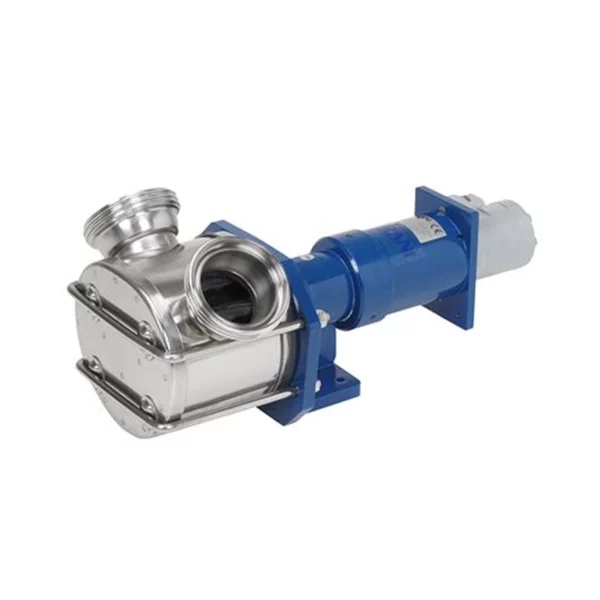
| MID | hydraulic orbital motor | There is no electricity, but the machinery is hydraulically powered |
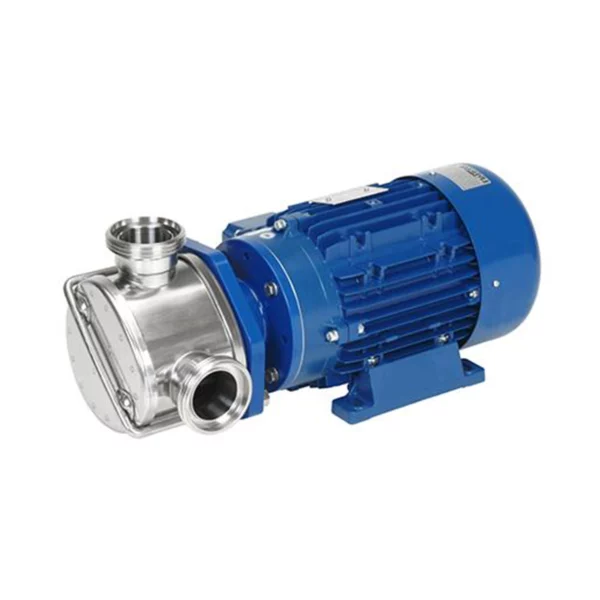
| EP | coaxial electric motor | six standard sizes; available in 12 V and 24 V versions |
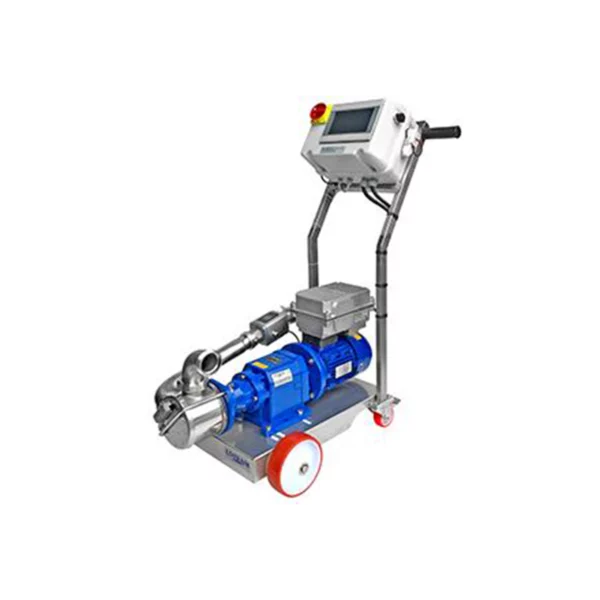
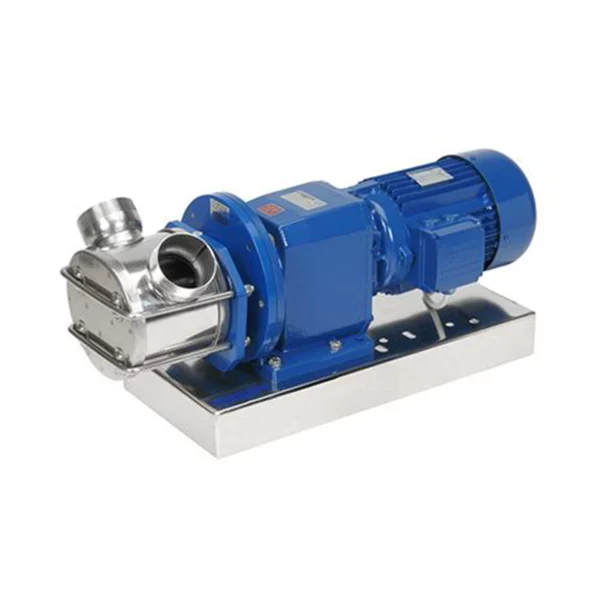
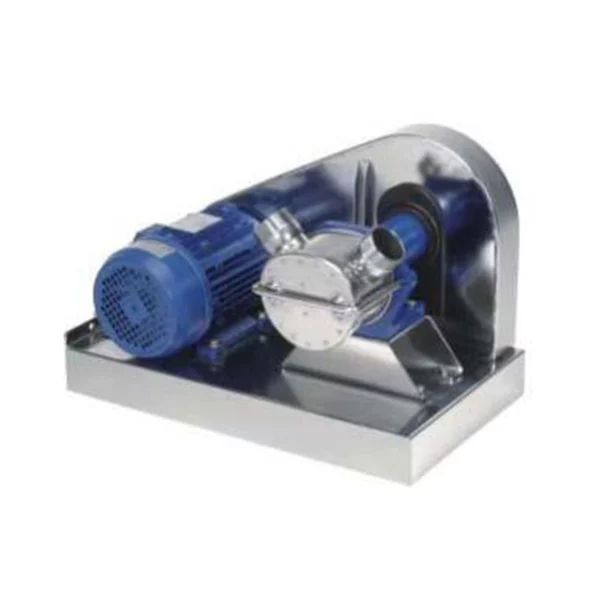
| GR | belt drive, base or carriage | mobility is required, maximum pressure |
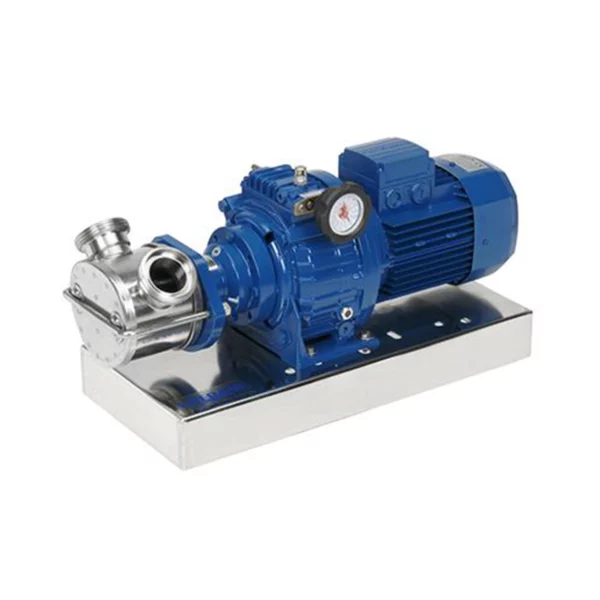
| RID | geared motor | low revs without a belt |
| VA / INV | a variable-speed drive or frequency converter | Flow control is required |
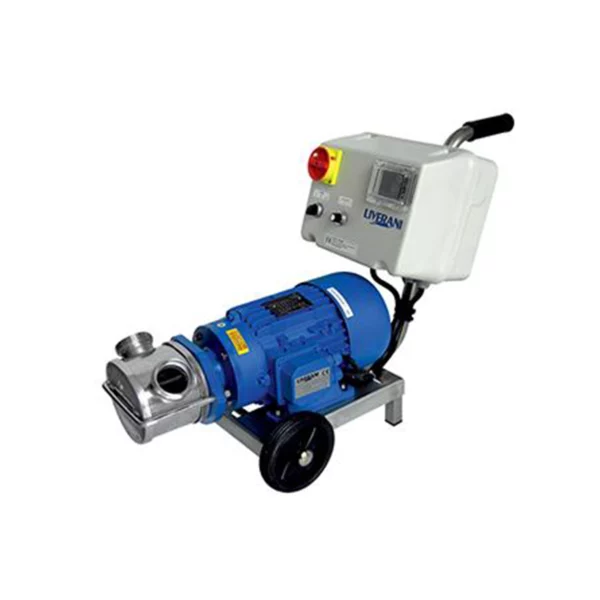
| INV BS | a converter with a panel on the housing | control unit next to the pump, without a control cabinet |
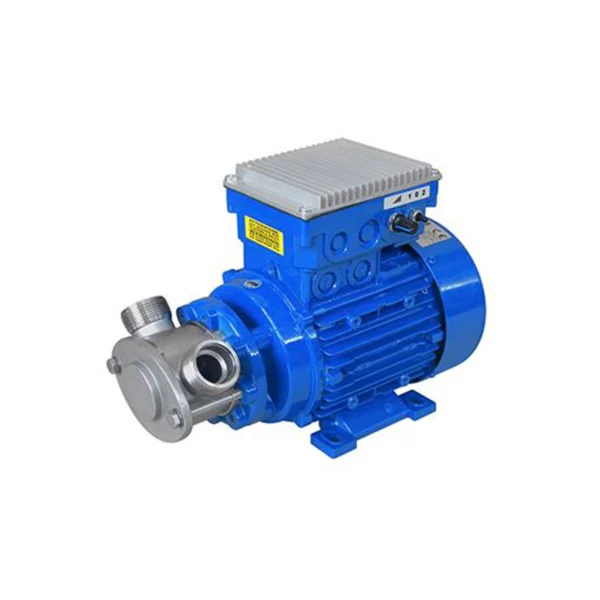
| MINIVERTER | converter in the terminal box | compact, single-phase 230 V mains supply |
| ALL IN ONE | converter, flow meter, touch panel | A record of the volume pumped is required |
The first thing to consider when choosing is the power source. No electricity, but hydraulic power is available — MID. Mains power is available — the rest of the series. You already have your own engine — SP.
The second question is whether the power supply needs to be changed. If not, choose EP, GR or RID. If so, choose VA, INV, INV BS or MINIVERTER. If volume measurement is also required, choose ALL IN ONE.
Standard sizes for impeller hydraulics
All series are based on six standard sizes. Not every series includes all six.
| Size | Accession | Flow rate, max. |
|---|---|---|
| MICRO 3/8″ | 3/8″ BSP-F | 480 litres per hour |
| MINI 3/4″ | 3/4″ BSP-M | 1,620 litres per hour |
| MIDEX 1″1/4 | 1″1/4 BSP-M | 5,760 litres per hour |
| MINOR 40 | as per the specification | 43,800 litres per hour |
| MAJOR 60 | as per the specification | 43,800 litres per hour |
| MAXI 80 | as per the specification | 72,000 litres per hour |
Common specifications for the whole range: maximum pressure difference of 4 bar, medium temperature up to +100 °C, viscosity up to 50,000 cP, flow rate from 0 to 72,000 litres per hour.
Other types of LIVERANI pumps
Water-ring self-priming pumps are characterised by their ability to draw in fluid even when gas is present in the medium. They are reversible and can operate dry. They are available in AISI 316 stainless steel or bronze. The range comprises ten models, including versions with a magnetic coupling, a hydraulic motor, a frequency converter and the explosion-proof GR ADPE model.
Screw pumps with an oscillating stator are designed to handle heavy liquids containing solid particles. The MO-I model features a stainless steel casing for food and chemical applications, whilst the MO-B has a bronze casing for marine applications. Screw pumps with a fixed stator are available in the MXF and MXF INCA series; the latter is fitted with a frequency converter and a remote control unit on a 15-metre cable, mounted on a trolley.
Gear-type positive displacement self-priming pumps are designed for viscous liquids without solid particles: lubricating oils, fuel oil and diesel fuel. They are available in a monoblock design and on a frame.
Piston pumps for filter presses deliver residual water from industrial processing and slurry under pressure. The S75 Inox and S75-S Inox models are single-piston, double-acting pumps, whilst the GS80 is a twin-piston, double-acting pump. Applications: feeding filter presses during the treatment of industrial effluents to remove sludge and feeding wine-making sediment to filters.
The ENOPRESS and ECOPRESS screw-type continuous presses press freshly harvested grapes, crushed grapes and fermented must. The 250–300 models operate at 11–12 rpm, whilst the 350–400 models operate at 3–9 rpm with adjustable speed. The contact surfaces are made of stainless steel, whilst the screw and Maltese cross are made of acid-resistant bronze. The bars of the cage have a trapezoidal profile with a gap of 0.5 mm.
The marine range comprises a separate catalogue of centrifugal, jet, peripheral, submersible and hand-operated pumps, pressure-boosting units, booster sets, helicoid and centrifugal air blowers, flow meters and diesel fuel transfer stations.
Which sectors are LIVERANI pumps designed for?
The manufacturer cites the wine industry, the food industry, cosmetics, pharmaceuticals, the chemical industry, agriculture and shipbuilding.
By product type, these include wine, must, vinegar, oil, fruit juices, beer, syrups and brines in the food industry; milk and dairy products; acids, solvents and photographic fluids in the chemical industry; and seawater and fresh water, as well as diesel fuel in the marine sector.
A separate area involves feeding grapes into filter presses and pressing them. Pumps for the food industry are grouped under in a separate section. Sector-specific recruitment — in sector-specific solutions.
How to choose LIVERANI pumps at Steiner Ukraine
Seven pieces of information are required to select an impeller pump: the required flow rate in litres per hour, the head or pipeline resistance in metres, the name of the product, its viscosity and temperature, the presence and size of any solid particles, the type and size of the connection, and the steel grade of the casing.
It is specified separately what power supply is available on site and whether the power supply needs to be changed during operation. These two answers determine the series.
Steiner Ukraine supplies LIVERANI equipment, together with design calculations, configuration, commissioning and spare parts, including impellers made from various elastomers. The scope is described in the section services. Industrial pumps — in the section industrial pumps, related entries — in the section pumps and systems. Other featured brands can be found in the section manufacturers.
Frequently asked questions about LIVERANI pumps
Who manufactures LIVERANI pumps?
LIVERANI s.r.l. — an Italian company based in Lugo, in the province of Ravenna, founded in the 1950s. It has been manufacturing pumps for viscous liquids for over 70 years.
What is an impeller pump?
A pump with a flexible elastomer impeller. The blades deform against the casing wall and transfer the fluid in closed volumes. This results in self-priming capability, positive displacement, gentle pumping and reversibility.
What viscosity can LIVERANI impeller pumps handle?
Up to 50,000 cP. Ambient temperature: up to +100 °C; maximum pressure differential: 4 bar.
What is the maximum capacity?
72,000 litres per hour for the MAXI 80 model. This is the top end of the impeller pump range.
How many series of impeller pumps does LIVERANI have?
Nine. The hydraulics are identical across the range; the only difference is in the drive system: ranging from a free-running shaft without a motor to a monoblock unit with a flow meter and a touchscreen panel.
Which material should I choose for the impeller?
Depends on the medium: NR for water and wine, CR for oils, NBR for fats and petroleum products, EPDM for hot water and cleaning solutions, VMQ for food and pharmaceutical products.
Is it safe to run an impeller pump dry?
Prolonged operation without fluid in the housing is not permitted. The impeller blades come into contact with the housing wall and are damaged by dry running. The self-priming function operates in this situation: the pump fills the dry suction line automatically.
Does LIVERANI offer anything other than impeller pumps?
Yes. Water-ring pumps, screw pumps with oscillating and fixed stators, gear pumps, piston pumps for filter presses, continuous grape presses and a separate marine range.
Is it possible to order spare parts for LIVERANI pumps in Ukraine?
Yes. Impellers, seals and other parts are supplied separately. To make an enquiry, you will need the series, model number and serial number.