

Static mixer
Equipment
Showing the single result
Frequently asked questions about static mixers
How does a mixer with no moving parts mix at all?
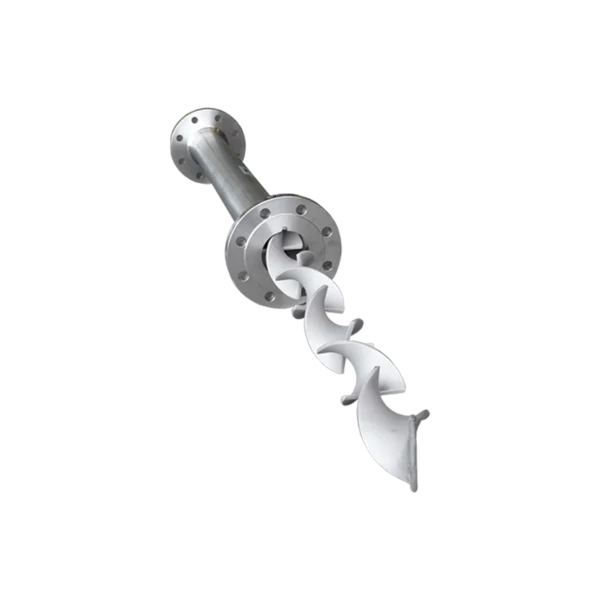
Fixed elements of a special geometry are installed inside the pipe. The flow is successively divided, displaced and recombined — after each element the number of layers grows in a geometric progression. The mixing is performed by the energy of the flow itself.
What are the main advantages?
There is no drive, no seals and no rotating parts — so there is nothing to break down and nothing to service. There is no electricity consumption, no dead zones, and it takes up only a section of pipe. For continuous processes this is the cheapest solution in terms of cost of ownership.
How many elements are needed for good mixing?
It depends on the flow rate ratio of the components, the difference in their viscosities and the required homogeneity. For liquids of similar viscosity a few elements are enough; for a large difference in viscosity or for small additions a longer section is needed. The calculation is made for the specific pair of components.
What pressure drop does it create?
A certain pressure drop is inevitable — it is precisely what performs the work of mixing. Its value is calculated at the selection stage and taken into account when choosing the pump, so that no bottleneck appears in the line. We provide this calculation together with our offer.
Where is it used in practice?
Dosing reagents into a water flow, blending beverages, mixing concentrate with water, evening out the temperature after a heat exchanger, adding colourants and additives, preparing solutions before filtration, mixing two-component compounds.