Steiner Pumps – plastic diaphragm pump (MK Plastic)
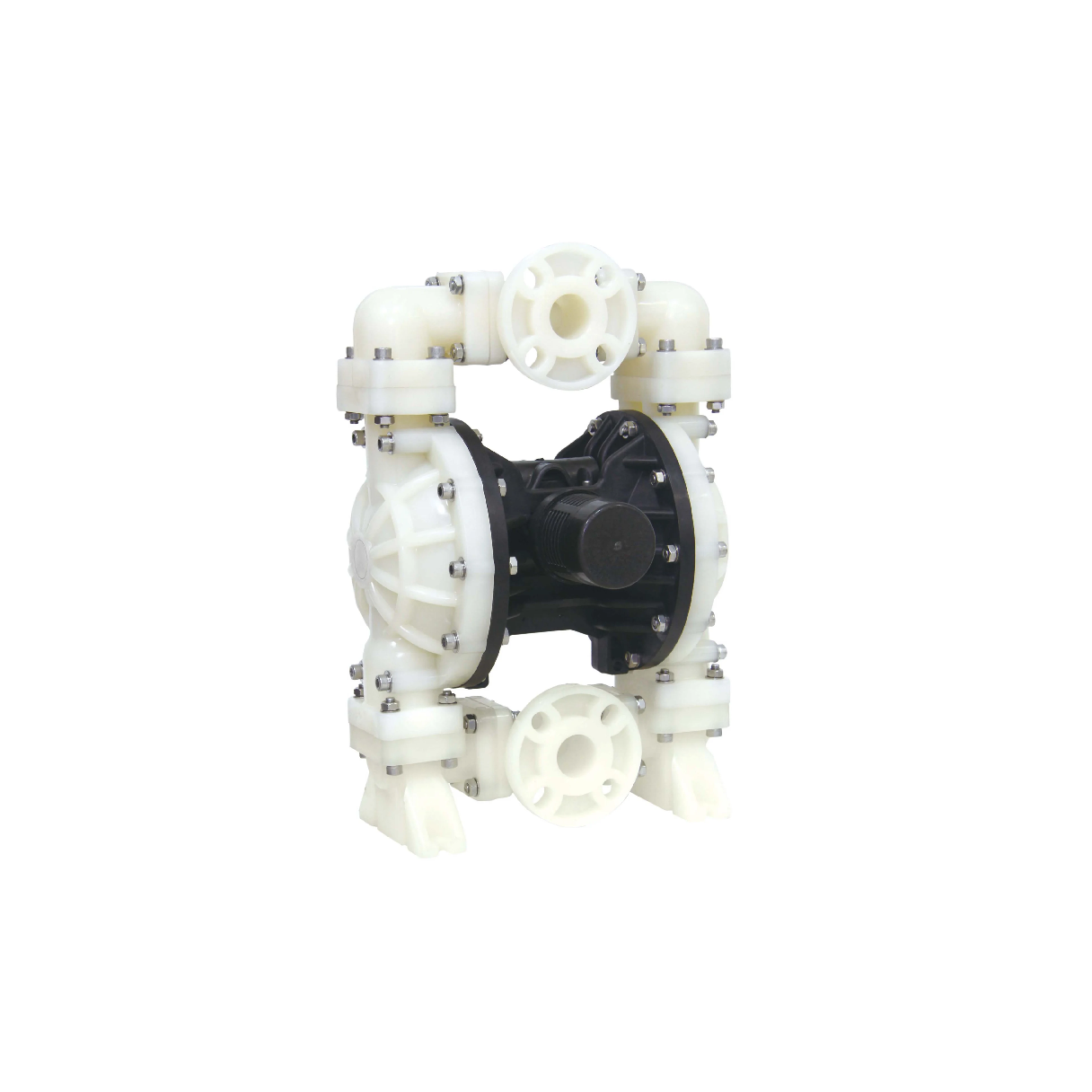
The MK series plastic membrane pump is an air-operated double-diaphragm pump with a polymer wetted path. It operates on compressed air, is self-priming, can run dry and has no rotating seals. The polymer design covers all six sizes in the series: from the MK 06/10 at 27 l/min to the MK 80 at 1060 l/min. General information about the series and article coding can be found on the page Steiner Pumps.
Where is a plastic diaphragm pump used?
A polymer housing is chosen where metal cannot withstand the environment. This is the main reason for the choice—neither weight nor price, but chemical resistance.
Typical environments: acids and alkalis, including concentrated ones; organic solvents; disinfectants and detergents; paints, varnishes and coatings; adhesives, sealants and viscous adhesive materials; ceramic suspensions, slips and glazes; mine and process waters; waste waters, sludges and sediments.
The design does not have an impeller, so shear is low and the product structure is not destroyed. Suspensions, slips and emulsions pass through without homogenisation.
The pump does not require a power supply. For combustible and flammable media, a conductive version is used — a special code C in an anti-static article.
Six size categories: technical specifications
| Parameter | MK 06/10 | MK 15/20 | MK 25 | MK 40 | Mk 50 | MK 80 |
|---|---|---|---|---|---|---|
| Suction / discharge nozzles | 1/4″, 3/8″ | 1/2″, 3/4″ | 1″ | 1 1/2″ | 2″ | 3″ |
| Maximum flow rate | 27 L/min (1.62 m³/h) | 57 litres per minute (3.42 m³/h) | 157 litres per minute (9.42 m³ per hour) | 358 litres per minute (21.5 m³ per hour) | 587 l/min (35.2 m³/h) | 1,060 l/min (63.6 m³/h) |
| Maximum head | 70m | 84 m | 84 m | 84 m | 84 m | 84 m |
| Maximum inlet air pressure | 7 bar | 8.4 bar | 8.4 bar | 8.4 bar | 8.4 bar | 8.4 bar |
| Compressed air inlet | 1/4″ | 3/8″ | 1/2″ | 1/2″ | 1/2″ | 3/4″ |
| Self-priming head, dry | 2.1 m | 4 m | 4 m | 5 m | 5 m | 5 m |
| Self-priming height, primed | 3.7–6.4 m | 7.6 m | 8 m | 8 m | 8 m | 8 m |
| Maximum particle size | 1.6 mm | 2.5 mm | 4 mm | 5 mm | 6 mm | 9.4 mm |
| Body materials | PP, PVDF, POM | PP, PVDF | PP, PVDF, POM | PP, PVDF | PP, PVDF | PP, PVDF |
| Mass in PP | 1.5 kg | 3.5 kg | 9 kg | 17 kg | 25 kg | 50 kg |
| Mass in PVDF | 2 kg | 4.5 kg | 12 kg | 24 kg | 34 kg | 90 kg |
Air head and pressure are different quantities. 8.4 bar refers to the inlet air, 84 m to the liquid delivery head. The figures are given based on water tests at 20 °C.
Plastic diaphragm pump: PP, PVDF or POM?
Polypropylene (PP). Universal material for most applications. Good chemical resistance, suitable for acids and alkalis. Operating temperature 0…+65.5 °C. Medium abrasion resistance.
PVDF Very high chemical and corrosion resistance, high mechanical strength and impact resistance. Designed for aggressive acids, alkalis and organic solvents. Operating temperature −12 to +107 °C — the widest range among the polymer series. The pump in PVDF is heavier than the same one in PP: MK 80 — 90 kg versus 50 kg.
POM (acetal). Solvent-resistant, low friction, low water absorption, high wear resistance. Operating temperature 0 to +65.5 °C. Available for MK 06/10 and MK 25.
The model's coding system also provides a body code PTFE— in the material tables of the model catalogue pages, this version is not listed — availability is to be confirmed when ordering.
If the ambient temperature is higher than 65 °C or organic solvents are present, PVDF is the default choice. For standard acid-alkaline chemistry at room temperature, PP is sufficient.
MK 06/10 — the smallest pump in the range
MK 06/10 differs from the other standard sizes not only in size.
It is being produced only in polymers — PP, PVDF or POM. There is no metallic version available for it.
Its maximum air pressure is 7 bar, not 8.4; the head is 70 m, not 84. The dry self-priming height is 2.1 m compared to 4–5 m in older models.
Air consumption is 0.084–0.14 m³/min (3–5 cfm). This means that the pump can be run from a small workshop compressor without a separate air line.
Weight 1.5 kg in PP or 2 kg in PVDF, connections 1/4″ and 3/8″. This is a portable device for laboratories, dosing units and small transfers.
Diaphragms, balls and valve seats
The body is polymeric, but the diaphragm and valves are selected separately — it is they that set the temperature and chemical limits.
Membrane for all standard sizes: Santoprene, Hytrel, PTFE (Teflon), Viton (FKM), EPDM, Buna-N.
| Material | Operating range | Briefly |
|---|---|---|
| PTFE (Teflon) | +4.4...+104 °C | maximum chemical resistance; not for molten alkali metals, chlorine trifluoride and liquid fluorine |
| Viton (FKM) | −40…+121 °C | acids, alkalis, salts, petroleum products, hydrocarbons |
| Santoprene | -40 to +82 °C | general-purpose acids and alkalis; good resistance to abrasion; not suitable for solvents |
| EPDM | −12…+82 °C | water, acids and alkalis; resistance to ageing and ozone |
| Hytrel | −29…+82 °C | neutral fluids, high wear resistance |
| Buna-N (NBR) | −12…+82 °C | petroleum products, fuels, lubricants |
The pump temperature limit is the lower of the two: the casing limit and the diaphragm limit. A PP casing limits the system to 65.5 °C even with a Viton diaphragm.
Valve ball. For MK 06/10 – PTFE. For MK 25 and larger – PTFE, stainless steel, Santoprene, Hytrel, Viton, ceramics.
Valve seat. For MK 06/10 — PP, PVDF. For MK 25 and larger — PTFE, Santoprene, Hytrel, Viton, polypropylene.
Central unit. For MK 06/10 and MK 15/20 — polypropylene. For MK 25 and larger — polypropylene, aluminium or stainless steel. The central unit is not in contact with the product.
Connection: thread, DIN/ANSI flanges, centre and side port
MK 06/10 and MK 15/20 have BSP or NPT threaded connections.
Starting from MK 25, DIN or ANSI flanged connections of the corresponding diameter are available: DIN/ANSI 25 for MK 25, DIN/ANSI 40 for MK 40, DIN/ANSI 50 for MK 50, DIN/ANSI 80 for MK 80.
For the MK 25, 40 and 50, two manifold designs are provided: central port and side port (code S in the article). The execution is chosen according to the piping layout—a side port allows the pump to be fitted where there is no space above or below it.
The three-section manifold design with a central port ensures a lower pulsation level. For processes sensitive to supply fluctuations, a pulsation dampener is optionally available.
Frequently asked questions about plastic diaphragm pumps
What polymers are available?
PP, PVDF and POM. POM is for MK 06/10 and MK 25, while PP and PVDF are for all six frame sizes.
What is the maximum ambient temperature?
107 °C for PVDF, 65.5 °C for PP and POM. The actual limit is the lower of the two values: body and diaphragm.
What is the maximum capacity?
1060 l/min (63.6 m³/h) — MK 80 with 3-inch connections.
Is 8.4 bar the discharge pressure?
No, this is the maximum compressed air inlet pressure. The delivery height is 84 m (for MK 06/10 – 70 m at 7 bar of air).
What is the maximum size of solid particles that can pass through?
From 1.6 mm (MK 06/10) to 9.4 mm (MK 80).
Does the pump withstand dry running?
Yes. There are no dynamic seals in the design, and operating the pump without fluid will not damage it.
Can concentrated acids and solvents be pumped?
Yes, in PVDF execution with a PTFE or Viton membrane. PP is intended for general-purpose acids and alkalis.
Can a flanged connection be fitted?
Right, starting from MK 25 — DIN or ANSI flanges. For MK 06/10 and MK 15/20, the connections are threaded.
What should I do if there is no space above the pump?
For MK 25, 40 and 50 there is a side port design (code S).
Can an electric motor be fitted instead of a pneumatic actuator?
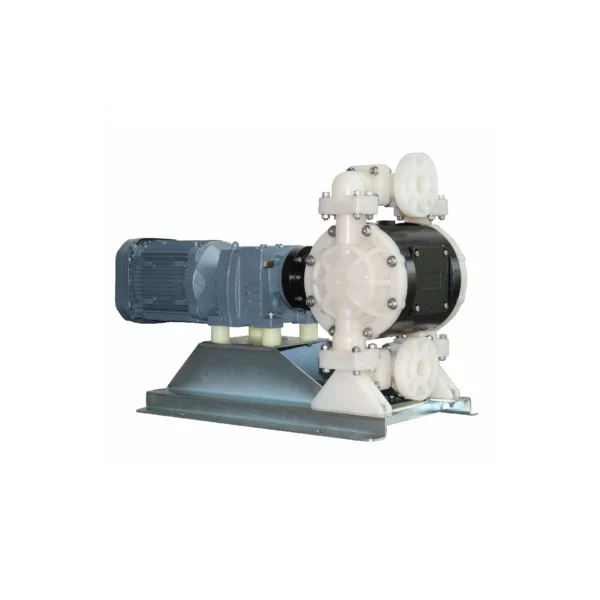
Yes, the electric drive is fitted to all models in the series — see. Motor-driven diaphragm pump.
What is needed for the selection?
Medium and its concentration, viscosity, density, temperature, size of solid inclusions, required flow rate, delivery head and pipeline length, available pressure and flow rate of compressed air, piping layout, explosion safety requirements.