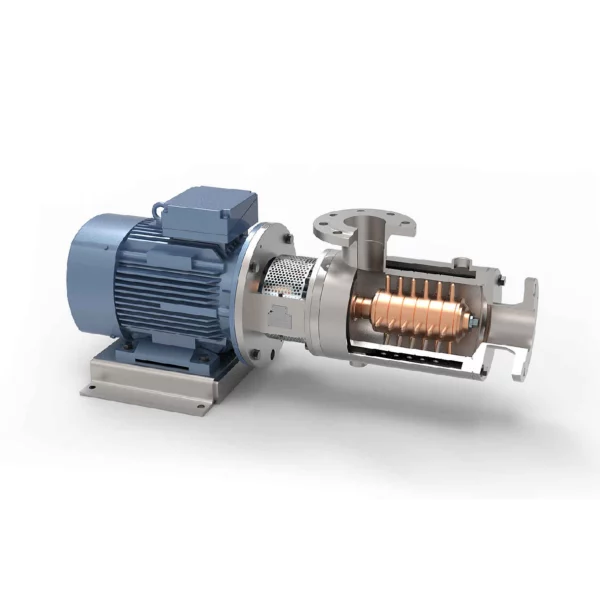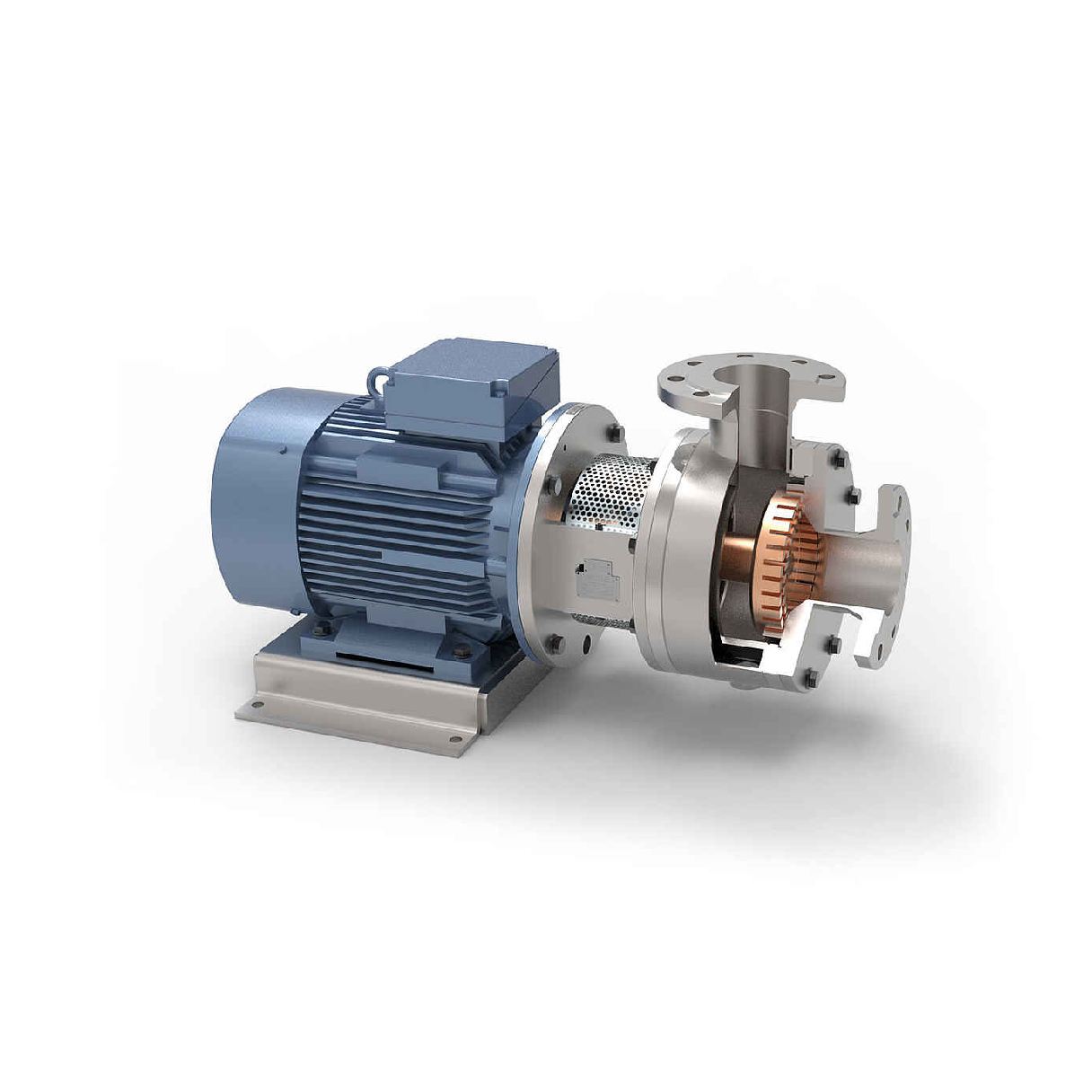
INDAG - Homogenizer (DLM/H)
The INDAG DLM/H homogeniser is a continuous in-line homogeniser manufactured by INDAG Maschinenbau GmbH (Ivenfleth 13, 25376 Borsfleth, Germany). The company was founded by Martin Willun in 1953. Today, INDAG has over 70 years’ experience and specialises in dynamic in-line mixers under the FlowMix® brand. Production is certified to DIN EN ISO 9001:2015.
The DLM/H is designed for emulsifying, dispersing and mixing liquids with solid components. Throughput: 50 to 120,000 litres per hour. Medium temperature: 0 to 250 °C. Viscosity: 1 to 500,000 mPa·s. With a rotor circumferential speed exceeding 20 m/s and a very narrow gap, the homogeniser produces droplet sizes of less than 1 µm.
INDAG DLM/H Homogeniser: Technical Specifications
| Parameter | Value |
|---|---|
| Productivity | 50–120,000 litres per hour |
| Rotor speed | 1,000–6,000 rpm, depending on the model |
| Medium temperature | 0–250 °C |
| Viscosity of the medium | 1–500,000 mPa·s |
| Drop size | less than 1 µm at a rotor circumferential speed of over 20 m/s |
| Pressure classes | 6, 10, 16, 25, 40 bar |
| Material | 1.4404 (AISI 316L), premium quality to order |
| Mixing elements | axial sliding elements on the rotor and in the stator |
| Mixing stages | 2 or 3, depending on the version |
| Accession | DIN 11851, DIN 11864, Tri-Clamp, SMS, others available on request |
| Shaft seal | single-ended, double-ended, including aseptic |
| Implementation | Compact KB, with LB bearing unit |
| Regulations | horizontal or vertical |
The rotor can be manufactured with heating or cooling. Versions with a double jacket and additional connections are available. For double mechanical seals, INDAG supplies a suitable sealing system. The manufacturer also produces special versions for high-pressure or high-viscosity applications.
Four DLM/H sizes
| Type | 2 | 3 | 4 | 5 |
|---|---|---|---|---|
| Capacity, l/h | 50–6,000 | 500–30,000 | 2,000–55,000 | 5,000–120,000 |
| Connection, DN | 25–50 | 50–80 | 80–100 | 100–125 |
| ASME connection, optional | 1–2″ | 2–3″ | 3–4″ | 4–5″ |
| Power, kW | 2.2–4.0 | 4–11 | 11–22 | 37.5–75 |
| Rotational speed, rpm | 1,000–6,000 | 1,000–5,000 | 1,000–3,000 | 1,000–3,000 |
| Compact design, 2-stage | DLM/H-202 KB | DLM/H-302 KB | DLM/H-402 KB | DLM/H-502 KB |
| With bearing assembly, 3-stage | — | DLM/H-303 LB | DLM/H-403 LB | DLM/H-503 LB |
Performance depends on the specific product. Size 2 is only available in the compact version. The three-stage LB version starts from size 3.
How is a droplet smaller than 1 µm produced?
The DLM/H rotor and stator are fitted with axial shear elements. The product passes through the gap between them. It is within this gap that shear is generated, which breaks up the droplets of the dispersed phase.
The result is determined by two parameters. The first is the rotational speed of the rotor: over 20 m/s. The second is the size of the gap between the rotor and the stator. The narrower the gap, the more intense the shear. When both conditions are met, the droplet size falls below 1 µm.
The homogeniser has between two and three mixing stages. Each stage consists of an additional rotor-stator pair through which the product passes. A greater number of stages results in a more uniform droplet size distribution.
Two versions: KB and LB
In the compact KB version, the rotor is mounted directly on the motor’s output shaft. This results in a shorter unit.
In the LB version, the rotor has its own bearing assembly. This offers two advantages. It allows for narrower shear clearances and, consequently, more intensive shearing. The LB version is also suitable for operation under high pressure or at high temperatures.
The type of shaft seal is selected to suit the specific application. For aseptic processes, a double mechanical seal in an aseptic design is available.
For which products is the INDAG homogeniser used?
The manufacturer lists four typical applications for the DLM/H.
Firstly, the breaking up of agglomerates in pumped media. This involves the deagglomeration of settled powder clumps in a liquid.
Secondly, the production of cosmetics. Oil, water and an emulsifier are combined to form a stable emulsion.
Thirdly, the production of mayonnaise. The oil, vinegar solution and egg are homogenised in a single machine.
Fourthly, the addition of phosphoric or citric acid to vegetable oil during the hydration of phospholipids.
The INDAG homogeniser is used where a stable emulsion or uniform dispersion is required without phase separation. Equipment for food production is available at in a separate section. Mixing systems — in the section pumping and mixing systems.
Hygienic operation and cleaning
The manufacturer states that the DLM/H features a hygienic design. The material used for parts in contact with the fluid is 1.4404 stainless steel, also known as AISI 316L. Higher-grade steel is available to order.
Connections are made in accordance with the DIN 11851 and DIN 11864 dairy standards, as well as Tri-Clamp and SMS. Other types of connections are available on request.
The design is highly self-cleaning during CIP cleaning. This means that the homogeniser does not need to be dismantled between batches. The modular design simplifies the replacement of parts during scheduled maintenance.
How does DLM/H differ from DLM/P, DLM/M and DLM/S?
INDAG manufactures four basic types of in-line machines. They differ in the shape of the working element, rotational speed and shear intensity.
| Type | Element | Rotational speed | Productivity | Viscosity, max. | Purpose |
|---|---|---|---|---|---|
| DLM/M | bladed | 100–1,800 rpm | 50–120,000 litres per hour | 50,000 mPa·s | mixing as gently as possible |
| DLM/P | round pins | 100–1,500 rpm | 50–20,000 litres per hour | 1,000,000 mPa·s | careful mixing of highly viscous materials |
| DLM/S | star-studded | 200–3,600 rpm | 50–120,000 litres per hour | 10,000,000 mPa·s | vigorous mixing |
| DLM/H | axial sliding | 1,000–6,000 rpm | 50–120,000 litres per hour | 500,000 mPa·s | emulsification and dispersion |
All four models operate within the 0–250 °C range. The DLM/H is at the top end of the scale in terms of rotation speed. It is the only model that produces an emulsion with droplets smaller than 1 µm.
If the product is shear-sensitive and highly viscous, the DLM/H is not suitable. For such applications, the following are used: DLM/P dynamic mixer — it keeps the temperature rise below 1 °C and operates at viscosities of up to 1,000,000 mPa·s. All the manufacturer’s products are available at the INDAG page.
How to choose an INDAG homogeniser from Steiner Ukraine
Seven pieces of data are required for the calculation: throughput in litres per hour, the composition of the product and the composition of the dispersed phase, the required droplet or particle size, viscosity, inlet temperature, operating pressure in the line, and the type of connection.
It is specified separately whether aseptic sealing is required. Another question is whether the product will be heated or cooled in the machine.
Steiner Ukraine supplies INDAG equipment, including design, configuration, commissioning and spare parts. The scope is described in the section services. Related entries — in the section process equipment. Sector-specific recruitment — in sector-specific solutions. The technical specifications of the original source are published at the INDAG website.
Frequently Asked Questions
What is the capacity of the INDAG DLM/H homogeniser?
From 50 to 120,000 litres per hour. The exact figure depends on the model: from 50–6,000 litres per hour for Type 2 to 5,000–120,000 litres per hour for Type 5.
What drop size does the DLM/H produce?
Less than 1 µm. Conditions: a rotor circumferential speed of over 20 m/s and a very narrow gap between the rotor and the stator.
How many sizes are there in the DLM/H range?
Four — from Type 2 to Type 5. Two or three mixing stages are available, as well as two design variants: KB and LB.
What pressure is the DLM/H rated for?
The homogeniser is available in five pressure ratings: 6, 10, 16, 25 and 40 bar.
Can the homogeniser be washed without taking it apart?
Yes. The manufacturer claims that the design self-cleans effectively during CIP cleaning.
What is the maximum viscosity of the product?
500,000 mPa·s. For higher viscosities, use DLM/P (up to 1,000,000 mPa·s) or DLM/S (up to 10,000,000 mPa·s).
How does KB differ from LB?
In the KB version, the rotor is mounted on the motor shaft. In the LB version, it has its own bearing assembly, which allows for tighter sliding clearances and more intense sliding. The LB version is also suitable for high pressure and high temperatures.
How much does the INDAG DLM/H homogeniser cost?
The price depends on the model size, the number of mixing stages, the pressure class, the KB or LB version, the seal type and the drive power. An aseptic double mechanical seal has a significant impact on the cost. Please send us the flow rate, product composition and required droplet size — we will prepare a quotation.