INDAG inline homogenisers and mixers — official representative in Ukraine
INDAG mixers are dynamic in-line mixers manufactured by the German company INDAG Maschinenbau GmbH (Ivenfleth 13, 25376 Borsfleth). The company was founded by Martin Willun in 1953. Initially, it manufactured internal gear pumps for viscous media in the food and chemical industries. Over time, individual pumps and mixers evolved into complete systems under the registered trademark FlowMix®.
From 1991 to 2025, the company was headed by Vilko Villun, the founder’s son, and it was during this period that INDAG specialised in dynamic in-line mixers. Since July 2025, the managing director has been Carsten Pump. In 2001, the company moved into a new building with production and office space. Production is certified to DIN EN ISO 9001:2015: initial certification by TÜV in 2005, recertification in May 2023.
INDAG supplies dynamic in-line mixers to over 70 countries worldwide. Exports account for 80 per cent of its business. In Ukraine, INDAG equipment is supplied by Steiner Ukraine.
Which INDAG mixers can be ordered in Ukraine?
The manufacturer’s product range comprises eleven types of equipment. Steiner Ukraine supplies the entire range.
| Type | Purpose |
|---|---|
| DLM/M | gentle mixing with blade elements |
| DLM/M ECO | gentle mixing, economical operation |
| DLM/P | dynamic mixing using pin-type elements |
| DLM/S | intense mixing by stellar components |
| DLM/S HP | High-pressure mixing for polymers and plastics |
| DLM/S-007 Mini | laboratory and pilot-scale mixer |
| DLM/H | homogenisation, emulsification, dispersion |
| DLM/FS | continuous mixing of solids with liquids |
| DLM/SK | mixing of high-viscosity products |
| DLM/KS | hydrolysis of sewage sludge |
| FlowMix®/MD | preparation of a polymer solution |
There are two vacancies in the Steiner Ukraine catalogue: DLM/P dynamic mixer and DLM/H homogeniser. The remaining types are available to order. The mixing systems are listed in the section pumping and mixing systems.
Steiner Engineering & Consulting is listed amongst INDAG’s partners
INDAG publishes a list of its sales partners by country on its website. In this list, Ukraine is represented by Steiner Engineering & Consulting, located at 23 Industrial Lane, Office 305, Kyiv 03056, telephone +38 044 390 73 38 and website steiner.com.ua.
In addition to Ukraine, the manufacturer’s list includes partners in Belgium, Brazil, China, the Czech Republic, France, Indonesia, Ireland, Italy, Japan, Malaysia, Poland, Slovakia, South Africa, Spain, Sweden, Taiwan and the USA.
There is one practical implication for the customer. Enquiries regarding INDAG equipment in Ukraine are channelled through Steiner Ukraine directly to the manufacturer. This applies to the selection of model sizes, warranty matters and the supply of spare parts.
The four basic types of in-line mixers
The range consists of four types. They differ in the shape of the mixing element, rotational speed and shear intensity.
| Type | Element | Rotational speed | Productivity | Viscosity, max. |
|---|---|---|---|---|
| DLM/M | bladed | 100–1,800 rpm | 50–120,000 litres per hour | 50,000 mPa·s |
| DLM/P | round pins | 100–1,500 rpm | 50–20,000 litres per hour | 1,000,000 mPa·s |
| DLM/S | star-studded | 200–3,600 rpm | 50–120,000 litres per hour | 10,000,000 mPa·s |
| DLM/H | axial sliding | 1,000–6,000 rpm | 50–120,000 litres per hour | 500,000 mPa·s |
All four types operate within a temperature range of 0 to 250 °C. The material of the wetted parts is 1.4404 stainless steel, also known as AISI 316 L. Pressure classes: 6, 10, 16, 25 and 40 bar.
The choice of type is determined by two parameters: the viscosity of the product and its sensitivity to shear. DLM/M is the gentlest, DLM/H the most intense. DLM/P stands apart: it maintains high viscosity at low shear and a temperature rise of less than 1 °C.
What viscosity range do INDAG mixers cover?
The manufacturer specifies an operating range of 1 to 70,000,000 mPa·s for its range of dynamic in-line mixers. The lower limit is the viscosity of water. The upper limit is that of extremely viscous polymeric compounds.
As a guide, INDAG publishes a reference table of the viscosities of typical products: milk at 20 °C — 2 mPa·s, apple purée at 20 °C — 1,500 mPa·s, mayonnaise at 20 °C — 2,000 mPa·s, honey at 40 °C — 2,000 mPa·s, butter at 40 °C — 30,000 mPa·s, processed cheese at 60 °C — 30,000 mPa·s, and toothpaste at 40 °C — 70,000 mPa·s.
Viscosity is highly dependent on temperature. Therefore, when selecting a value, it is always specified together with the temperature at which it was measured.
What processes do INDAG mixers carry out?
The manufacturer lists nine processes: emulsification, dispersion, mixing, dissolution, bringing to the boil, dilution, aeration, foaming and grinding.
All of these processes are carried out in-line, without the use of intermediate tanks. This is the key difference between in-line equipment and batch-process equipment. The product passes through the mixer once and emerges ready for use.
A hygienic version is available for processes with cleanliness requirements. Connections are made in accordance with the dairy standards DIN 11851 and DIN 11864, as well as Tri-Clamp and SMS. The shaft seal is a single or double mechanical seal, including in an aseptic design. The design is highly self-cleaning during CIP cleaning.
Which sectors is INDAG equipment designed for?
The manufacturer divides the sectors into food and non-food.
The food sector includes dairy products, confectionery, foodstuffs in general, beverages and bakery products. Non-food sectors include chemicals, plastics, cosmetics and environmental protection. INDAG specifically mentions vegetable oil production and wastewater treatment.
On the Ukrainian market, the most common applications include the incorporation of flavourings and colourings into fat and chocolate mixtures, the preparation of emulsions in mayonnaise and sauce production, the hydration of vegetable oil phospholipids, and the preparation of polymer solutions at water treatment plants. Equipment for food production is categorised under in a separate section. Sector-specific recruitment — in sector-specific solutions.
KB and LB variants
Each type of mixer is available in two designs.
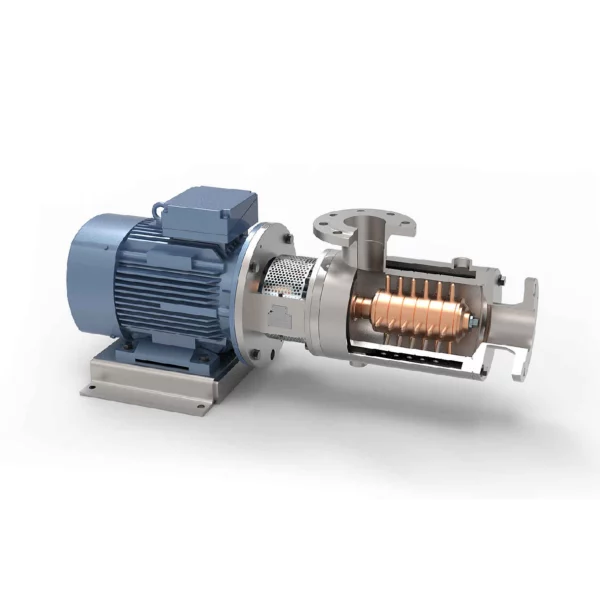
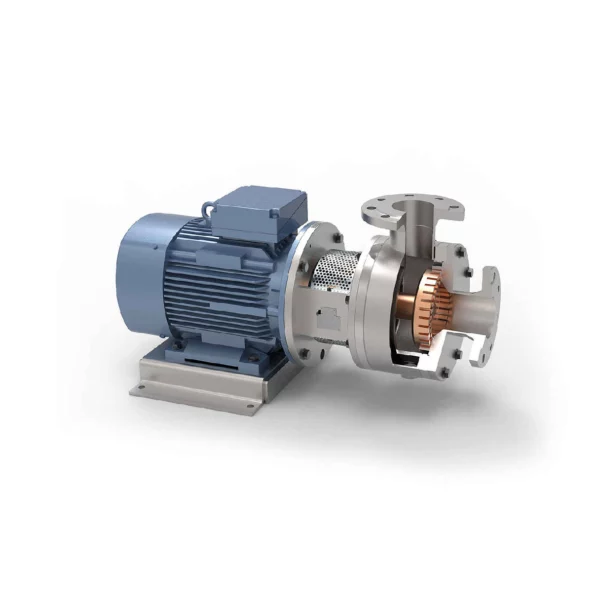
In the compact KB version, the rotor is mounted directly on the motor’s output shaft. The unit is shorter and cheaper.
In the LB version, the rotor has its own bearing assembly. For the DLM/P, this allows for longer rotors and larger mixing volumes. For the DLM/H version, it enables narrower shear gaps and more intense shearing. Both LB variants are also suitable for operation at high pressure or high temperature.
The mixer can be installed horizontally or vertically. The rotor and stator are available in heated or cooled versions. A version with a double jacket and additional connections is available.
How to choose and order from Steiner Ukraine
Seven pieces of data are required for the calculation: flow rate in litres per hour, product composition, product viscosity (specifying the temperature), inlet temperature, proportion and type of additive, operating pressure in the line, and connection type.
The product’s sensitivity to shear is specified separately. It is this factor that determines the choice between DLM/M, DLM/P, DLM/S and DLM/H. Another consideration is whether an aseptic seal is required.
Steiner Ukraine supplies INDAG equipment, including design, configuration, commissioning and spare parts. The scope is described in the section services. Related entries — in the section process equipment. Other featured brands can be found in the section manufacturers. The technical specifications of the original source are published at the INDAG website.
Frequently Asked Questions
Who manufactures INDAG mixers?
INDAG Maschinenbau GmbH is a German company based in Borsfleth, founded in 1953 by Martin Willun. It specialises in dynamic in-line mixers under the FlowMix® brand.
Who represents INDAG in Ukraine?
Steiner Engineering & Consulting. The company is listed on the INDAG website as a sales partner for Ukraine.
How many types of mixers does INDAG manufacture?
Eleven. The core range consists of four models: DLM/M, DLM/P, DLM/S and DLM/H. The rest are specialised versions designed for specific processes.
Which INDAG mixer should I choose for making emulsions?
The DLM/H homogeniser. It operates at 1,000–6,000 rpm and produces droplet sizes of less than 1 µm at a rotor circumferential speed of over 20 m/s.
Which INDAG mixer should I choose for making chocolate?
The DLM/P dynamic mixer. It operates with viscosities of up to 1,000,000 mPa·s and does not raise the product temperature by more than 1 °C.
What is the maximum viscosity that INDAG equipment can handle?
The manufacturer states that the range of the product line is from 1 to 70,000,000 mPa·s. Among the four basic models, the upper limit is 10,000,000 mPa·s for the DLM/S.
Can you wash the mixer without taking it apart?
Yes. The design features good self-cleaning properties during CIP cleaning. For aseptic processes, a double mechanical seal in an aseptic version is available.
How many countries does INDAG supply?
Over 70 countries. Exports account for 80 per cent of the company’s turnover.