
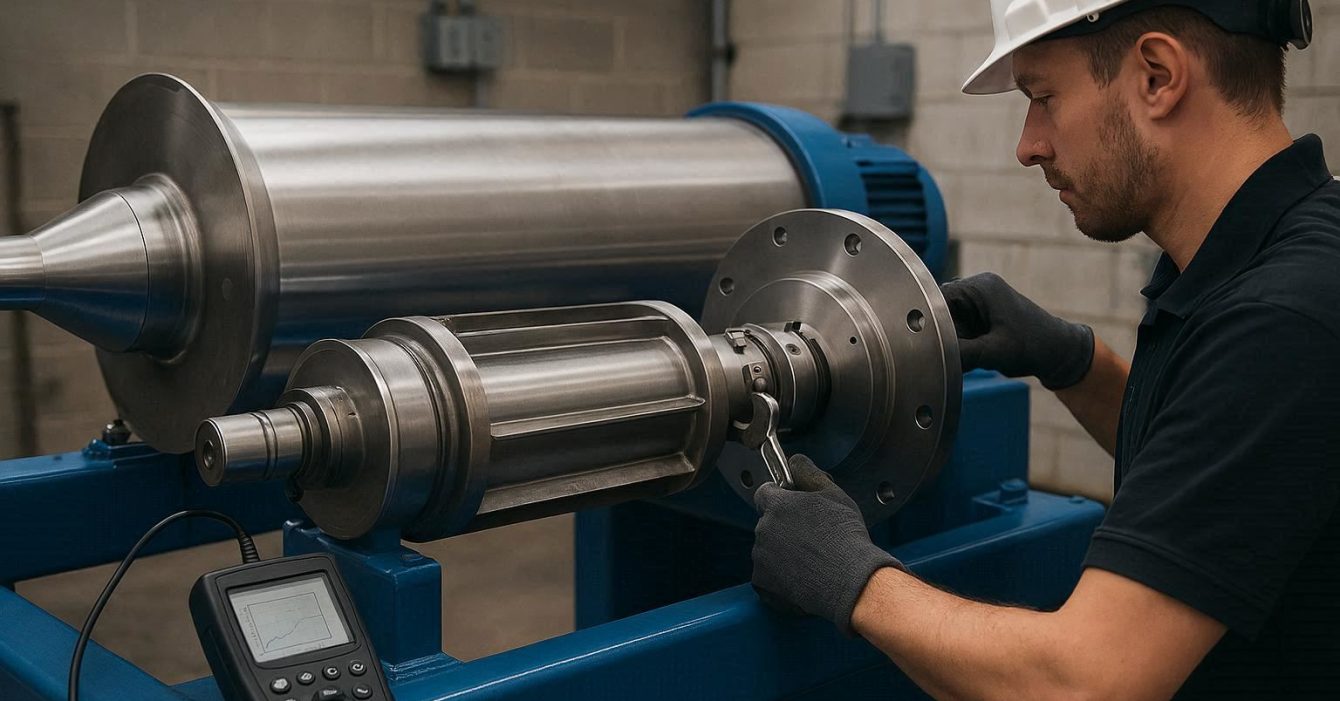
In the world of industrial equipment, centrifuges and decanters hold a special place. They are the “athletes” of production lines, running at speeds of 2,000 to 5,000 revolutions per minute. Under such conditions, any deviation of the rotor mass from the axis of rotation turns into a destructive force.
Many enterprises make a critical mistake, believing that decanter repair is only about replacing bearings or restoring the scroll. Yet without precision balancing, any repair is merely a temporary “sticking plaster”. Let us look at why balancing is the heart of the service process and why you should not save money on it.
What is decanter balancing really?
When we speak about decanter centrifuges, we mean dynamic balancing in their own bearings or on specialised rigs. Since the decanter bowl has a considerable length, ordinary static balancing is not enough. It is necessary to take into account the distribution of mass along the whole length of the rotor in order to avoid a moment imbalance.
Real balancing means:
- Compensation of micron deviations: Even 10 grams of uneven weight at a radius of 300 mm at a speed of 3,000 rpm creates a centrifugal force equivalent to hundreds of kilograms.
- Working with resonant frequencies: Every decanter has its “critical speeds”. Professional service guarantees that the equipment passes through these zones without vibration stress.
- Synchronisation of the scroll and the bowl: Both parts must be balanced, both separately and as an assembly (if this is provided for by the manufacturer’s design).
Why is “just a repair” without balancing money down the drain?
Imagine that you have ordered decanter servicing, the seals and bearings have been replaced, but a minimal imbalance has been left. What happens next?
- Accelerated bearing wear: Vibration creates an additional load for which the bearings are not designed. Their service life is reduced by a factor of 3-5.
- Destruction of the seating surfaces: Constant “knocking” breaks up the seating surfaces in the housing, which leads to major expenditure in the future.
- Risk of an emergency shutdown: Metal stress can lead to fatigue cracks in the bowl. This is no longer just a matter of money, but of personnel safety.
That is exactly why buying spare parts for a centrifuge (even original ones) is only 50% of success. The remaining 50% is professional installation and final adjustment.
Original spare parts vs analogues: their role in balancing
The quality of spare parts has a direct effect on the stability of the decanter. The use of non-original scrolls or bowls often becomes a nightmare for the balancing engineer.
- Uniformity of the metal: Original parts have a uniform casting density.
- Geometric accuracy: The slightest deviation in the geometry of an analogue makes perfect balancing of it impossible.
If you are planning to order spare parts for a GEA, Alfa Laval, Andritz or other world-brand decanter, remember: saving money on a “replica” often results in the decanter being impossible to bring up to operating speed because of vibration.
How can you tell that your decanter urgently needs balancing?
Do not wait until the vibration sensor is triggered or the equipment starts to “walk” across the foundation. The signs of a problem are:
- An increased noise level.
- Heating of the bearing housings.
- The appearance of fine cracks on the metal structures nearby.
- A deterioration in the quality of fraction separation (because of flow instability inside the bowl).
A professional approach from Steiner
Steiner offers a comprehensive approach to supporting your fleet of centrifuges. We understand that every day of downtime means lost profits.
Our services include:
- Full technical maintenance of decanters using specialised diagnostic equipment.
- Dynamic balancing of rotors on professional machines.
- Supply of original spare parts for industrial centrifuges from stock and to order.
- A service team visit for vibration monitoring and on-site diagnostics.
Decanter repair is not a fitter’s operation, but a precise engineering task. Without professional balancing and quality components, any intervention merely postpones the inevitable breakdown.
Do you need a consultation on the condition of your equipment?
Contact the Steiner specialists — we will ensure the stable operation of your production without unnecessary vibration and unpredictable costs.


