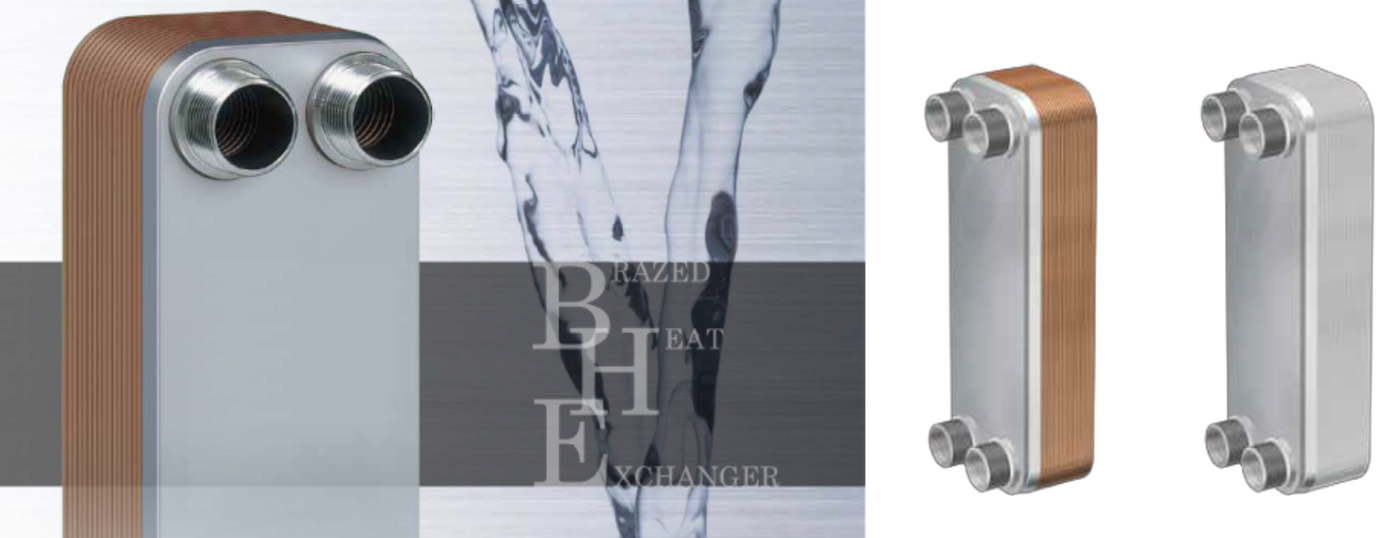
The Arsopi Thermal brazed heat exchanger is a non-dismountable plate unit in which the plates are brazed into a single pack. It offers the efficiency of a gasketed heat exchanger with fewer parts, lower weight and smaller dimensions.
Brazing provides high tightness, so the unit works with refrigerants, including ammonia and freons. Steiner Ukraine is the official representative of Arsopi Thermal in Ukraine. The general working principle is described on the page Arsopi Thermal.
How does the Arsopi Thermal brazed heat exchanger work?
Thin corrugated plates have low thermal resistance. The complex channel shape creates strong turbulence, and full counterflow makes it possible to use the maximum temperature difference.
As a result, a smaller heat transfer area is needed for the same duty than in a unit of a different design.
Arsopi Thermal brazed heat exchanger: technical specifications
| Parameter |
Value |
| Design |
plate pack joined by brazing |
| Design pressure |
from full vacuum to 4.5 MPa |
| Design temperature |
from −100 to +200 °C |
| Flow arrangement |
full counterflow |
| Gaskets |
none |
| Working media |
water, oils, refrigerants including ammonia and freons |
How does a brazed unit differ from a gasketed one?
- Compactness. No frame or tie bolts, so the unit is lighter and smaller.
- Pressure and temperature. Up to 4.5 MPa and from −100 to +200 °C — a wider range than a gasketed unit.
- Maintenance. The unit cannot be opened: mechanical cleaning and changing the number of plates are not possible; it is cleaned chemically.
- Cost. The minimum number of parts and series production make the brazed unit economical.
If the product leaves deposits or access to the plates is needed, choose the Arsopi Thermal gasketed heat exchanger.
Where is the Arsopi Thermal brazed heat exchanger used?
- evaporators and condensers of compression chillers and heat pumps;
- solution heat exchangers in absorption chillers;
- industrial and domestic water heaters;
- heat recovery in cogeneration plants and gas heat pumps;
- oil cooling for hydraulic equipment;
- temperature control of industrial and laboratory equipment.
How to estimate the effect of heat recovery at a plant is described in the article on heat recovery.
Selection and supply
Selection requires the media, flow rates, inlet and outlet temperatures, operating pressure and allowable pressure drop. For refrigeration duties — also the refrigerant type and evaporating or condensing temperatures.
How to choose between heat exchanger types is explained in the article «How to choose the optimal heat exchanger». Prices are quoted on request.
FAQ
What pressure does the Arsopi Thermal brazed heat exchanger withstand?
Design pressure ranges from full vacuum to 4.5 MPa.
What temperature range does it operate in?
From −100 to +200 °C.
Is it suitable for ammonia?
Yes. Brazing provides tightness sufficient for refrigerants, including ammonia and freons.
Can a brazed heat exchanger be opened and cleaned?
No. The unit is cleaned chemically without opening.