Pemo Pumps
Pemo Pumps — a trademark of the Italian company Perissinotto S.p.A. The company has been operating since 1947 and specialises in a single task: centrifugal pumps for abrasive and acidic media, custom-built for specific applications.
The catalogue consists of 20 basic models in horizontal, vertical, submersible and multistage versions. Based on them, the manufacturer claims over 3,000 configurations. The flow rate ranges from 1 to 2000 m³/h.
Steiner Ukraine supplies Pemo Pumps equipment to Ukraine: media sizing, material selection, supply, service, spare parts.
Who is the manufacturer Pemo Pumps?
| Parameter | Value |
|---|---|
| Legal name | Perissinotto S.p.A. |
| Trademark | PEMO PUMPS |
| Year of establishment | 1947 |
| The production of | Via Pascoli 17, 20055 Vimodrone (Milan), Italy |
| Production area | 20,000 m² |
| Origin of production | 100 % Italy |
| Basic pump models | 20 |
| Configurations based on them | over 3,000 |
| Presence | subsidiaries, representatives and agents in 20 countries |
| Clients | over 4,000 worldwide |
| Certification | ISO 14001 (environmental management system) |
The manufacturer emphasises its custom profile: pumps are designed for a specific application rather than being selected from a standard range. This also determines the way of working with them — the enquiry requires the characteristics of the medium, not just flow rate and head.
What types of pumps does Pemo Pumps manufacture?
| Type | Series | Capacity | Pressure / head |
|---|---|---|---|
| Horizontal | AO, AO/TD, AO/AB | 1–1500 m³/h | up to 90 m head (Hardalloy) |
| Verticals | JOLLY, AUSTRALIA | 5–1500 m³/h | 6–7 bar |
| Submersible | — | up to 700 m³/h | up to 7 bar |
| Two-stage | — | upon request | higher than single-stage |
| Three-stage | — | upon request | three impellers in series |
| Four-stage | — | upon request | four impellers in series |
| Self-priming | — | upon request | work with an air-liquid mixture |
The overall flow rate range across the entire catalogue is from 1 to 2000 m³/h. The maximum head of a single-stage pump is 90 m in the Hardalloy PEMO version.
There are currently four items in the Steiner Ukraine catalogue: horizontal, submersible, verticals and multi-stageFor four-stage and self-priming ones, please send a separate enquiry.
Which horizontal series are in the catalogue?
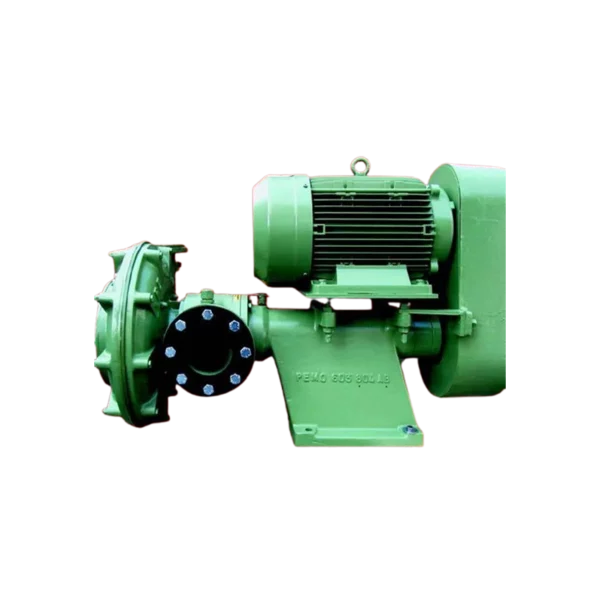
Horizontal pumps are divided into three series, and the difference between them lies in the sealing system and the pressure experienced by the friction pair.
| The series | Entrance | Gaskets | Capacity | Max. pressure | What is it for? |
|---|---|---|---|---|---|
| AO, AO/AD | frontal | single-ended | — | up to 2 bar | liquids such as water, virtually free of abrasives |
| AO/TD, AO/TD/AD | frontal | double mechanical seal | 1–1500 m³/h | 3–4 bar output | abrasive and acidic environments |
| AO/AB, AO/AB/AD | side | double mechanical seal | 1–900 m³/h | head up to 90 m (Hardalloy) | abrasive and acidic, maximum seal life |
AO/AB is the manufacturer's key series. The reason lies in the side entry. In a conventional pump, the mechanical seal experiences the discharge pressure, which is the highest in the circuit. With a side entry, the seal only sees the suction pressure. The pressure differential across the friction face directly determines its lifespan when handling abrasive media.
Practical implication for operation: the seal flush in the AO/TD series is supplied at a pressure approximately 1 bar higher than the operating pressure at the exit, and in the AO/AB series — 1 bar higher than the pressure at the input. These are the different volumes of wash water used.
The maximum particle size in the AO/AB series is 2 mm, depending on the application.
The friction pairs of mechanical seals are made from tungsten carbide (Widia) or silicon carbide. The seals are lubricated using flushing water at a specified pressure or a water/glycol mixture in a closed circuit with natural or forced circulation. The bearings are lubricated with grease or oil.
The drive is either a V-belt drive or a direct drive.
What are the differences between the JOLLY and AUS vertical ranges?
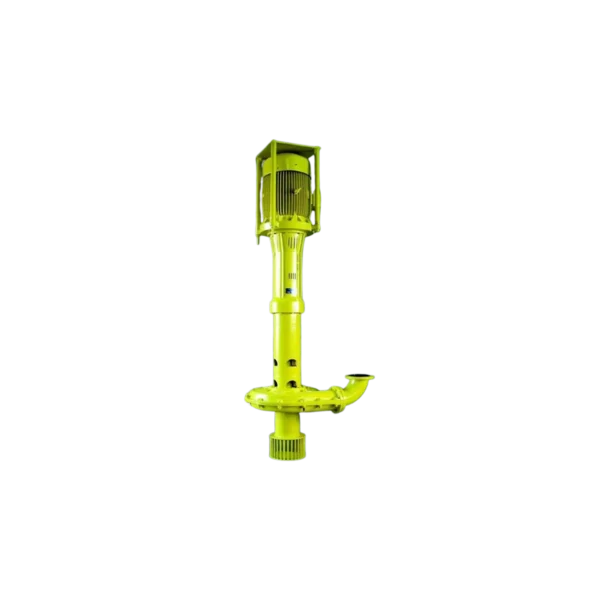
Both series have identical hydraulic specifications: a flow rate of 5–1,500 m³/h and a maximum pressure of 6–7 bar. Mechanically, according to the manufacturer’s description, they are identical pumps. There is one thing that sets them apart — dry running.
| Parameter | JOLLY | Australia |
|---|---|---|
| Gaskets | sleeve bearing | there is no mechanical seal |
| Dry cleaning | impossible below a certain level | possible |
| Maximum length under the slab | 4–5 m | usually no more than 2 m |
| Liquid inlet | standard | above the housing or near the bottom (double-sided impeller) |
| Installation | in the tank | inside or outside the tank |
| Capacity | 5–1500 m³/h | 5–1500 m³/h |
| Pressure | 6–7 bar | 6–7 bar |
The choice between them determines the operating mode of the sump. If the level can drop below the pump, it is AUS. If a large immersion depth is required, up to 4–5 metres below the slab, it is JOLLY.
The design of the vertical pump consists of five assemblies: a motor above the baseplate, a column pipe with a shaft inside, a semi-open impeller, a casing made of Hardalloy or with rubber lining, and a suction strainer at the inlet. The shaft in the JOLLY is supported by two bearings in the base above the plate — meaning there are no bearings in the product zone.
What makes Pemo Pumps’ submersible pumps so special?
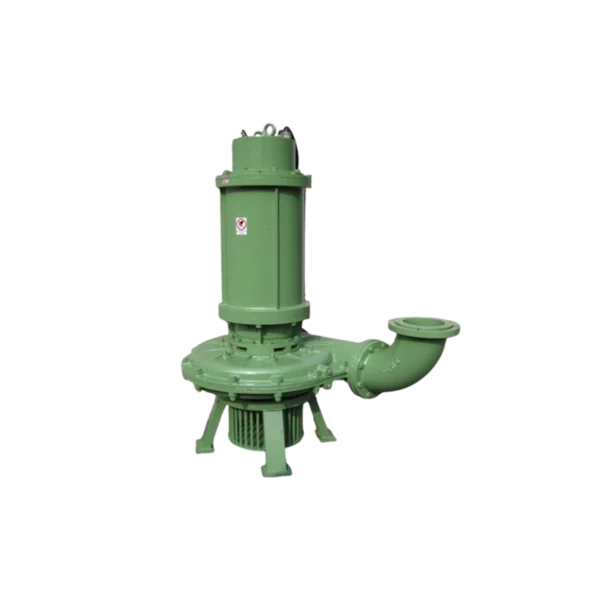
Submersible pump operates fully submerged in slurry. The motor is cooled by the pumped liquid itself.
| Parameter | Value |
|---|---|
| Maximum flow rate | up to 700 m³/h |
| Maximum pressure | up to 7 bar |
| Motor | three-phase induction, IE3 class |
| Power | 1.1–90 kW |
| Revolutions | 735–3,500 rpm (50 and 60 Hz) |
| Impeller | only half-open |
| Gaskets | double back-to-back face seals, silicon carbide or tungsten carbide rings, lubricated with oil |
| Shaft | AISI 431 stainless steel |
| Bearings | radial-thrust, lubricated for the entire service life, maintenance-free |
| Body | Hardalloy or rubber lining |
| Working with an inverter | provided |
It is also worth noting the control system. Every submersible pump comes equipped with thermal sensor of the motor (bi-metallic switch, PTC on request) and with two oil level sensors — they record sludge leakage into the oil chamber. The signal analysis device for both sensors is supplied with the pump.
This means that seal damage is visible before the sludge reaches the engine.
Mixers. Submersible pumps can be equipped with two types of agitator:
| Type of agitator | Location | Principle |
|---|---|---|
| Mechanical | on the shaft, at the pump inlet | stirs up settled sediment and keeps it in suspension, cleans the filter |
| Hydraulic | at the pump outlet | uses part of the discharge flow for sludge weighting and filter cleaning |
The agitator solves a typical sump problem: the solid phase settles and the pump pumps the clarified liquid while a layer of sediment grows on the bottom.
Why are multistage pumps needed?
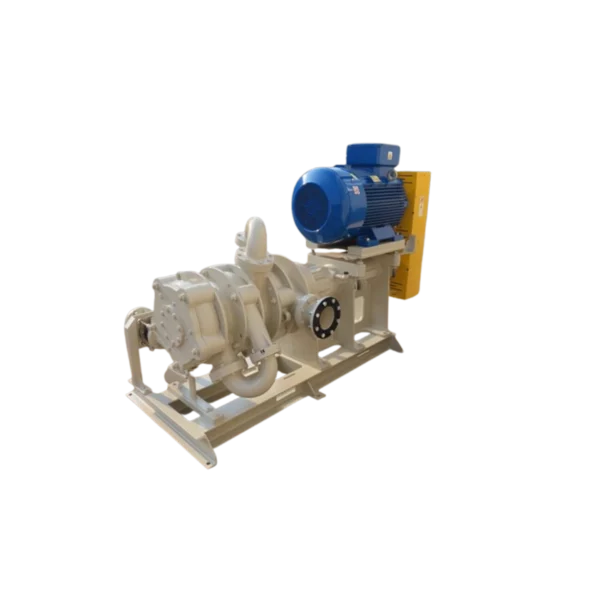
A single-stage pump is limited by the head generated by a single impeller. In the Hardalloy design, this is 90 metres. Beyond that, the head is increased by successive stages.
| Implementation | Impellers | Manufacturer designation |
|---|---|---|
| Two-stage | 2 | increased head relative to the single-stage one |
| Three-stage | 3 | continuous fluid supply under pressure |
| Four-stage | 4 | deep bottom-up suction |
Each stage consists of an impeller and a diffuser. The diffuser converts the velocity imparted by the impeller into pressure and directs the flow to the next impeller.
The four-stage pump is the manufacturer's newest development. It was created in response to requests from customers who need a higher head, and is shipped worldwide.
What materials are Pemo Pumps made of?
Material execution is the main selection tool for this manufacturer. The same hydraulics are supplied in different materials for different media.
Impellers:
| Implementation | Where is it used |
|---|---|
| Metal core with a thick rubber coating | abrasive without sharp edges, moderate temperatures |
| Hardalloy PEMO, hardness 750–800 HB | heavy-duty abrasive |
| AISI | moderately corrosive environments |
| Hastelloy C | acids and strong oxidising agents |
Cases:
| Material | Where is it used |
|---|---|
| Cast iron | standard performance |
| Hardalloy PEMO | abrasive slurries |
| Stainless steel | corrosive environments |
| Hastelloy | acids |
| Rubber lining — vulcanised or removable, of various compositions | abrasive, possibility of replacing the lining without replacing the casing |
Hardalloy PEMO — the manufacturer's proprietary wear-resistant alloy with a hardness of 750–800 Brinell. For comparison: standard grey cast iron has around 200 HB. The difference in hardness directly determines the abrasive service life.
Removable rubber lining provides repairability: the worn lining is replaced, the casing remains.
For acidic environments in AO/AB series horizontal pumps, the shaft and mechanical seal chamber are also made from special alloys.
The manufacturer designs shafts and bearings with a size safety margin — this is the declared method for extending lifespan under heavy operating conditions.
What industries are Pemo Pumps designed for?
| Industry | Typical tasks according to the manufacturer's description |
|---|---|
| Mining | dewatering, tailings pumping, mineral slurry processing |
| Quarries and non-metallic materials | dewatering, feed to hydrocyclones, material washing |
| Ceramic | return of press powders, slip feeding to mills and spray dryers, glaze supply, wash waters, thickened sludge, filter press feed |
| Stone-working | sawing and grinding sludge |
| Chemical | corrosive and abrasive slurries |
| Food | technological environments |
| Sewage treatment | recirculation, sludge pumping, filter press feed |
| Processing of the organic fraction of municipal solid waste | feed to settling tanks, feeding of anaerobic reactors, digestate recirculation |
| Construction | jet grouting, dewatering, bentonite slurries in tunnelling, concrete |
| Dredging | sediment transport |
| Energy sector | ash and slag slurries |
| Pulp and paper | cellulose pulp and fibrous suspensions |
A common feature of all these applications is a solid phase, abrasiveness or acidity. For clean, low-viscosity liquids without inclusions, this manufacturer is redundant.
Frequently asked questions about Pemo Pumps
Who manufactures Pemo pumps?
Perissinotto S.p.A., Italy. The company has been operating since 1947, with production located in Vimodrone near Milan on an area of 20,000 m². Production is entirely Italian.
How many models are in the catalogue?
Twenty base models, on the basis of which the manufacturer claims over 3,000 configurations.
What is the maximum flow rate?
2000 m³/h across the entire catalogue. Horizontal series provide up to 1500 m³/h, vertical ones up to 1500 m³/h, and submersible ones up to 700 m³/h.
What is the maximum head?
90 metres for a single-stage pump in the Hardalloy PEMO design. For a higher head, two-, three- or four-stage designs are used.
What is Hardalloy?
Manufacturer's proprietary wear-resistant alloy with a hardness of 750–800 HB. Used for impellers and casings in abrasive slurries.
Can the worn lining be replaced without replacing the casing?
Yes, rubber lining is supplied in a removable design, as well as vulcanised.
Which pump can run dry?
The AUS vertical series has no mechanical seal. The JOLLY series cannot run dry below a certain level.
How does the AO/AB series differ from other horizontal ones?
Through the side entrance. Thanks to this, the mechanical seal experiences the inlet pressure rather than the discharge pressure, which extends its service life. The manufacturer calls this series the key one in its range.
How is the condition of the submersible pump monitored?
With a thermal engine sensor and two oil level sensors that detect sludge leaking into the oil chamber. The signal processing device is included in the supply.
Does the manufacturer have certificates?
Perissinotto S.p.A. holds the ISO 14001 certificate, which is an international standard for environmental management systems.
What is the maximum particle size?
In the horizontal AO/AB series, the manufacturer indicates 2 mm, with the proviso that the value depends on the specific application. For other series, the figures are not published.
Enquiry for selection and price via ContactsCatalog positions: horizontal slurry pumps, submersible slurry pumps, vertical slurry pumps, multistage pumpsRelated sections: Industrial pumps, Pumps and systems, Industry solutions, Spare parts, Services.