Condensed milk with sugar has for many decades remained one of the most popular products both among consumers and among confectionery manufacturers. It is used in beverages, desserts, creams and caramel masses, and thanks to its affordable price it is one of the basic ingredients of the confectionery sector.
The classic format — the tinplate can — remains to this day one of the most reliable and convenient solutions for filling condensed milk and boiled condensed milk, ensuring stable quality and long shelf life.
In this material we will consider:
-
the features of filling condensed milk into tinplate cans;
-
the key ZACMI solutions for filling and seaming lines;
-
approaches to heat treatment in horizontal STERIFLOW autoclaves using the «water cascade» technology.
The filling line: «wet» and «dry» zones
A typical condensed milk filling line is conventionally divided into two parts:
-
The «wet» zone – container treatment, sterilisation, product filling, seaming.
-
The «dry» zone – labelling, group packaging, palletising.
To increase the hygiene of production it is advisable to physically separate these zones into different, adjacent rooms. All equipment that has direct contact with the product must be located in a separate «clean» zone, isolated from the other sections.
Preparation of the container and filling of condensed milk
Before entering the filling unit the tinplate can undergoes heat treatment with hot air, steam or flame to destroy microorganisms on the surface.
Next the container is fed into the filling zone along a closed conveyor, into which purified air is supplied. The ZACMI filling unit is a rotary carousel-type machine with volumetric piston dosers that ensure precise and stable dosing of a thick product.
Before being fed to seaming the lids also undergo disinfection — usually by means of UV radiation or hot air. Both solutions are effective, and the choice depends on the customer's requirements and the specifics of the production.
Can seaming: seam stability as a key parameter
After filling, the can enters the seaming unit, which is mechanically synchronised with the filling unit. This makes it possible to:
-
avoid splashing of the product;
-
ensure a smooth transfer of the can;
-
maintain the stability of the filling level.
The ZACMI seaming unit is of the carousel type, with several seaming heads. The distinctive feature of the design is the dynamic control of the forces of the seaming rollers. The controller monitors the pressure of each roller on the seam in real time. At the outlet the automation «knows» how well each can has been seamed:
-
cans with deviations are automatically rejected;
-
information about defects is stored in the statistical data collection system.
The whole «wet» part of the line is controlled via a PLC in fully automatic mode.
Design advantages of ZACMI equipment
Strength and reliability
-
A frame of stainless steel, the drives — in an oil reservoir.
-
Lifting mechanisms made of AISI 304, cylinders made of hardened steel.
-
Filling valves made of stainless steel and hygienic materials, adapted for a viscous product.
-
Slat chain conveyors with a synchronising screw and a ratchet mechanism, made of non-toxic wear-resistant PVC.
-
A ring-shaped thick-walled tank of the filling unit made of stainless steel.
-
Synchronous operation with the seaming machine.
-
An electrical control panel with protection class IP55.
-
PLC control and built-in safety systems in accordance with European standards.
Hygiene
-
All elements that come into contact with the product are made of stainless steel and hygienic materials.
-
The equipment is adapted for CIP cleaning.
-
Stationary systems for external foam cleaning of the filling unit, the seamer and the conveyors are provided.
From condensed milk to boiled: the role of autoclaves
Classic boiled condensed milk («toffee») is obtained in industrial conditions by boiling condensed milk in a hermetically sealed container under pressure.
For this purpose autoclaves are used — devices in which sterilisation is also carried out of:
-
condensed milk without sugar;
-
other concentrated dairy products;
-
canned goods of plant and animal origin.
Thermal sterilisation and pasteurisation are the key processes that destroy microorganisms and their spores, ensuring long shelf life of the product. At the same time, for canned dairy products the costs of heat carrier and electricity often approach the cost of the raw materials, therefore energy efficiency becomes a critical factor.
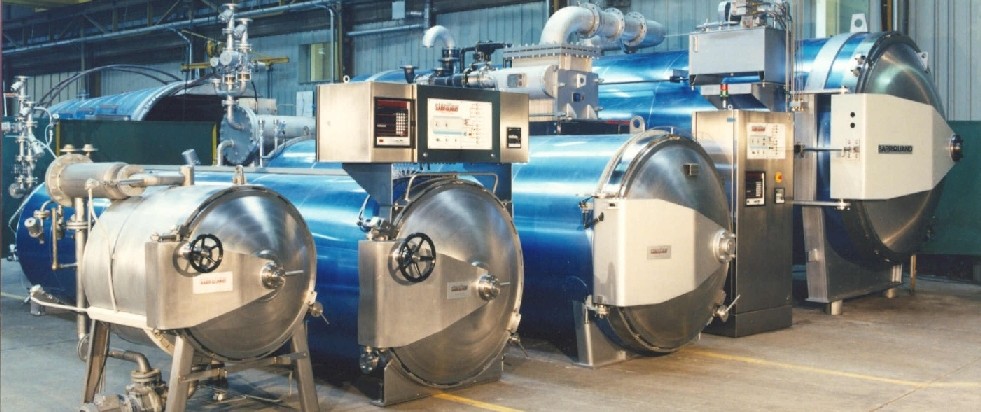
Horizontal STERIFLOW autoclaves and the «water cascade» technology
World practice shows that for the heat treatment of condensed milk in cans the optimal choice is horizontal autoclaves with different modes:
-
Steam & Air
-
Air Steam Spray
-
Full Water
-
Shower Cascading (water cascade)
The most efficient technology is considered to be Shower Cascading, implemented by the company STERIFLOW. It ensures:
-
even heat treatment;
-
a reduction of the cycle time;
-
a reduction of energy consumption;
-
careful handling even of sensitive glass or polymer containers.
How a STERIFLOW autoclave with a water cascade works
-
Into the bottom of the chamber is poured 100–400 l of process water (depending on the model).
-
A circulation pump feeds the water into a PLATULAR plate heat exchanger, where it is heated by steam to the set temperature.
-
The heated water, through a distribution system, sprays the product in a cascade, ensuring even heating of all layers.
-
After heating and holding, the water is cooled in the same heat exchanger and is used for cooling the products.
-
The water does not come into contact with the product, circulates in a closed circuit and, after the process is completed, can be discharged into the environment without additional treatment.
-
The pressure in the chamber is regulated automatically by supplying or removing compressed air at all phases of the cycle.
The patented heat exchanger PLATULAR (fully welded from stainless steel, without gaskets) ensures:
-
high heat transfer efficiency;
-
compactness and low metal consumption;
-
a long service life — up to 30 years.
Working with different types of packaging
The design of STERIFLOW autoclaves:
-
eliminates the risk of thermal shock for glass containers;
-
makes it possible to sterilise products in metal, glass and polymer packaging;
-
is suitable for operation in conditions of unstable power supply.
The «water cascade» technology makes it possible to:
-
flexibly adjust the temperature and pressure;
-
use modern polymer packaging (lighter, cheaper, more convenient);
-
combine the processes of sterilisation, pasteurisation and boiling in a single unit.
The reliability of STERIFLOW solutions
Today in 105 countries of the world more than 3500 STERIFLOW autoclavesare in operation, which every year provide the pasteurisation and sterilisation of more than 6 billion units of products.
In Ukraine and the countries of the former USSR more than 100 Barriquand STERIFLOW autoclaves have been installed, some of which have been in operation since Soviet times and still demonstrate stable results.
Conclusion
The quality of condensed milk and boiled canned dairy products directly depends on:
-
the precision and hygiene of the filling (ZACMI lines);
-
the efficiency and controllability of the heat treatment (STERIFLOW autoclaves);
-
the energy efficiency of the equipment in conditions of rising resource costs.
Modern ZACMI and STERIFLOW solutions allow manufacturers to:
-
increase the stability of product quality;
-
shorten the duration of the heat cycles;
-
reduce energy consumption and service costs;
-
work with different types of packaging — from the classic tinplate can to modern polymer containers.


