
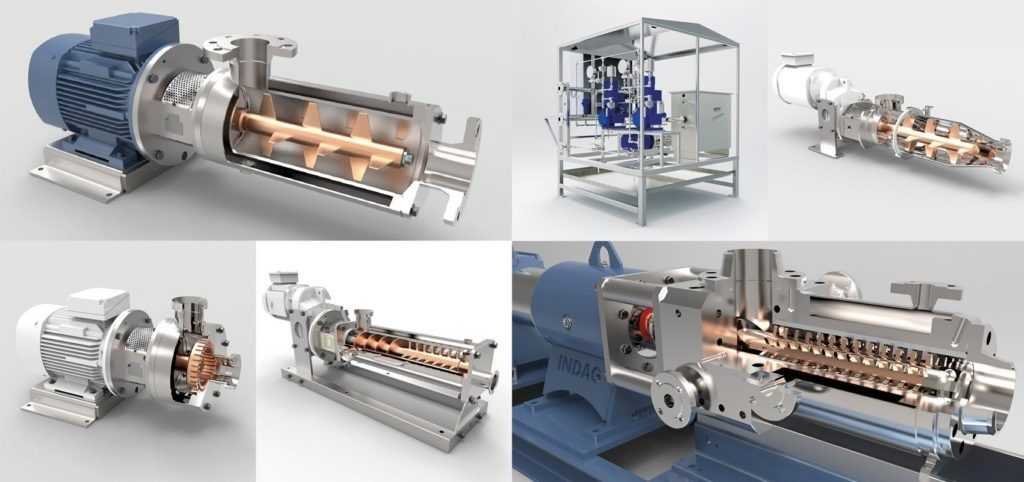
The cooling system is a critically important part of industrial equipment. It ensures a stable temperature regime, protects the assemblies from overheating and maintains the productivity of the production processes. The wrong choice of cooling system can lead to premature wear of components, emergency shutdowns and increased energy consumption, so engineering analysis is a mandatory stage.
The main types of industrial cooling and their applications
1. Water cooling
One of the most efficient ways of removing heat. Water has a high heat capacity, so it is able to transfer significant volumes of heat quickly.
Advantages:
- high heat exchange efficiency;
- temperature stability under high thermal loads;
- the possibility of operating in a closed circuit (chillers, glycol systems).
Disadvantages:
- dependence on the availability of water;
- the need for pipelines and pumping equipment;
- the risk of corrosion or fouling without proper water treatment.
Applications: the food industry, metallurgy, extrusion, autoclaves, large hydraulic systems.
2. Air cooling
Uses atmospheric air as the heat carrier. The simplest and cheapest type of cooling.
Advantages:
- low installation cost;
- no water or liquids in the circuit;
- minimal maintenance.
Disadvantages:
- low efficiency at high ambient temperatures;
- dependence on ventilation;
- limited heat dissipation.
Applications: compressors, server cabinets, low-power electronic equipment.
3. Cooling with a liquid heat carrier (oil, glycol, special fluids)
Considered when air is not sufficient and water is unavailable or undesirable.
Advantages:
- stable heat transfer without dependence on air humidity or temperature;
- the possibility of operating in sealed systems;
- high efficiency and a low risk of corrosion.
Disadvantages:
- more complex maintenance;
- higher cost;
- the need for a pump unit.
Applications: high-precision electronics, food industry equipment, cooling of hydraulic stations, laser systems.
4. Thermoelectric systems (Peltier elements)
Suitable for small assemblies or spot cooling.
Advantages:
- compactness and precision;
- the ability to work in difficult conditions;
- the absence of moving parts.
Disadvantages:
- low capacity;
- not suitable for equipment with a high thermal load.
Applications: laboratory installations, optics, small electronic modules.
How to choose the optimal cooling system?
When choosing a system it is necessary to take into account:
1. The type of equipment and the thermal load
The amount of heat that has to be removed determines the type of heat carrier and the capacity of the system.
2. The operating temperature regime
If an accuracy of ±1°C is required, liquid or chiller systems are needed.
3. Operating conditions
Humidity, temperature, dust levels, access to water and energy resources.
4. Energy efficiency and operating costs
The best system is the one that provides the required capacity with minimal energy consumption.
5. Environmental friendliness and safety
Modern systems must operate without harmful emissions and with minimal consumption of resources.
Examples of application in various industries
Food industry
Water or glycol systems are often used for cooling reactors, mixers, heat exchangers and extruders. Glycol is safe, does not come into contact with the product and ensures a stable temperature.
The electronics industry
Liquid dielectric coolers make it possible to remove heat from microchips, boards and power supply units without the risk of short circuits.
Metallurgy and heavy industry
Water cooling of steels, presses, hydraulic systems and furnaces is mandatory in order to maintain the safety and service life of the equipment.
Conclusion
The optimal cooling system is a balance between efficiency, cost, operating conditions and the requirements for temperature accuracy. Competent technical analysis makes it possible to select a solution that will ensure stable and safe operation of the equipment throughout its entire life cycle.


