
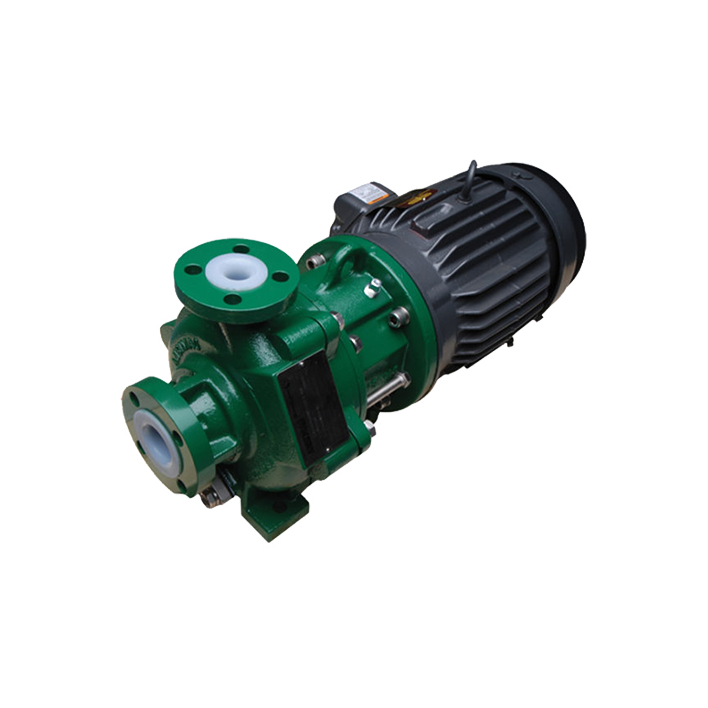
Sundyne – Chemical Pump (ANSIMAG)
The Sundyne ANSIMAG pump is a sealless centrifugal pump with a magnetic coupling in which all wetted parts are made of the fluoropolymer ETFE. The series is intended for acids, alkalis and solvents at temperatures up to 121 °C. ANSIMAG pumps have been supplied since 1985. The magnetic coupling principle is described on the page Sundyne.
How the Sundyne ANSIMAG pump is built
- The inner neodymium-iron-boron magnets are fully encapsulated. A layer of carbon-fibre-reinforced ETFE and a second layer of 316 stainless steel separate them from the liquid.
- The containment shell is reinforced with Kevlar fibre. The rear casing generates no eddy currents, so the coupling does not heat the liquid or lose energy this way.
- The ductile iron casing is lined with ETFE or PFA. The impeller parts are glass-fibre-reinforced PFA.
- The shaft is supported at both ends, which eliminates deflection at low flow. The bushings are silicon carbide.
- The casing is sealed by a single O-ring.
- The impeller is replaceable and attaches to the inner magnet with a tongue-and-groove joint.
- Nine parts are in contact with the liquid, and repairs need no special tools. The drive end can be serviced without opening the wet end.
Which Sundyne ANSIMAG pump to choose: models and specifications
Values for 50 Hz supply according to the manufacturer.
| Model | A distinctive feature | Flow up to, m³/h | Head up to, m | Motor up to, kW |
|---|---|---|---|---|
| K+ | ASME B73.3 and ISO 2858 dimensions, 8 hydraulics | 125 | 67 | 22 |
| KF | ASME B73.3 dimensions, 7 hydraulics | 275 | 110 | 75 |
| KV | vertical, ASME B73.2 dimensions | 59 | 69 | 22 |
| KP | self-priming | 52 | 32 | 22 |
| KM | low flow, 3 hydraulics | 27 | 30 | 5,5 |
Liquid temperature for all models is from −30 to +120 °C. K+ is available in a low-temperature version from −84 °C.
The series also includes:
- KMLF for low flow: up to 9 m³/h, head up to 52 m;
- ALI with ISO 2858/15783 dimensions: up to 150 m³/h, head up to 105 m, motor up to 75 kW.
Pumping liquids with solids
Generous internal clearances allow liquids with up to 20 % solids by weight and particles up to 1/8″ (about 3 mm) to be pumped. KV and KP handle concentrations up to 40 %. The design has no tight silicon carbide wear rings where particles could get trapped.
Typical solids: inorganic salts, fine sand, caustic precipitates, titanium dioxide, steel pickling slag, carbon black.
Which liquids the Sundyne ANSIMAG pump handles
| Industry | Liquids |
|---|---|
| Chemical | chlor-alkali, crop protection chemicals, fertilisers |
| Refining | sour water, sulphuric acid, benzene, xylene, toluene |
| Mining | sodium cyanide, sulphuric and hydrochloric acid |
| Steel pickling | hydrochloric acid |
| Semiconductors | hydrofluoric acid, sulphuric acid |
| Batteries | sulphuric acid, potassium hydroxide |
| Water conditioning | sodium hypochlorite, sodium hydroxide, ferric chloride |
| Biofuels | biodiesel, ethanol |
How to select materials for a specific liquid — see the article “How to select a pump for aggressive and chemically active liquids”.
Options and replacement of existing pumps
- power monitor;
- secondary containment to ASME B73.3;
- liquid leak detector;
- carbon bushings for dry-run resistance;
- BASETEK polymer concrete baseplates.
ASME B73.3 and ISO 2858 dimensions allow ANSIMAG to replace a mechanically sealed pump without changing the piping or baseplate.
For temperatures above 120 °C and API 685 requirements, use the metallic HMD Kontro. Other chemical magnetic drive pumps in the catalogue: DEBEM KM and DEBEM DM.
Frequently asked questions
What temperature does ANSIMAG operate at?
From −30 to +120 °C. K+ in the low-temperature version operates from −84 °C.
How does ANSIMAG differ from HMD Kontro?
ANSIMAG is a non-metallic ETFE-lined pump for corrosive liquids up to 120 °C. HMD Kontro is a metallic pump for temperatures up to 450 °C, with models to API 685.
Can ANSIMAG replace an existing pump?
Yes. ASME B73.3 and ISO 2858 dimensions allow replacement without changing the piping or baseplate.
Does ANSIMAG handle liquids with solids?
Yes: up to 20 % by weight, and up to 40 % in the KV and KP models.