
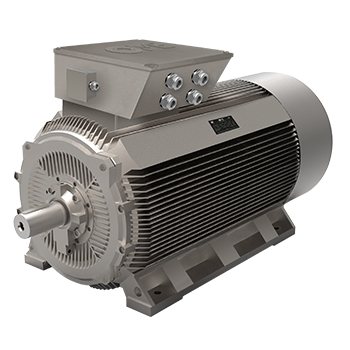
OME Motors – Permanent Magnet Synchronous Motor (OMPM)
The OME Motors OMPM permanent magnet motor is a synchronous motor (PMSM) for variable-speed drives. Power 0.75–2500 kW, frame sizes 80–400, efficiency above the IE4 threshold.
The series is designed for variable-speed drives: pumps, fans, compressors, conveyors. Two versions are available — VFD-fed and direct-on-line (Line-Start).
OMPM permanent magnet motor: technical specifications
| Parameter | Value |
|---|---|
| Type | permanent magnet synchronous (PMSM) |
| Power | 0.75–2500 kW |
| Standard sizes | 80–400 |
| Number of poles | 2, 4, 6, 8 |
| Energy efficiency | efficiency above the IE4 threshold |
| Voltage | to the customer’s supply parameters |
| Power supply | frequency converter with vector control (sensorless or with encoder) |
| Line-Start version | direct-on-line start, rotor with auxiliary squirrel-cage winding |
| Rotor design | IPM (interior magnets) or SPM (surface magnets) |
| Insulation | reinforced, for operation with PWM converters |
How does a permanent magnet motor differ from an induction motor?
Permanent magnets are embedded in the OMPM rotor, so the rotor flux is produced without magnetising current. There are no rotor winding losses, which limit the efficiency of an induction motor.
Compared with a NEMA Premium induction motor of the same power:
- Efficiency is 2–5 points higher across the whole load curve. The largest difference is at partial load.
- Torque at low speed. OMPM delivers rated torque from almost zero speed without forced cooling. A VFD-fed induction motor loses available torque below 30 % of base speed.
- Dimensions. The OMPM housing is typically one or two IEC frame sizes smaller.
- Start-up. Standard OMPM motors start from a frequency converter. For direct-on-line starting there is the Line-Start version.
For drives running at constant speed, the induction motor of the series is suitable: Standard.
IPM or SPM: which rotor design to choose?
In the IPM design, the magnets are located inside the rotor lamination stack. A reluctance torque component is added, which extends the constant-torque speed range and improves operation in the field-weakening region.
Design SPM has a simpler magnetic circuit. It suits lower-speed drives.
Where are OMPM motors used?
- pumping systems — water supply, wastewater, irrigation;
- ventilation and air conditioning — air handling units, chillers;
- compressors with variable load — centrifugal and screw;
- food production — conveyors, mixers and variable-speed pumps;
- power plant auxiliaries — boiler feed pumps, cooling water pumps, fans.
Motors are supplied separately or together with food-grade pumps and industrial pumps.
Selection and supply by Steiner Ukraine
Selection requires:
- load profile — how many hours the motor runs at partial load;
- speed range and required torque;
- supply voltage;
- existing frequency converter — its model and whether it supports permanent magnet synchronous motor control;
- mounting arrangement.
The price depends on the version and quantity. We prepare a quotation on request. The general selection method is on the page OME Motors.
FAQ about the OMPM permanent magnet motor
Does an OMPM motor need a frequency converter?
The standard version runs from a frequency converter. For direct-on-line starting there is the Line-Start version with an auxiliary squirrel-cage rotor winding.
Can OMPM be connected to an existing frequency converter?
Yes, if the converter supports permanent magnet synchronous motor control. We check the converter model during selection.
When is OMPM more cost-effective than an induction motor?
When speed is controlled, the motor runs at partial load for long periods, or full torque is needed at low speed.
What is the power range of the OMPM series?
From 0.75 to 2500 kW, frame sizes 80 to 400.
How do the IPM and SPM versions differ?
IPM has a wider constant-torque speed range. SPM has a simpler magnetic circuit and suits lower speeds.
Manufacturer: OME Motors, Italy
Category: Electric motors
Industries: Food industry, Water supply, Wastewater, Irrigation, Ventilation
Model range: OMPM, 0.75–2500 kW, efficiency above IE4

