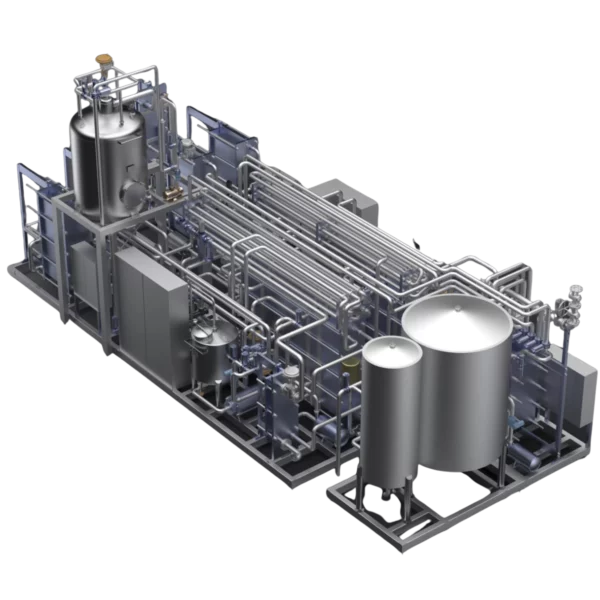
The Fischer plate heat exchanger is a gasketed plate heat exchanger for heating, cooling and pasteurizing liquids. The area of a single plate is from 0.05 to 1.5 m², and the operating temperature is up to 160 °C. The manufacturer and all equipment are described on the Fischer brand page.
What are the specifications of the Fischer plate heat exchanger?
| Parameter |
Value |
| Area of a single plate |
0.05–1.5 m² |
| Throughput |
up to 1,000 m³/h |
| Operating temperature |
up to 160 °C |
| Gaskets |
NBR, EPDM, butyl rubber, Viton |
| Plate profiles |
several options, special plates for steam condensers |
| Cleaning |
suitable for cleaning in place (CIP) |
What are Eurocal Omni Flow plates?
Eurocal 60 and Eurocal 104 Omni Flow (OFG) are Fischer plates for applications with high heat transfer requirements. One plate size can provide different thermal lengths. The embossing is made to customer specification, with a variable profile angle.
One plate can contain both "soft" and "hard" flow channels. The more intensive the heat transfer, the higher the pressure drop. The profile angle is selected to balance heat transfer intensity, pressure drop and surface area.
These plates suit media whose viscosity strongly depends on temperature.
| Eurocal 60 OFG parameter |
Value |
| Plate heat transfer area |
0.6 m² |
| Plate thickness |
0.5–0.8 mm |
| Plate spacing |
3.2 mm |
| Sealing type |
elastomer |
| Standard materials |
1.4301 (AISI 304), 1.4404 (AISI 316L) |
| Special material |
1.4571 (AISI 316Ti) |
Where is the Fischer plate heat exchanger used?
- food industry: dairy products, drinks, syrups, pasteurization;
- chemical industry: water cooling systems, heaters and coolers for acids and bases;
- petrochemical industry: oils;
- paper industry: water cooling systems, heaters and coolers for acids and bases.
How is the heat exchanger maintained?
The heat exchanger is cleaned without disassembly using CIP. During regeneration, the Steiner Ukraine service team dismantles the plate pack, checks the plates for capillary cracks, replaces the gaskets and reassembles the unit with control of plate pack tightening.
Plates and gaskets can be ordered in the Heat exchanger spare parts section.
How to select a Fischer plate heat exchanger?
- You provide the input data: media, flow rates, inlet and outlet temperatures, allowable pressure drop and cleaning method.
- Steiner Ukraine, together with the manufacturer, calculates the heat exchanger and selects the plate profile, material and gaskets.
- You receive a commercial offer. The price depends on the calculation and configuration.
How to estimate savings from heat recovery is described in the article “Heat recovery in food production: how much can really be saved”.
Frequently asked questions
What is the maximum temperature of a Fischer heat exchanger?
Up to 160 °C.
What materials are the gaskets made of?
NBR, EPDM, butyl rubber or Viton. The material is selected for the medium and temperature.
What steel are the plates made of?
For Eurocal 60 OFG plates, the standard materials are 1.4301 (AISI 304) and 1.4404 (AISI 316L), and the special material is 1.4571 (AISI 316Ti).
Can the heat exchanger be used as a steam condenser?
Yes. Fischer makes special plates for this purpose.
How much does a Fischer plate heat exchanger cost?
The price is provided on request. It depends on the calculation and configuration.