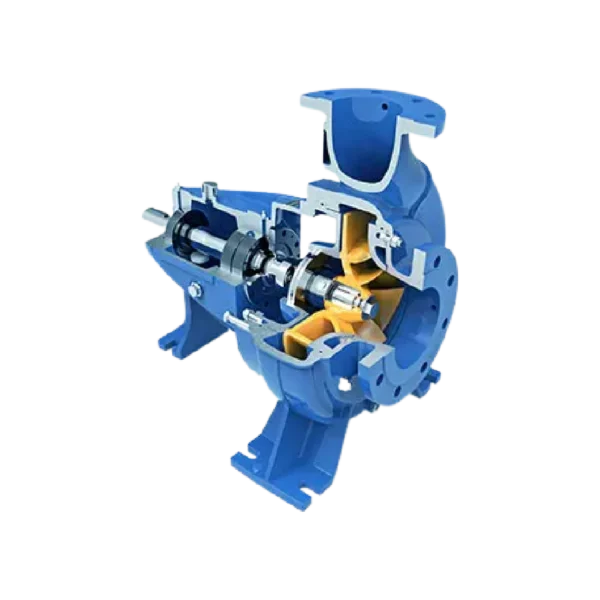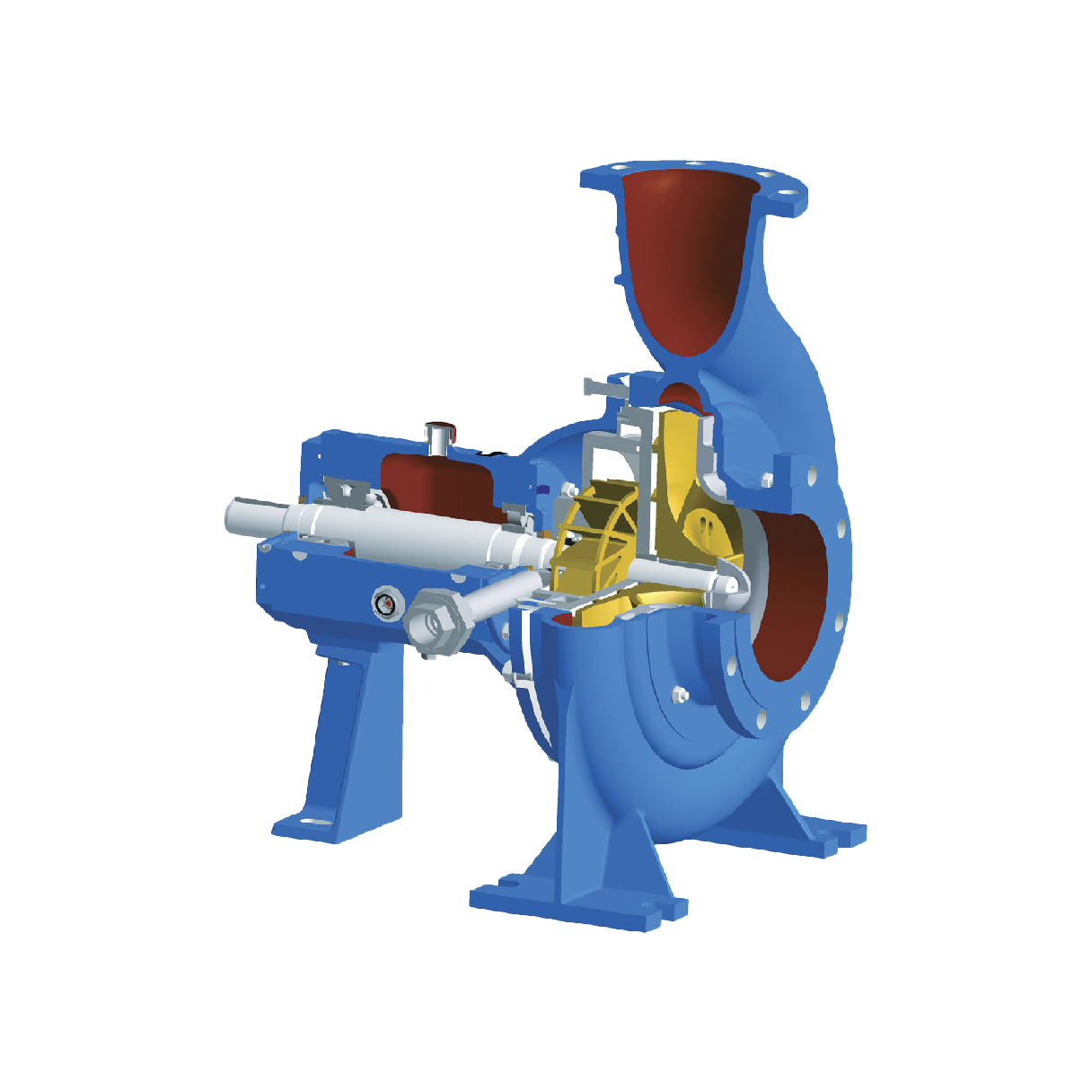
ANDRITZ - End suction pump (AD)
The ANDRITZ AD pump is a single-stage, self-priming centrifugal pump with a single-sided inlet and an integrated vacuum pump. Flow rate up to 9,000 m³/h, head up to 190 m, pressure up to 40 bar. The impeller is semi-open and clog-resistant. The series is designed for media containing solids and gas: pulp, paper stock, effluents, and sugar solutions with a concentration of up to 70 per cent.
How does the ANDRITZ AD pump self-prime?
Self-priming is provided by a built-in water-ring vacuum pump. It performs two functions simultaneously.
The first prevents air from accumulating at the inlet to the impeller. A conventional centrifugal pump cuts off the flow when a gas phase appears in the impeller: the impeller does not expel the air, but instead traps it in a plug. A vacuum pump continuously removes this plug.
The second method removes gas from the medium itself. This is known as deaeration: the medium enters the impeller free of bubbles, so the flow remains stable even when the product has a high gas content.
The manufacturer describes the practical benefit as follows: the pump reliably self-priming even with a high gas content or an unfavourable suction pipework configuration. Furthermore, the design allows for a greater suction head than a conventional centrifugal pump.
Why is a make-up tank needed, and why is it not required for the AD pump?
The classic self-priming system for high-flow applications involves a feed tank: a separate vessel located upstream of the pump, which maintains a head of liquid and prevents the pump from running dry during start-up.
The tank takes up space, requires pipework, valves and level control, and is itself a source of faults. During refurbishment, space must be found for it, and the cost of the tank and its installation must be included in the project.
The built-in vacuum pump eliminates this requirement entirely. The manufacturer’s wording is clear: the feed tank is no longer needed, and with it go the space requirements and capital expenditure associated with it.
For the designer, this is the series’ key selling point: the same task is achieved without the need for a separate capacitor in the circuit.
Technical specifications of the ANDRITZ AD pump
| Parameter | Value |
|---|---|
| Type | centrifugal, self-priming |
| Levels | one |
| Conclusion | one-sided |
| Capacity | up to 9,000 m³/h |
| Pressure | up to 190 m |
| Pressure | up to 40 bar |
| Impeller | semi-open, uncluttered |
| Self-priming | built-in water-ring vacuum pump |
| Shaft seal | single-ended |
| Bearings | oversized |
| Viscous media | sugar solutions with a concentration of up to 70 per cent |
| Solid phase | cellulose, paper pulp, effluent |
| Make-up tank | not required |
How does a semi-open impeller differ from a closed one?
In a closed impeller, the channels are sealed by discs on both sides. This provides higher efficiency when running on clean water, but the channel has a limited cross-section: any solid particles or fibres get stuck in it.
A semi-open impeller has a disc on one side only; the other side of the channel is formed by the pump casing. The cross-section is open, so fibrous and solid particles can pass through without clogging the impeller. This is why the manufacturer describes this design as non-clogging.
The second difference concerns viscosity. According to the manufacturer, on viscous media, the semi-open impeller provides higher efficiency than a closed system. The reason is that, in a viscous medium, the losses in closed, narrow channels increase faster than the benefits derived from their being closed.
Selection rule: clear water without any solids – a closed impeller; media containing fibres, solids or with high viscosity – a semi-open impeller, i.e. the AD series.
ANDRITZ AD pump for sugar solutions up to 70 per cent
A 70 per cent sugar solution is no longer a liquid in the conventional sense: its viscosity is several orders of magnitude higher than that of water, and it changes dramatically with temperature.
The manufacturer explicitly states that this series is suitable for such media. This combines two design features: a semi-open impeller operates more efficiently in viscous media than a closed one, whilst the built-in vacuum pump ensures the suction line is filled, something that cannot be achieved by gravity alone with a thick solution.
For sugar production, this means that a single type of pump can handle both the juice stream and the thicker intermediate products, without the need to switch to positive displacement pumps.
Material versions
The range is available in several material finishes. According to the manufacturer’s specification sheet, the following materials are used:
| Node | EN designation | US equivalent |
|---|---|---|
| Impeller, spiral casing | EN-GJL-250 | Class 40B |
| Bearing housing, front cover insert | 1.4460 | Grade 1A J93370 |
| Housing cover, shaft | 1.4462 | S32205 |
Grade 1.4462 is a duplex stainless steel with enhanced resistance to chloride-induced stress corrosion cracking, which makes it suitable for use in wastewater systems and the pulp and paper industry. EN-GJL-250 is grey cast iron, the standard housing material for abrasive media.
Single-end shaft seal; oversized bearings to extend service life.
Where is the ANDRITZ AD pump used?
The manufacturer lists six sectors: sugar production, the pulp industry, paper production, the food industry, water supply and wastewater treatment.
A common feature of these applications is a medium that a standard centrifugal pump cannot handle. In the pulp and paper industry, this is a fibrous slurry with a high solid content. In wastewater, there are impurities of unpredictable composition. In sugar production, the medium is highly viscous. In all cases, there is also a gas content: the medium carries air, and it is precisely for this reason that a standard pump loses its flow rate.
Selection and service from Steiner Ukraine
When selecting a self-priming pump, the process begins with the inlet conditions and the nature of the fluid, rather than the flow rate. The suction head, the length and layout of the suction pipework, the gas content, the content and nature of the solid phase, and the viscosity at operating temperature — these factors determine whether a particular series is suitable at all, and in which material configuration.
We clarify these conditions, as well as the design flow rate and pressure, the system resistance characteristics, the temperature regime, the requirements for materials in contact with the medium, and the presence of a make-up tank in the existing system. Based on this, we determine the size, material specification and configuration of the vacuum unit. Next come supply, service and spare parts. Steiner Ukraine has been operating in the industrial equipment market since 2006.
Other items — in the section industrial pumps, in the catalogue pumps and systems and in the section sector-specific solutions.
Frequently Asked Questions
What is an ANDRITZ AD pump?
A single-stage, self-priming centrifugal pump with single-sided inlet and an integrated vacuum pump. Flow rate up to 9,000 m³/h, head up to 190 m, pressure up to 40 bar.
How does the AD pump self-prime without a feed tank?
Self-priming is provided by a built-in water-ring vacuum pump. It removes air from the impeller inlet and gas from the fluid itself, so the pump fills the suction line automatically. A separate feed tank is not required in this system.
What is the maximum flow rate of the ANDRITZ AD pump?
Up to 9,000 m³/h at a head of up to 190 metres.
Can the AD pump handle fluids containing solid particles?
Yes. The impeller is of a semi-open, clog-resistant design. This series is used for pulp, paper stock and wastewater.
Is the AD pump suitable for sugar solutions?
Yes. The manufacturer states that it is suitable for viscous media, in particular sugar solutions with a concentration of up to 70 per cent.
Why is a semi-open impeller better than a closed one in viscous fluids?
According to the manufacturer, in viscous media, a semi-open impeller delivers higher efficiency than a closed one, whilst allowing solid and fibrous particles to pass through without causing blockages.
Where are ANDRITZ AD pumps used?
In sugar production, the pulp and paper industry, the food sector, water supply and at wastewater treatment works.
Manufacturer: ANDRITZ
Category: End suction pumps
Industries: Beverages, Other
Model range: 5 positions