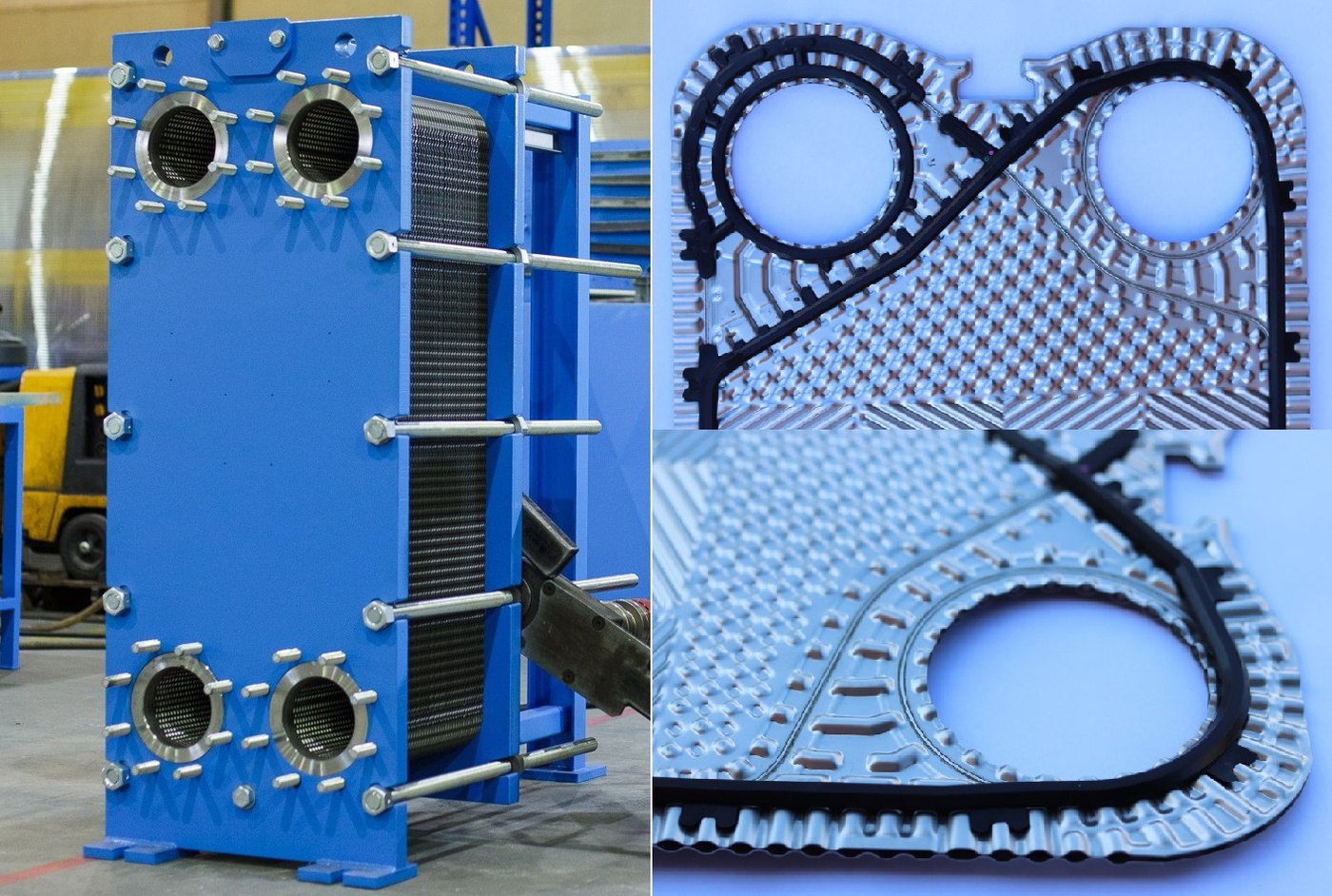
The Arsopi Thermal semi-welded plate heat exchanger combines the flexibility of a gasketed unit with the strength of a welded one. It is used where one of the media attacks gasket rubber, is hazardous or operates under high pressure.
Steiner Ukraine is the official representative of Arsopi Thermal in Ukraine. The general working principle of plate heat exchangers is described on the page Arsopi Thermal.
How is a semi-welded plate heat exchanger designed?
Two plates are laser-welded into a cassette. Ring gaskets are fitted at the cassette ports, and a conventional gasket runs around the perimeter.
The aggressive medium or refrigerant flows inside the welded cassettes and hardly contacts the gaskets. The second medium flows between the cassettes, as in a conventional gasketed unit.
The side between the cassettes remains accessible: it can be inspected and cleaned mechanically.
Arsopi Thermal semi-welded plate heat exchanger: specifications
| Parameter |
Conventional gasketed |
Semi-welded |
| Working pressure |
up to 3.0 MPa |
up to 4.0 MPa |
| Operating temperature |
up to 150 °C |
up to 180 °C |
| Contact of aggressive medium with gaskets |
along the entire channel perimeter |
only ring gaskets at the ports |
| Mechanical cleaning |
both sides |
side between cassettes |
Gaskets with high chemical resistance, including PTFE-encapsulated (TCG), are available for welded cassettes.
When is a semi-welded plate heat exchanger needed?
- The medium attacks the synthetic rubber of the gaskets.
- The medium is hazardous, for example sulphuric acid.
- Pressure or temperature exceed the limits of a gasketed unit.
- High tightness is required.
- A high-purity medium must not come into contact with gasket components.
- Gaskets have to be replaced frequently and maintenance costs need to be reduced.
Where is it used?
- heating and cooling of liquids that attack synthetic rubber;
- heating and cooling of hazardous liquids;
- duties where pressure or temperature exceed the limits of a gasketed unit;
- refrigeration cycles with refrigerants.
Spare parts and service
Steiner Ukraine supplies plates and gaskets for heat exchangers and performs regeneration on site and at the service centre. Catalogue — in the section heat exchanger parts.
For units handling aggressive media, the quality of parts is especially important. Why — see the article on original components in heat exchange equipment. The risks of non-original parts are covered in the article «Original or non-original spare parts».
Selecting a semi-welded plate heat exchanger
Selection requires the composition and concentration of the aggressive medium, the second medium, flow rates, inlet and outlet temperatures, operating pressure and allowable pressure drop. Prices are quoted on request.
FAQ
How does a semi-welded plate heat exchanger differ from a gasketed one?
One medium flows inside laser-welded cassettes. The unit withstands up to 4.0 MPa and 180 °C versus 3.0 MPa and 150 °C for a conventional gasketed unit.
Can a semi-welded heat exchanger be cleaned?
The side between the cassettes can be opened and cleaned mechanically. The inside of the cassettes is cleaned chemically.
Is it suitable for refrigerants?
Yes. Refrigeration cycles with refrigerants are one of its typical duties.
Which gaskets are used?
Ring gaskets at the cassette ports and conventional gaskets around the perimeter. Materials with high chemical resistance are available, including PTFE-encapsulated.