
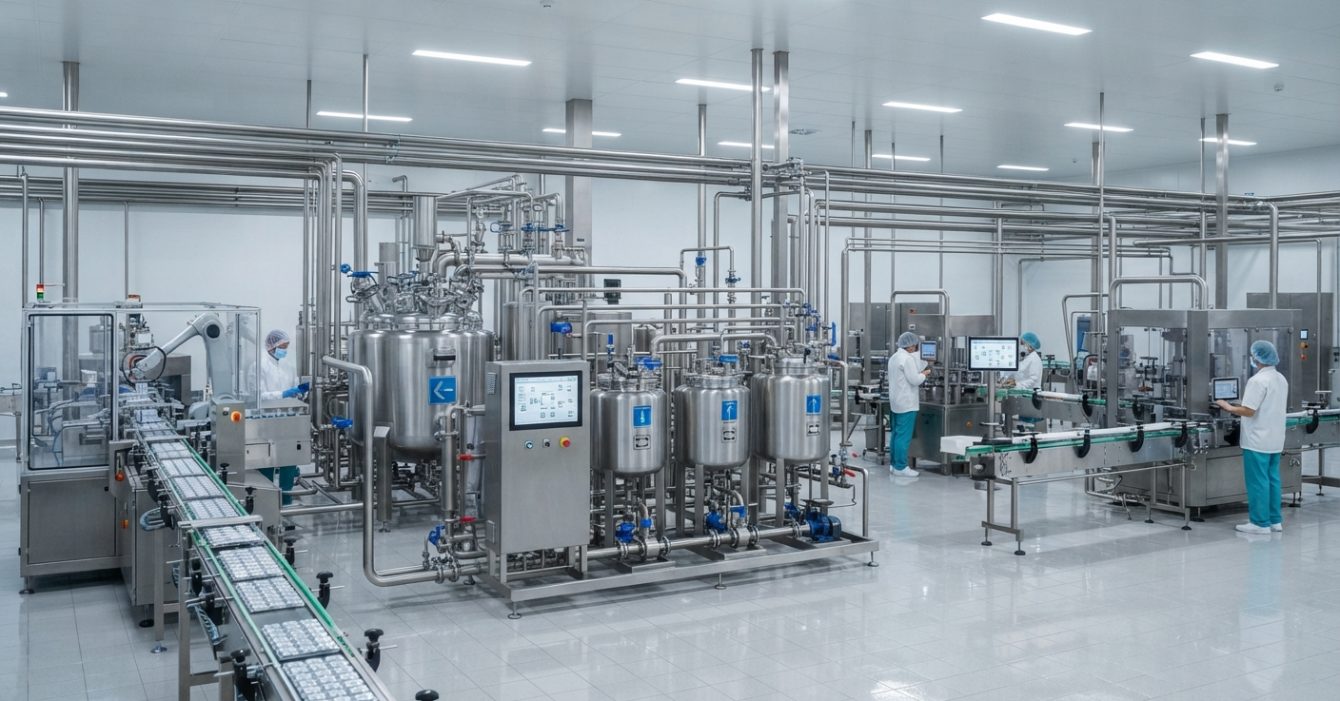
In the food and pharmaceutical industries, the cleanliness of equipment is not a matter of tidiness, but of product safety. Microbiological contamination resulting from inadequate cleaning of production lines can bring an entire business to a standstill: from a spoiled batch of products to a product recall. That is precisely why CIP (Cleaning In Place) has become the industry standard in sectors where the cost of error is simply too high.
What is CIP cleaning and how does it differ from manual cleaning?
CIP is a technology for the automated cleaning of the internal surfaces of equipment using circulating solutions, without the need to dismantle pipework, tanks, pumps or heat exchangers. Unlike manual cleaning (COP, Cleaning Out of Place), which requires the dismantling of components and physical access by staff to each surface, a CIP system pumps the cleaning solution directly through the equipment’s closed circuit, cleaning it from the inside just as thoroughly as the product that flows through it during production.
The key advantage is clear: there is no need to shut down the production line for long periods or dismantle it manually. The washing cycle is integrated into the production process as a separate, fully automated stage — which is crucial for businesses operating on a continuous or multi-shift basis.
The principle of recirculating washing: how it works
Circulation cleaning is based on the sequential circulation of several solutions through a system of pipework, tanks and equipment in a closed circuit. A typical CIP cycle consists of several consecutive stages:
- — removes the bulk of product residues from surfaces, thereby reducing the load on subsequent chemical stages.
- Мойка щелочным раствором — usually based on sodium hydroxide, it effectively dissolves organic contaminants: fats, proteins and carbohydrates.
- Final rinse — removes any residual alkaline solution from the system before moving on to the next stage.
- Washing with an acidic solution — usually based on nitric or phosphoric acid, it removes mineral deposits, including limescale and carbonate deposits.
- Final rinse — drinking-quality water, sometimes followed by sanitisation (disinfection using hot water or a chemical disinfectant).
Each stage operates at a specified temperature, solution concentration and flow rate — these parameters are selected to suit the specific type of contamination, the equipment material and industry requirements. It is the combination of these four factors (time, temperature, concentration and the mechanical action of the flow) that determines cleaning efficiency — in CIP technology, this principle is known as the TACT formula.
Why CIP cleaning does not require the entire production line to be shut down
The main advantage of modern CIP systems is that they allow cleaning to be carried out without bringing the plant to a complete standstill. This is achieved by:
- Line segmentation. Production is divided into process sections, each of which has its own CIP loop. Whilst one line is undergoing a cleaning cycle, the others continue to operate as normal.
- Automated cycle planning. The CIP station is controlled by a programmable controller, which initiates the cleaning cycle either according to a schedule or in response to signals from sensors — for example, once the production of a specific batch of product has been completed.
- Tanks for cleaning solutions. Ready-to-use solutions are stored in special tanks at the CIP station, which allows the cleaning cycle to be started immediately, without having to wait for new solutions to be prepared.
- The parallel operation of several circuits. In large-scale production facilities, a CIP station can serve several production lines in turn, making the most efficient use of the time between production cycles.
This approach makes it possible to transform cleaning from an unavoidable interruption into a controlled, predictable stage of the production cycle — which has a direct impact on the company’s overall productivity.
Food industry requirements for CIP cleaning
In the food industry, CIP systems are designed in accordance with the principles of hygienic design: the absence of stagnant zones, a minimum of threaded connections within the product channel, and polished internal pipe surfaces without sharp corners. This is particularly critical in the dairy industry, where product residues provide an ideal breeding ground for bacteria, including heat-resistant strains capable of forming biofilms on equipment surfaces.
Regular validation of cleaning effectiveness is a mandatory practice for food production facilities operating in accordance with HACCP or ISO 22000 standards. This involves microbiological testing of surfaces following a CIP cycle, as well as periodic checks on the operation of sensors measuring the concentration and temperature of cleaning solutions.
Requirements in the pharmaceutical sector: even stricter standards
The pharmaceutical industry imposes requirements on CIP cleaning that are significantly stricter than those in the food sector. The industry is governed by GMP (Good Manufacturing Practice) standards, which require:
- Documented validation of wash cycles — Each CIP cycle must be validated to ensure that it reliably removes residues of the previous product to a level below the specified limit (validated cleaning procedure).
- Process traceability — The system records all cleaning parameters (temperature, duration, concentration, solution flow rate) for each cycle, enabling subsequent auditing.
- Preventing cross-contamination — This is particularly critical when several products are manufactured using the same equipment, as even microscopic traces of the active ingredient can affect the next batch.
- Use of pharmacopoeial-grade water For the final rinse — water for injections (WFI) or purified water, depending on the type of production.
This is precisely why pharmaceutical CIP systems are often fitted with additional sensors to monitor water conductivity (to confirm that the cleaning solution has been completely removed) and electronic logging systems that integrate with the company’s overall quality management system.
Common mistakes when organising CIP cleaning
- Insufficient flow rate in the pipework. If the circulation rate of the solution is lower than that required for turbulent flow, the cleaning solution does not exert sufficient mechanical action on the dirt, and some of the residues simply remain on the surface.
- Ignoring ‘dead zones’. Sections with poor circulation — dead-end pipeline branches, incorrectly selected valves, and outdated connections — remain unflushed even during a technically correct CIP cycle.
- The use of worn-out equipment. Damaged seals, corrosion on internal surfaces or worn spray heads in tanks reduce cleaning efficiency, even if the CIP programme itself is set up correctly.
- Lack of regular validation. Without regular microbiological monitoring, it is impossible to confirm that the CIP system actually performs its intended functions in the long term.
CIP cleaning is not an additional stage in production, but an integral part of the manufacturing process that directly affects product safety and operational efficiency. A properly designed circulation cleaning system enables hygiene standards in the food or pharmaceutical industries to be maintained without prolonged production stoppages or manual dismantling of equipment. Steiner Ukraine selects equipment and CIP solutions taking into account product-specific characteristics, hygienic design requirements and industry standards — ensuring that cleaning becomes a controlled and predictable stage of production, rather than a source of risk.


