
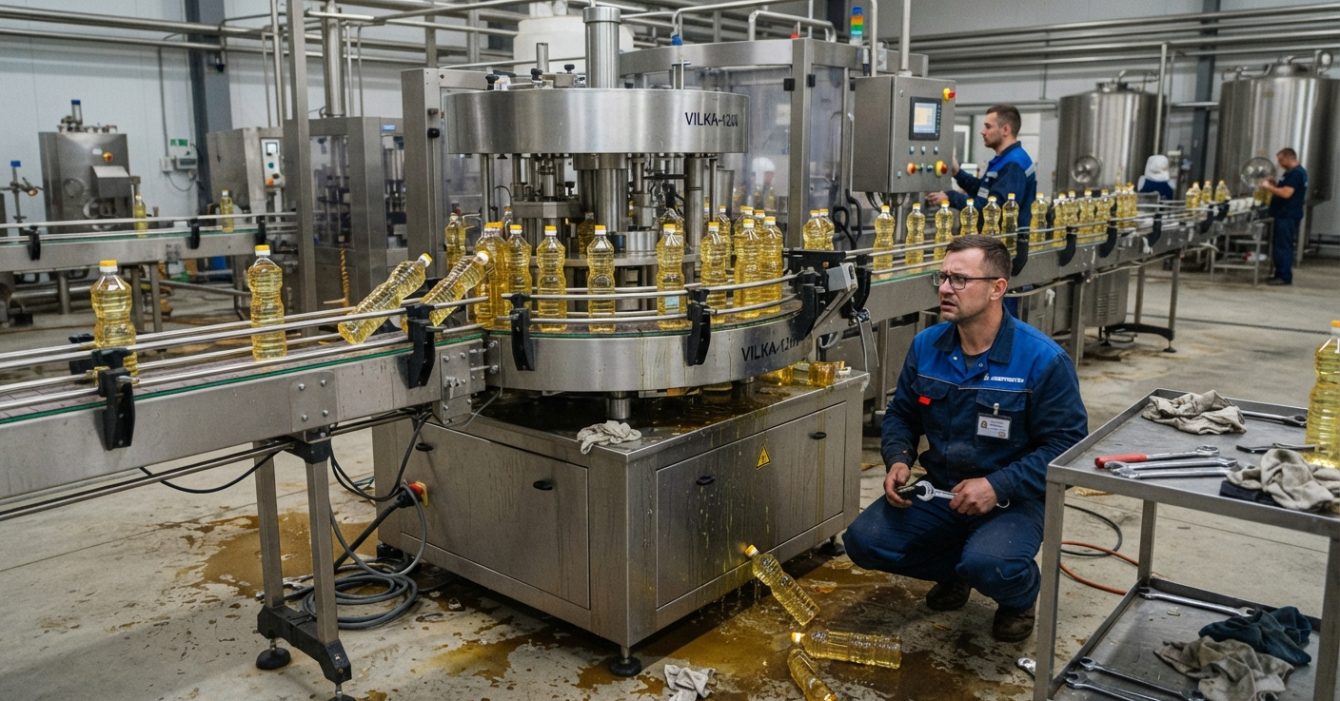
Choosing a filling line is one of the most critical decisions when planning or modernising a food production facility. A mistake at this stage is costly: insufficient productivity, inconsistent dosing, frequent stoppages for maintenance, or even the inability to process a particular product at all. The key factor in determining which equipment is suitable is the viscosity of the product being filled.
Why viscosity is the key criterion for selection
Viscosity directly influences the dosing principle, the design of the dosing heads, the type of pumps used in the line, and even the materials from which the contact surfaces are made. A line that performs excellently with water or juice often proves completely unsuitable for yoghurt, ketchup or mayonnaise — and conversely, equipment designed for viscous products will be excessively slow and inefficient for low-viscosity liquids.
Therefore, the selection of a filling line always begins not with the desired throughput, but with a detailed technical profile of the product: viscosity, presence of particles, filling temperature and sensitivity to mechanical stress.
Product types by viscosity and filling methods
Low-viscosity products (water, juices, pulp-free drinks)
For liquids with a consistency similar to that of water, volumetric or gravity-fed dosing systems are ideal. They ensure high filling speeds and dosing accuracy thanks to the simple, predictable flow of the product. Such lines often operate at high speeds — tens of thousands of containers per hour — as the product offers no significant resistance to flow.
Medium-viscosity products (milk, cream, runny sauces, oil)
In such cases, dosing systems with controlled feed pressure are required, often based on piston or vane pumps. It is important to ensure a uniform flow without foaming and to maintain the homogeneity of the product, particularly in the case of emulsions that are prone to separation.
High-viscosity products (yoghurt, sour cream, ketchup, mayonnaise, pasta, honey)
For viscous products, piston dispensers or specialised positive displacement pumps (such as rotary or progressive cavity pumps) are used, which are capable of operating with high product resistance without damaging or overheating the product. It is of fundamental importance to avoid excessive shear stress — mechanical action on the product’s structure can alter its texture, disrupt the consistency of the sauce or cause the emulsion to separate.
Products containing inclusions (pieces, pulp, crystals)
A separate category comprises products containing solid particles: jams with pieces of fruit, sauces with spices, and wet pet food with pieces of meat. Such products require dosing systems with an increased flow cross-section and specially designed valves that do not damage or crush the inclusions during dosing.
Key parameters of a filling line, apart from the type of dosing unit
As well as the dosing principle, the following should be taken into account when selecting a line:
- Dosing accuracy — is of critical importance for products in prepackaged containers, where any deviation directly affects the production cost and compliance with the weight stated on the label;
- Temperature conditions during bottling — hot filling (for preservation) or cold filling, as this affects the sealing materials and the design of the dispensing heads;
- Type of packaging — bottles, jars, flow-packs, doy-packs, tubes — each type of packaging imposes its own requirements on the design of the dispensing unit;
- Sanitary requirements — the ability to carry out quick and effective CIP cleaning without dismantling the equipment, which is particularly crucial for dairy and pharmaceutical products;
- Flexibility in reconfiguration — If a production facility handles several types of products and packaging, it is important to assess how quickly the production line can switch from one format to another.
Common mistakes when choosing a bottling line
- A focus solely on productivity. A high advertised line speed is irrelevant if the equipment is unable to operate consistently with the viscosity of a particular product.
- Ignoring changes in viscosity with temperature. Many products undergo significant changes in viscosity depending on the filling temperature — this needs to be taken into account at the design stage, rather than after the fact.
- Underestimating the requirements for sensitive products. Excessive pressure or shear stress during dosing can damage the product’s structure, even if the dosing process was technically carried out accurately.
- No scope for expansion. A production line designed to meet current output levels often becomes a bottleneck within just a year or two of production growth.
How is equipment selection carried out in practice?
The correct approach begins with laboratory or pilot testing of the actual product on the dosing unit — this allows us to see how the product behaves under conditions close to those in production, even before investing in a full-scale production line. Next, process engineers analyse the compatibility of the materials used for contact surfaces with the product, calculate the required throughput taking peak loads into account, and draw up a line specification tailored to specific production requirements.
Product viscosity is not a secondary parameter, but rather the starting point when selecting a filling line. Correctly selected dosing equipment ensures consistent product quality, minimises raw material wastage and reduces maintenance costs in the long term. Steiner Ukraine selects filling lines tailored to the specific technological profile of the product — from low-viscosity drinks to thick sauces and products containing chunks — whilst taking into account requirements for throughput, hygiene and future production scaling.


